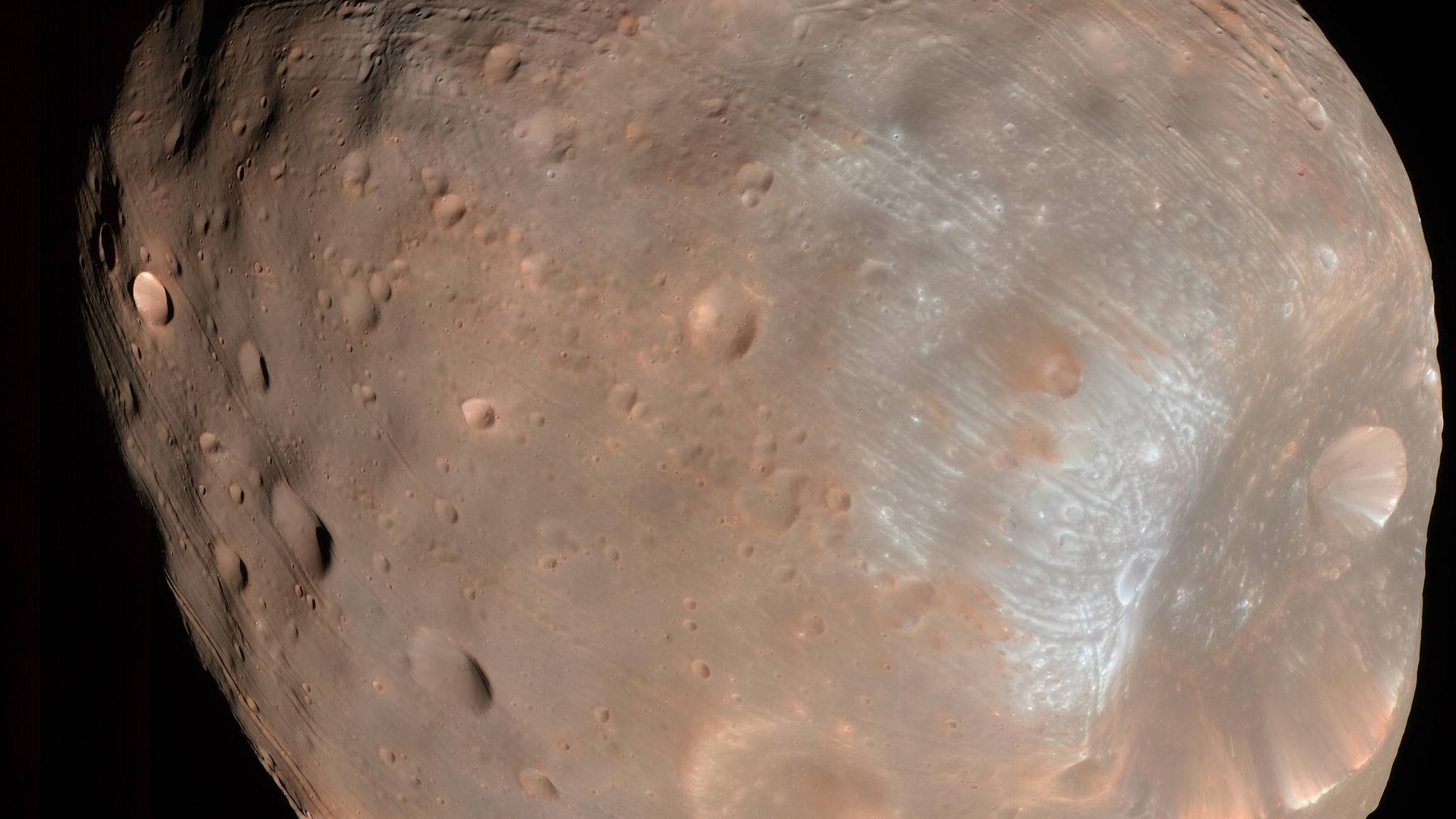
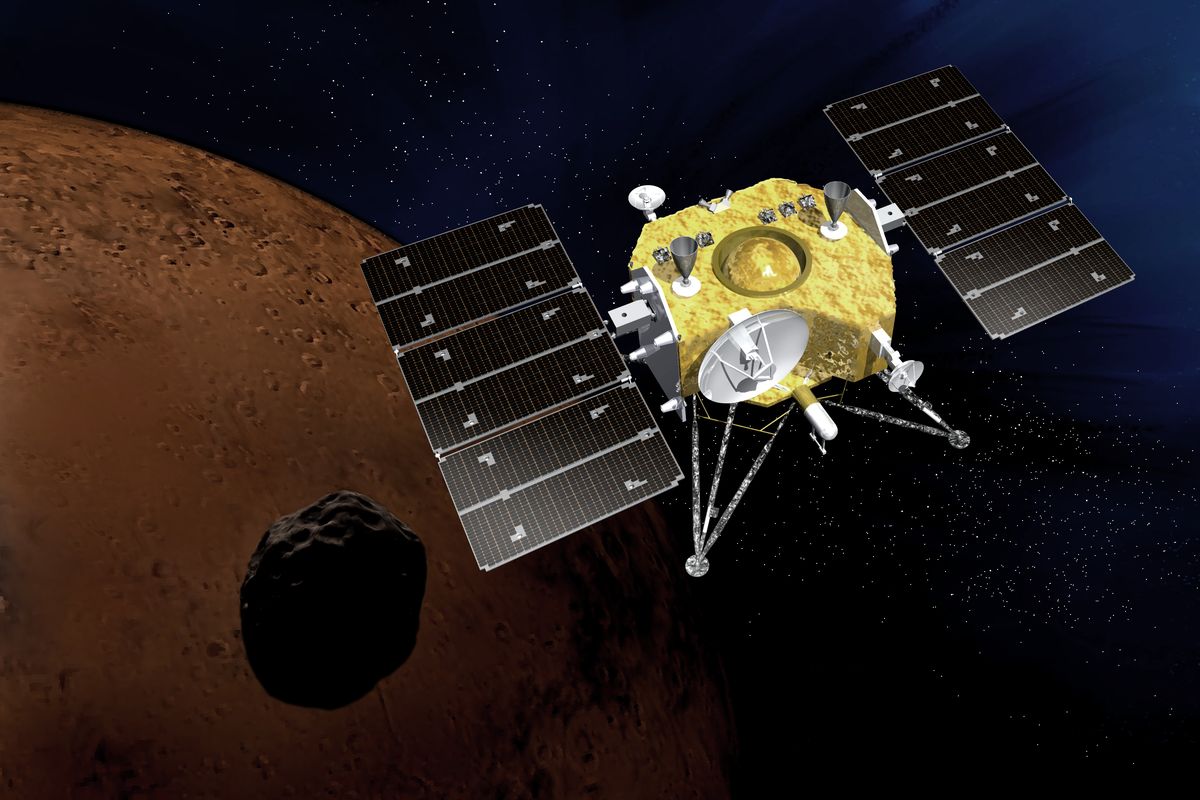
Japan’s MMX mission is scheduled to lift off from the Tanegashima Space Center at 4:41:03 a.m. Japan time on Tuesday, October 20, which is 3:41 p.m. EDT on Monday, October 19. Its European partner says MMX “will be the first mission to collect a sample from Mars’s moon Phobos and bring it back to Earth.”
“More than a decade ago, we began the MMX journey. Through countless challenges, the dedication and ingenuity of scientists and engineers across Japan and around the world have brought us to this moment. Seeing MMX lift off will be an emotional milestone for all of us,” said Yasuhiro Kawakatsu, MMX project manager at JAXA, in a DLR announcement.
On the mission’s website, Kawakatsu put the goal this way: “The Martian moon Phobos remains an unexplored frontier for humankind. By bringing home samples from Phobos, we hope to explore how the Martian moons were formed, how the Mars sphere evolved, and how the water and organic materials found on the terrestrial planets originated.”
A launch window that runs to November 7
JAXA’s August 20 press release lists a reserved launch period from October 21 to November 7, 2026, from the Yoshinobu Launch Complex, and notes that “the launch time may vary during the reserved launch period.”
The ride is an H3, the same rocket whose eighth flight failed to put the Michibiki 5 satellite in orbit. After the August 11 launch of the QZS-7 navigation satellite, JAXA reported that “the Launch Vehicle flew as planned.”
MMX is led by JAXA with NASA, the French space agency CNES, the German Aerospace Center (DLR) and the European Space Agency (ESA). The DLR calls it “the largest Japanese mission to the Solar System to date.”
Nobody agrees on where Phobos came from
“Understanding how Mars and the two moons formed is a heavily debated topic in theories on the formation of our Solar System,” JAXA writes. One camp favors a giant impact on Mars that threw debris into orbit, and the other says the moons are asteroids “captured by Mars’s gravity.”
Kiyoshi Kuramoto, a planetary scientist at Hokkaido University and the mission’s principal investigator, starts much further back in his message on the mission site. “In ancient times, Mars was a world shrouded in a thick atmosphere. Rivers flowed across the planet’s landscape into vast oceans. How did Mars acquire such a primordial, water-rich environment where life could conceivably have existed? The key to this mystery lies in the Martian moons, which closely resemble carbonaceous asteroids,” Kuramoto writes.
DLR puts the open question plainly: “Approximately 150 years after their discovery, the origin of the Martian moons remains an open question: are they captured asteroids, or did they form after a massive meteorite impact on Mars?”
A 55-pound rover goes first
The rover is called Idefix, after the dog in the Asterix comics, and CNES and DLR built it together. It has a mass of about 55 pounds (25 kilograms), but ESA says “the gravity on Phobos is so low that Idefix will only weigh the equivalent of 15 grams on its surface.”
According to DLR, “Around the turn of 2028/2029, the MMX mothership is expected to release the Idefix® rover into free fall towards Phobos from a height of approximately 40 metres above the surface.” That is about 130 feet, and the agency adds that “no wheeled exploration vehicle has ever driven on a celestial body with gravity of less than a thousandth that of Earth.”
Once it has landed, DLR says, the rover “will right itself autonomously and will then be ready for the roughly three-month mission phase on the Martian moon.”
“Our rover Idefix® and the MMX spacecraft of our Japanese collaborators are beginning their journey into the Mars system as a single unit. Only at Phobos will their paths separate. There, Idefix® will make history: as the first rover ever to leave tracks on a moon of Mars,” said DLR project leader Markus Grebenstein and CNES project leader Julien Baroukh.
Two landings and a few grams of Phobos
JAXA’s press kit describes the main event plainly. “The MMX spacecraft will land on the surface of the Martian moon and remain there for several hours. Using advanced sampling equipment with a manipulator and corer, the spacecraft aims to collect more than 10g of sample from a depth of at least 2cm (Hayabusa2 aimed to collect 0.1g, and succeeded in gathering 5.4g).”
That is about 0.35 ounce from at least 0.8 inch down. The Ryugu grains from Hayabusa2 later turned out to hold all five basic letters of DNA and RNA, which is why a few grams can matter.
The main spacecraft carries two different sampling devices, according to ESA. DLR adds that “traces of Martian rock are likely to be found on the surface of Phobos,” which means “material from Mars could also make its way to Earth in the return capsule.”
NASA’s spectrometer and two 8K-class cameras
ESA counts “a total of 11 science instruments: seven on the main spacecraft, and four on the rover.” NASA’s piece is MEGANE, a gamma-ray and neutron spectrometer from the Johns Hopkins Applied Physics Laboratory.
“MEGANE will be a key instrument on MMX, making a big contribution toward the goal of understanding the origin of the Martian moons,” Statler said in March 2024, when NASA delivered the instrument to JAXA.
Japan’s broadcaster NHK helped build the Super Hi-Vision cameras.
Samples are due in Australia in 2031
ESA says MMX “is expected to enter orbit around the Red Planet in August 2027, and orbit Phobos from September 2027,” will “release Idefix in early 2029,” and will land on Phobos in 2030. The return module is due back in 2031 and will “send down at least ten grams of Phobos material in a sample return capsule.”
“Bringing samples to our most sophisticated labs here on Earth is a multiplier for discoveries, because our most precise instruments are too large, complex or sensitive to send to space,” said Elliot Sefton-Nash, ESA’s MMX project scientist. “Even after the mission has been completed, future generations of scientists will study the Phobos samples with even more advanced instruments: samples brought to Earth are the gift that keeps on giving.”
Those grams would land at a moment when NASA’s plan to bring Perseverance’s Mars rocks home has stalled and China is aiming for its own return in 2031.
What could still go wrong
JAXA’s own list of hazards is long: “a long-duration spanning approximately five years, the unexplored surface of Phobos, a communication time lag of up to 44 minutes (round-trip), a gravitational environment distinct from that of Earth or our Moon, limited propellant, and the extreme temperature fluctuations in space.”
The date can still move inside the window that closes November 7, and every milestone after launch is a plan rather than a result.
The launch schedule was announced by JAXA on August 20, 2026, and confirmed by ESA on October 13, 2026.
JAXA will stream the launch live in Japanese and English on its YouTube channel, and ESA says it will issue an image release on October 20 confirming a successful launch.
Image: NASA/JPL-Caltech/University of Arizona