Scientists have managed to teleport light. Thanks to a quantum property called entanglement, it’s possible to copy their information to another place. This same process could, in theory, be used to communicate across galaxies, opening the door to a kind of interstellar messaging system. It might sound like pure science fiction… but it’s already happening.
What’s this about teleporting light?
When scientists talk about teleporting light, they’re not referring to beaming objects across space like in a sci-fi
movie. What they’re talking about is quantum teleportation, and it works in a different way.
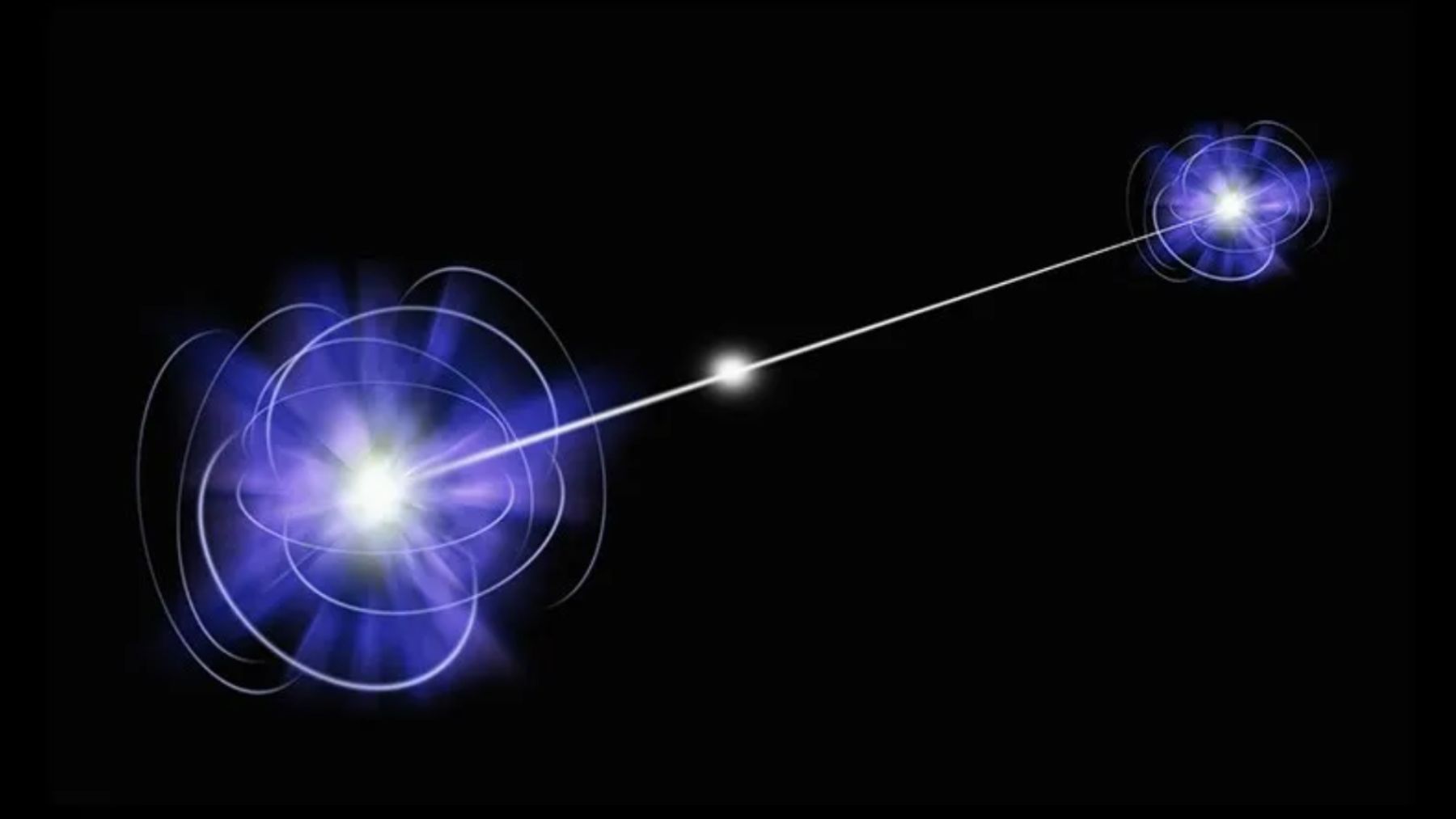
This process transfers the state of a light particle (a photon) from one place to another. It all happens through
quantum entanglement, a connection between particles that lets them share information instantly, no matter how far apart they are.
What is quantum entanglement?
Quantum entanglement is a phenomenon in quantum physics where two particles become so deeply connected that the state of one directly influences the state of the other, regardless of the distance between them. For example, if you change something in a particle on Earth, the other particle, even if it’s in another galaxy, “knows” about it immediately and reacts.
Albert Einstein himself was aware of this phenomenon, and dubbed it”spooky action at a distance” because it
defied classical physics logic (this wasn’t the only prediction Einstein made that has since been proven correct).
It is this profound and weird entanglement between particles that allows for quantum teleportation and the teleportation of light. The important thing is that the implications are more than just conceptual. This finding, could quite literally change the nature of communication, maybe changing our understanding of space, time, and information.
Why this breakthrough could rewrite the future of communication
Most recently, researchers at Oak Ridge National Laboratory (ORNL), EPB of Chattanooga, and the University of Tennessee performed an unprecedented experiment in which they sent entangled photons through a commercial fiber-optic network and maintained an entangled connection for over 30 hours!
They used a system called automatic polarization compensation, or just APC. It keeps the photons in check, adjusting them in real time so the signal doesn’t drop, even if the environment around it starts to shift
In essence, the team used something called automatic polarization compensation, or APC, which basically keeps the photons contained and then adjusts to keep the entangled state without quitting if the conditions that are present in the environment change. This breakthrough means quantum networks are a real possibility and viable!
The future of quantum communication: advancements that could send data beyond our solar system
Sending light to another galaxy is still a distant dream. However, the recent breakthrough in stabilizing entangled photons has opened new doors for quantum communication and future computing.
Recent advancements in nanometer-scale engineering, such as the development of ultra-compact photon
generators, are also pushing the limits of what is possible, signaling a future where quantum communication
could surpass even our solar system. What once seemed like science fiction steleporting light sis now proven by scientists to be a reality.
With every new advance, we get closer to a future where instantaneous, secure communication over unimaginable distances stops being a dream and becomes a reality. Whether it’s across the street or to another galaxy, the way we think about sending information is being fundamentally transformed.
Maybe we’re closer to a reality like the one in the film Back to the Future than we realize, especially with
recent research advancements that, for instance, are transforming light into an exotic material – a discovery that
promises to redefine physics and quantum computing.