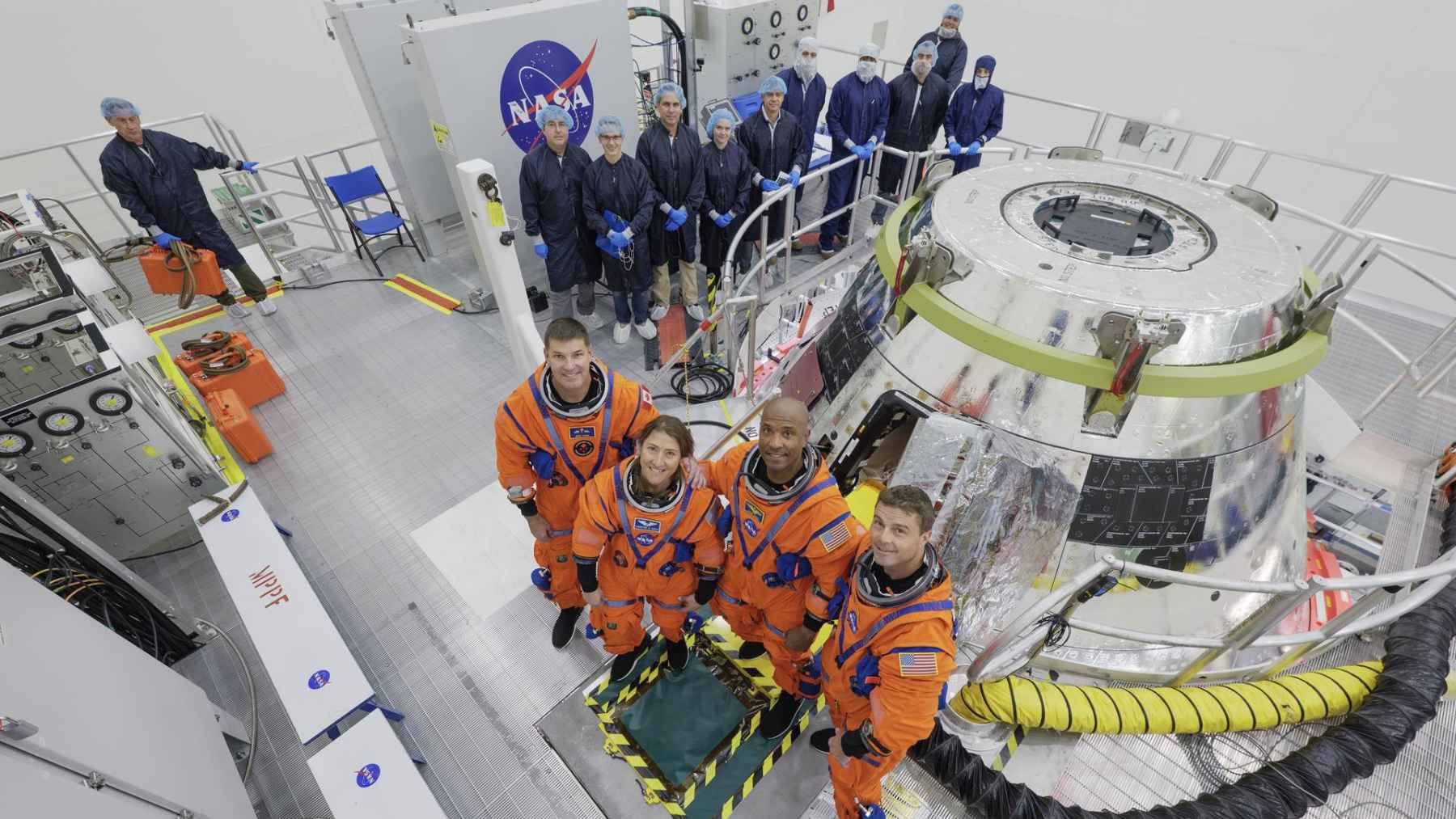
As NASA prepares to roll its giant Space Launch System rocket and Orion spacecraft out to the pad in Florida, the first crewed journey beyond low Earth orbit in more than half a century is finally within reach. Artemis II is a ten-day mission that will loop four astronauts around the Moon then bring them home, a crucial test before humans try to land there again.
So why should anyone outside the space community care about a spaceship leaving our planet for a week and a half? Because this flight is also a dress rehearsal for how to live with limited water, power, and air in one of the harshest environments imaginable, lessons that loop straight back to life on Earth.
Rolling out a mega rocket
At Florida’s Kennedy Space Center, teams are getting ready for a slow-motion spectacle. The fully-stacked rocket, spacecraft, and mobile launch tower will crawl about four miles from the Vehicle Assembly Building to Launch Pad 39B on the crawler transporter, a trip that can last up to twelve hours.
Engineers have been working around the clock to close out a long checklist before that journey, including replacing a faulty hatch pressurization valve on Orion and fixing leaky ground support lines that feed oxygen gas to the capsule.
Once the stack is parked at the pad, technicians will hook up electrical power, environmental ducts, and the cryogenic propellant lines that load super-chilled liquid hydrogen and liquid oxygen into the rocket. For the first time, all the integrated systems will be powered up together so teams can watch how the launch vehicle, the mobile launcher, and the pad infrastructure behave as one.
Fuel tests and narrow launch windows
Toward the end of this preparation phase, NASA will perform a full “wet dress rehearsal” that fills the tanks with more than seven hundred thousand gallons of cryogenic propellants, runs through a detailed launch countdown, then safely drains the fuel again.
Controllers will deliberately pause, recycle, and resume the clock several times in the final ten minutes to practice dealing with minor glitches without putting a crew at risk. Lessons from the hydrogen leaks that complicated the uncrewed Artemis I campaign are baked into these updated procedures.
If the fueling test goes well, a flight readiness review will decide whether the vehicle, ground systems, and operations teams are truly ready to commit to a launch date. The official mission page lists launch “no earlier than March 6, 2026,” with only a handful of viable days in each monthly window because engineers must juggle orbital mechanics, lighting conditions, and strict limits on how long Orion can stay in darkness.
A diverse crew with a long way to travel
Inside Orion will be commander Reid Wiseman, pilot Victor Glover, mission specialist Christina Koch, and mission specialist Jeremy Hansen from the Canadian Space Agency. Koch will be the first woman to head for the Moon, Glover the first person of color, and Hansen the first Canadian to fly on a lunar mission.
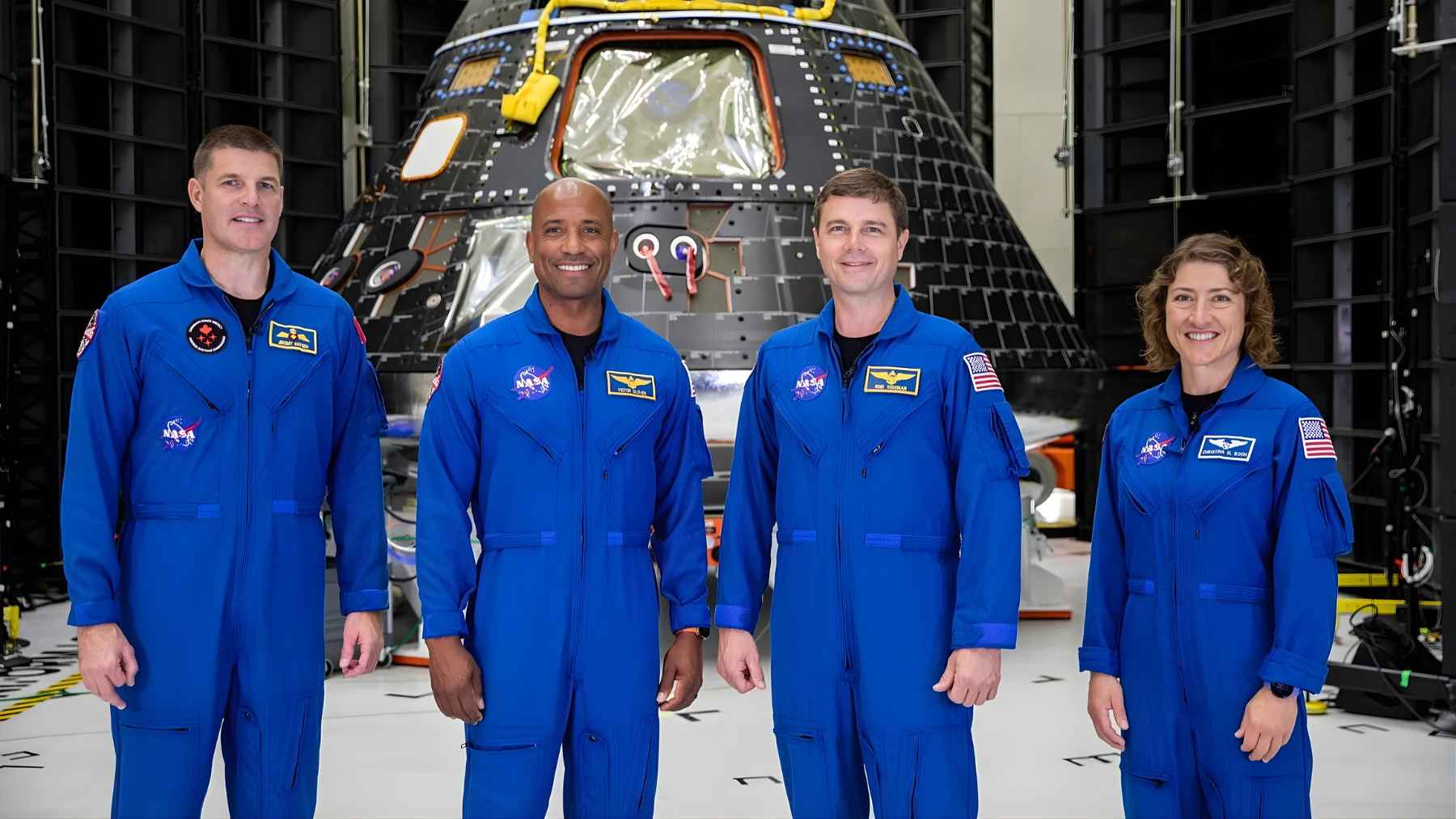
Their roughly ten-day flight will send Orion into high Earth orbit to shake down life support systems before a powerful engine burn pushes the spacecraft on a looping path around the Moon and back. At its farthest point, the crew will travel about six thousand miles beyond the lunar surface and cover close to six hundred thousand miles in total before splashing down in the Pacific.
Reading the Moon to understand our own world
Artemis II is not just a sightseeing trip. As Orion swings around the lunar far side, the crew will photograph impact craters, ancient lava plains, and large structures such as the Orientale Basin while talking in real time with scientists on the ground.
Geologists will analyze subtle differences in color and texture to better reconstruct the Moon’s history and to help choose safe and scientifically-rich landing zones for Artemis III near the south pole, where rocks and buried ice could store clues about how our planet and the wider solar system evolved.
“Artemis II is a chance for astronauts to implement the lunar science skills they have developed in training,” explains Kelsey Young, the mission’s lunar science lead. In practical terms, that means using the crew like highly-trained field geologists who just happen to be orbiting another world.
Closed loop life support and recycling in space
The mission is also a major test of environmental control systems that must keep four people alive far from any rescue. Many of these technologies trace back to research on the International Space Station, which helped mature carbon dioxide scrubbers, advanced air filters, and water recycling hardware.
Artemis II will fly radiation sensors, upgraded CO₂ removal systems, emergency fire masks, and even organ on a chip experiments that use tiny devices seeded with human cells to study how deep space radiation affects health.
These same tools push engineers to squeeze every drop of usefulness out of air and water, something that matters just as much in a closed spacecraft as it does in a drought-stricken city or an off-grid home trying to keep the electric bill under control.
Imagine keeping an entire apartment building livable using almost only yesterday’s air and water. That is roughly the challenge facing Orion. ISS systems already recover about ninety eight percent of onboard water and Artemis needs to reach similar levels for longer trips to the Moon and, later on, to Mars.
A step toward sustainable exploration
The wider Artemis program aims to create a lasting human and robotic presence around and on the Moon, not just a series of brief flag planting visits. To a large extent, that long-term vision depends on how well early missions like Artemis II can prove out closed loop life support, careful resource use, and international cooperation.
Experts also note that the same playbook used to keep astronauts safe in a vacuum often feeds new ideas for saving energy, filtering polluted air, or managing scarce water on Earth. The technology is not a silver bullet for the climate crisis, but it can nudge everything from emergency shelters to remote research stations toward more self-sufficient and resilient designs.
For now, the focus is on getting this first crewed test flight off the ground safely. NASA managers have been clear that they will add extra dress rehearsals or even roll the rocket back indoors if the data hints at trouble, letting hardware readiness set the schedule rather than the other way around.
The official press release was published by NASA.