Southwest hydropower hit record lows this summer, 28% below the 10-year average, and by September Lake Powell was less than 1% above Glen Canyon Dam's minimum power pool, the EIA says
Record-low summer output as Lake Powell neared its minimum power pool; Reclamation data show where Powell and Mead stood on November 27.

· 4 min read
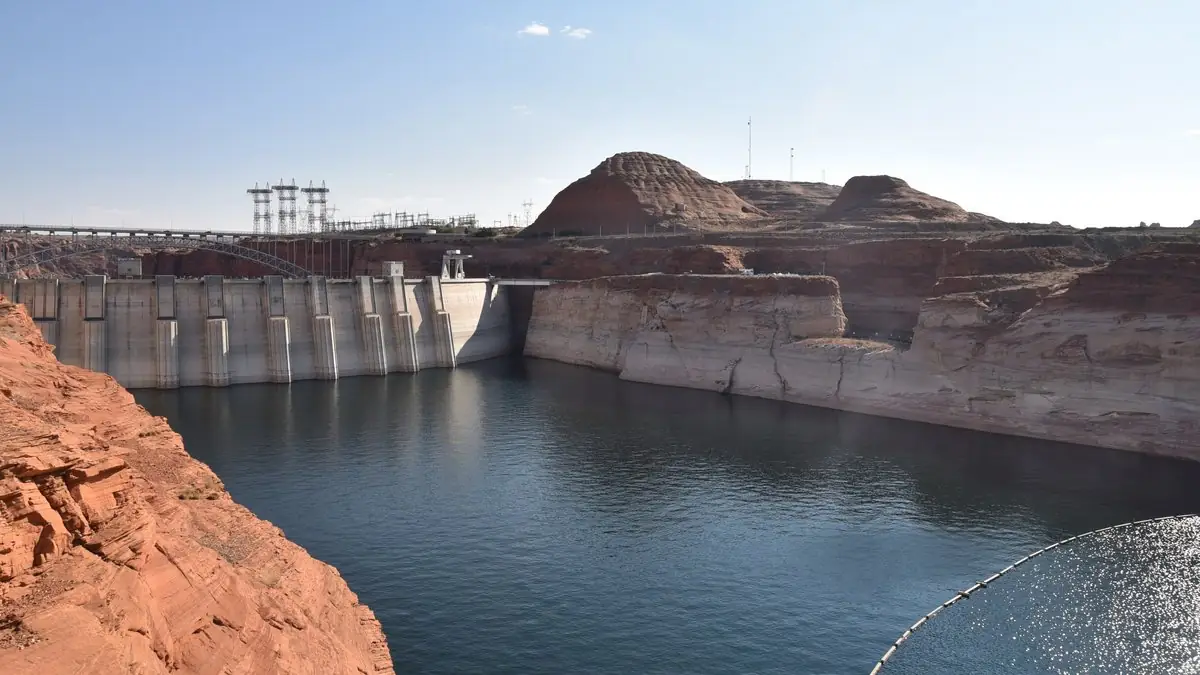
Hydropower in the Southwest fell to record lows this summer, as drought in the Colorado River Basin kept cutting generation. From April through August, output in the region was nineteen percent below last year and twenty-eight percent below the ten-year average, according to the U.S. Energy Information Administration. By the end of September, Lake Powell stood at three thousand five hundred eighteen feet, less than one percent above the three thousand four hundred ninety feet Glen Canyon Dam needs to generate power. To protect the dam, officials released water from Flaming Gorge and cut releases from Lake Powell. The Interior Department also ordered California, Arizona and Nevada to reduce their combined water use by one point two five million acre-feet a year for two years. The agency expects Southwest hydropower to drop nine percent this year, and says an El Niño could help, but one good water year likely won't erase years of scarcity.
Key points
- The EIA says Southwest hydropower from April through August 2026 was 19% below last year and 28% below the 10-year average.
- Interior is cutting combined water use in California, Arizona and Nevada by 1.25 million acre-feet a year for two years.
- The EIA expects hydropower to supply about 4% of the Southwest's electricity in 2026, down from 8% in 2011.
Southwest hydropower fell to record lows this summer. Prolonged drought in the Colorado River Basin cut generation in the Southwestern electricity supply region, the U.S. Energy Information Administration (EIA) said in an analysis published on November 13.
The region includes Arizona, New Mexico and small parts of Nevada and California. From April through August 2026, its hydropower generation was 19% lower than in the same months last year. It was also 28% lower than the 10-year average, according to the EIA's Form EIA-923 power plant survey.
The EIA's generation figures cover April through August, and its reservoir levels run to the end of September. Newer daily data from the U.S. Bureau of Reclamation show where the two big reservoirs stood on November 27.
Lake Powell near minimum power pool
Lake Powell and Lake Mead are formed by Glen Canyon Dam and Hoover Dam. Water elevations at both lakes hit record lows, the EIA wrote.
To generate hydropower at Glen Canyon Dam, Lake Powell should be at least 3,490 feet above sea level. That threshold is known as the minimum power pool.
At the end of September, the lake reached 3,518 feet. That was less than 1% above minimum power pool, according to the EIA.
Hoover Dam needs Lake Mead to stay at 950 feet or more. By the end of September, Lake Mead stood at 1,038 feet, which is 9% above its minimum power pool.
Reclamation manages most dams in the Colorado River Basin. Seven states depend on the river for hydropower and other water supply needs: Arizona, California, Colorado, Nevada, New Mexico, Utah and Wyoming.
Steps to protect the dam
To reduce the risk of Lake Powell falling below minimum power pool, water was released from Flaming Gorge. That reservoir sits in the Upper Colorado River Basin.
Releases from Lake Powell were also cut. The goal was to keep the lake at 3,510 feet or higher, given the most probable inflows, the EIA explained.
Reclamation's July 2026 24-Month Study adds detail. Interior reduced Lake Powell's release for water year 2026 from 7.48 million acre-feet to 6.00 million acre-feet. As of July, the Drought Response Operations Plan was set to send roughly 660,000 acre-feet to 1.00 million acre-feet of extra water from Flaming Gorge to Lake Powell by April 2027.
The same study forecast unregulated inflow into Lake Powell of 1.08 million acre-feet for April through July 2026. That was 17% of average. For the whole 2026 water year, the forecast was 3.50 million acre-feet, or 36% of average.
Lower releases from Lake Powell could in turn lower Lake Mead downstream and affect power output at Hoover Dam. To address that, the Department of the Interior decided to reduce the combined water use of California, Arizona and Nevada. The cut is 1.25 million acre-feet each year over the next two years.
Where the lakes stand now
Reclamation's daily reservoir data put Lake Powell at 3,541.28 feet on November 27, 2026. The same series shows 3,518.08 feet on September 30, 2026, and 3,543.60 feet on November 27, 2025.
On November 27, inflow into Lake Powell was 9,000 cubic feet per second and the release from Glen Canyon Dam was 6,600, according to Reclamation's operations report. The report lists Lake Powell's content that day at 6.53 million acre-feet.
Lake Mead stood at 1,041.28 feet on November 27, 2026, according to Reclamation's Lower Colorado River operations report.
A weak outlook for 2026
In its November Short-Term Energy Outlook, the EIA expects Southwest hydropower to total 6.13 billion kilowatthours in 2026. That would be 9% lower than last year and 24% lower than the 10-year average.
For 2027, the agency expects 6.1 billion kilowatthours, or 0.5% less than this year.
This year's El Niño could bring more precipitation than normal, the EIA noted. That could provide some drought relief and improve the hydropower forecast for the region.
Still, the agency cautioned that one good water year likely won't eliminate the effects of multiple years of water scarcity.
A shrinking share of power
Hydropower is expected to supply about 4% of the Southwest's electricity in 2026, according to the outlook. That share has fallen from a peak of 8% in 2011.
Lake levels also shape how much power a dam can deliver. In its July study, Reclamation said that, because Lake Mead's elevation is changing, Hoover's generator capacity is adjusted based on estimated effective capacity and plant availability. That effective capacity is based on projected Lake Mead elevations, and unit capacity tests will be performed as the lake level changes.
Lindsay Aramayo was the principal contributor to the EIA analysis, which draws on data from the agency's Form EIA-923 power plant survey.
U.S. Bureau of Reclamation
Glossary for this story
- Hydropower
- Electricity made by falling or flowing water spinning the turbines of a dam or power plant.
- Drought
- A long period of much-lower-than-normal rainfall that reduces the water in rivers, reservoirs and soil.
- El Niño
- A natural pattern in the tropical Pacific: El Niño warms its waters and La Niña cools them, and both shift weather around much of the world for months.
Adrián Villellas
Writer at ECOnewsAdrián Villellas is a computer engineer and entrepreneur in the fields of digital marketing and advertising technology. He has led projects in data analysis, sustainable advertising, and solutions for new audiences. He also contributes to scientific initiatives related to astronomy and space observation. He writes for science, technology, and environmental media outlets, where he makes complex topics and innovative advances accessible to a broad audience.
More from Adrián VillellasComments · 0
Rules ›No comments yet. Be the first to share your view.