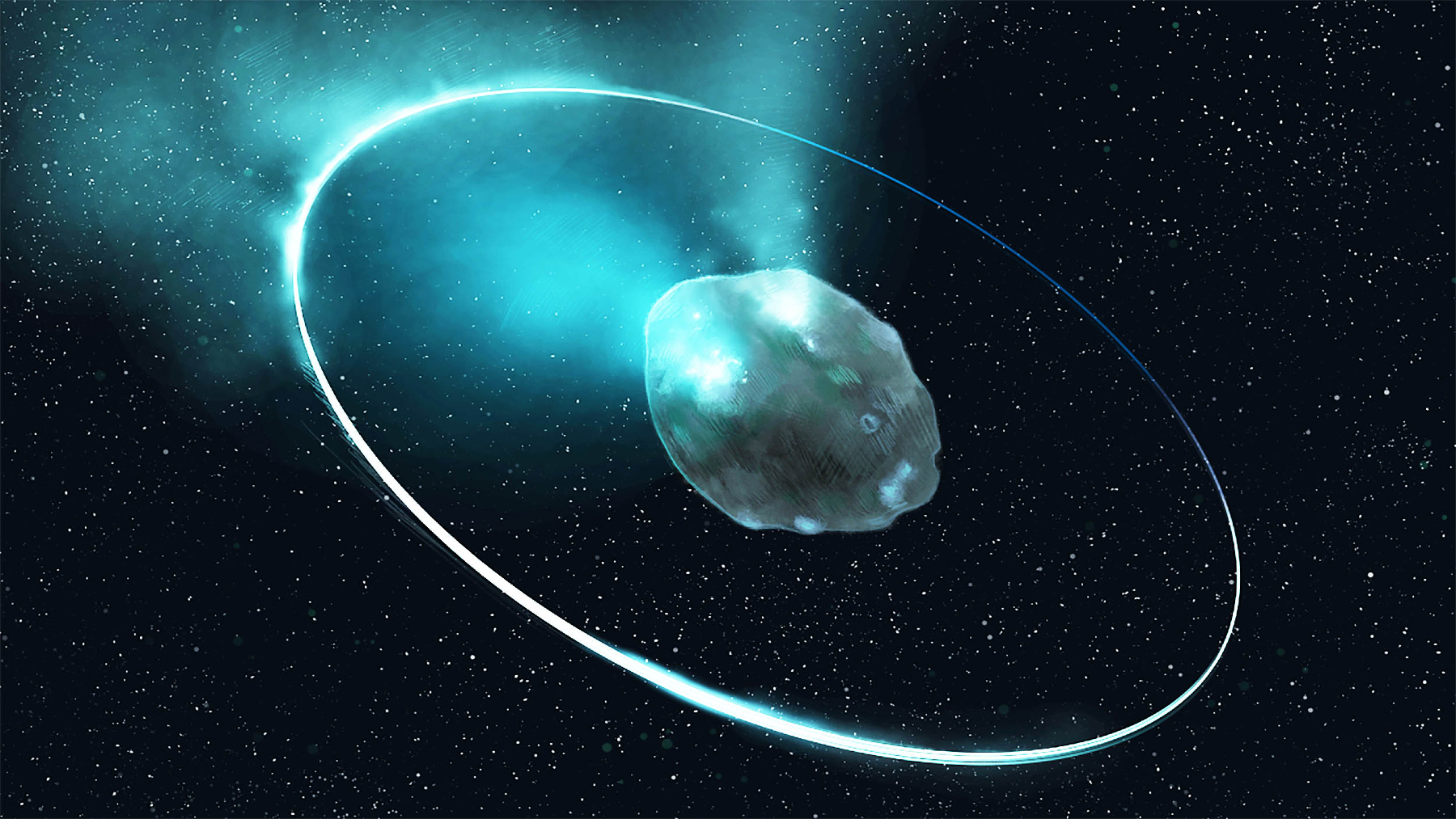
The interest in celestial bodies as seen through the different centuries is focused primarily on astronomers; however, few have done so as from an interesting point as number (2060) Chiron. This was discovered as the body of an asteroid among the huge planets, yet it’s different from both asteroids and comets. Moreover, recent observations with (JWST) above the James Webb Space Telescope have confirmed some extraordinary elements concerning Chiron, which might shed some light on how the solar system came into being.
Chiron – An icy, rocky hybrid of the Centaur family
Chiron is not really an icy or rocky celestial object because it is part of the Centaurs, a family of celestial objects named after half-human and half-horse creatures. Even in other parallels, Chiron was both Asteroid-like and assigned to the icy activities of comets.
Chiron was discovered by Charles Kowal in 1977 as an asteroid, but the bright halo that envelops the object was the signature of cometary bodies in space. However, Chiron was classified as an asteroid. It moves around Jupiter and Neptune through one orbit that is extremely unstable.
Studying Chiron is particularly difficult because of such characteristics. At the end of countertops, carbon monoxide ices as well as carbon dioxide ices on the surface of gases like methane filled its coma agents. Their presence and mutual interplay show that the emission of volatile substances within Chiron’s interior can be realized by the heating process of the Sun. This would be a rare opportunity to explore the surface and subsurface chemistry of an enigmatic object.
JWST: Revolutionizing the study of Chiron and similar objects
This is the main event that JWST will revolutionize in the study of objects like Chiron, which will also lead to its success. For the first time, the majority will have access to deep insight into the kinds of objects found on Chiron. Chiron’s icy surface is indeed composed of a vast array of ices-methane and carbon dioxide, among the more well-known residues-and provides a unique space for studies.
These very substances are perhaps a throwback to the earliest era of our solar system before the birth nebula. Objects that are buried much deeper under continents and incorporated into the ice layers-assuming they do exist-are, in terms of the facies composition, unsuspected carriers of methane.
However, this frees up huge potential for there being more to be discovered concerning the whole question of correlations between areas on the surface of worlds and rich localities made up of ice and gas. The discoveries lead to Chiron possibly having been formed in the highly distant trans-Neptunian area and later having been lofted into its present orbit.
From Centaur to comet and beyond: The changing multi-faceted journey of Chiron
Behind the study of Chiron lies not just a slight understanding of an object on its own, but also a study that offers a lens that could be used to study the larger history of the solar system. These objects are acted upon mostly by the giant planets, and their movements are thus controlled over time.
There may be a high probability that objects like Chiron eventually turn into Jupiter Family comets or plow back into the trans-Neptunian area, continuing their cosmic journey. Chemical findings of molecules like acetylene and propane on this centaur, however, made the identification as unique.
These chemical species might have come from chemical reactions on its surface wherein its chemical complexity depicts many hidden layers in it. This discloses that the idea of a “standard” centaur probably can be questioned, considering that they do carry a hidden evolutionary path, very different from one another influenced by the environment and history.
A breakthrough in unraveling the secrets of the solar system is the Chiron. The universe offers clues about how ice, gas and solar heat may produce celestial bodies through the tools such as JWST. The future holds a lot more information about this comet-asteroid hybrid, as it furthers its investigation into the cosmos.