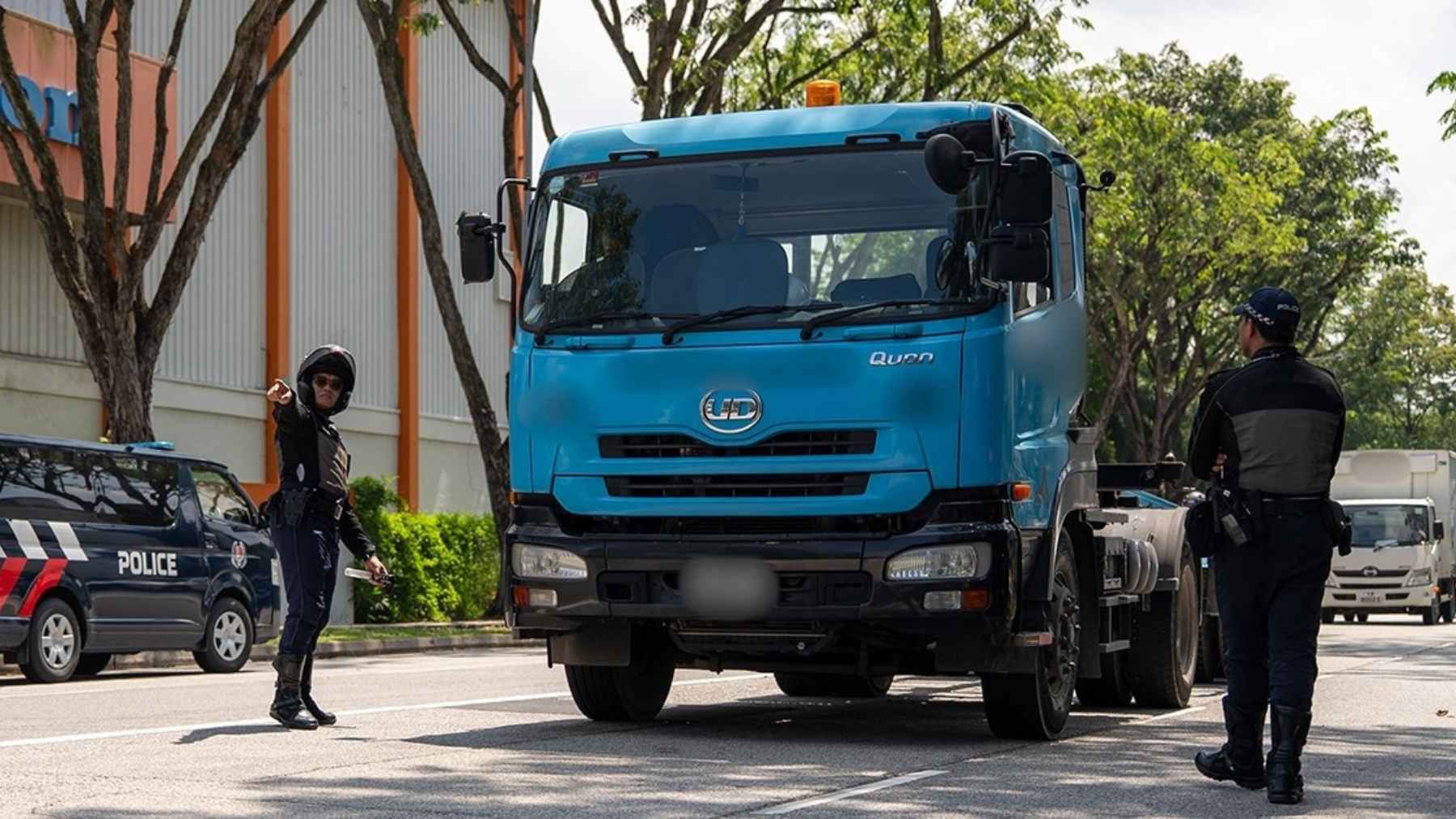
If you have ever felt a heavy lorry roar past your bus stop a little too fast, you already know how unsettling that moment can be. In Singapore, that gut feeling has now turned into firm policy, with the Traffic Police moving against companies that ignored a legal deadline to slow their trucks down.
As of January 1, owners of certain lorries must have installed electronic speed limiters that cap their vehicles at 60 kilometers per hour. Yet 141 lorries missed that deadline, even after months of reminders. Their road tax will not be renewed, their owners face fines and even jail, and the companies risk trouble during workplace safety audits and when bidding for public projects.
At first glance, this looks like a simple road safety story. In reality, it says a lot about how cities can tackle both traffic danger and emissions in one move.
Singapore is expanding its speed-limiter regime to cover all lorries with a maximum laden weight between 3,501 and 12,000 kilograms. These devices are now required in phases, with older, heavier trucks facing the first deadlines and the rest to follow through mid 2027. The Singapore Police Force explains that limiters are meant to keep these vehicles within 60 kilometers per hour and to improve driving behavior over time.
The clampdown on the 141 non-compliant lorries sits on top of a tougher tool that kicked in this year. Companies whose drivers are caught speeding can now receive a Remedial Order under workplace safety law. Once that happens, they must install speed limiters across their whole lorry fleet ahead of the usual statutory dates or risk fines of up to 50,000 Singapore dollars.
Why such a hard line over a few kilometers per hour. Because speed is still one of the most stubborn killers on the road. Research reviewed by the International Transport Forum and the OECD links inappropriate speed to roughly 20 to 30 percent of fatal crashes worldwide. In Singapore, speeding has recently contributed to about one in three fatal accidents, according to local media reports that drew on police data.
Heavy trucks add another layer of risk. When a multi-ton lorry is going too fast, braking distance grows, impact energy soars and any mistake can turn into a serious crash. Studies of commercial fleets in North America and Europe have repeatedly found that trucks without speed limiters are involved in many more high-speed crashes than those with limiters engaged.
There is also a quieter benefit that does not show up in the traffic court. Slower heavy vehicles usually burn less fuel. International studies on heavy duty trucks and environmental speed limits point to lower fuel consumption and reduced emissions when speeds are capped, especially on highways.
In Europe, for example, heavy-duty traffic is responsible for roughly a quarter of road transport carbon dioxide emissions and around 5 percent of total emissions, so even modest savings per truck can add up at scale.
Lower speed also means less aggressive braking and a bit less tire and brake wear. One study of environmental speed limits in Oslo found that cutting speeds reduced coarse-particle pollution by 6 to 12 percent along affected roads. Those are the tiny fragments that end up in the air we breathe and in the dust that settles on balconies, parks and schoolyards.
For residents, the change may feel simple. Fewer lorries racing to beat the light. A little less engine roar outside housing estates. Slightly calmer morning commutes when you are stuck in traffic next to a fully-loaded truck. It will not turn diesel fleets into zero-emission vehicles, but it nudges daily operations in a cleaner direction while the world waits for more electric and hydrogen trucks to arrive.
For companies, the message is that safety and sustainability are no longer side projects. Speed limiters are now tied to road tax, insurance risks and workplace safety certifications that matter for winning government work. In practical terms, that means fleet managers who ignore the rules are not just gambling with fines. They may be putting their business pipeline and environmental credibility on the line too.
At the end of the day, Singapore’s move shows how a technical device inside a truck engine can ripple outward into safer streets and slightly smaller exhaust footprints. Slowing heavy vehicles is not as flashy as unveiling a new solar farm or electric bus line, yet it quietly supports the same goal of safer and more sustainable urban life.
The official statement was published by the Singapore Police Force.