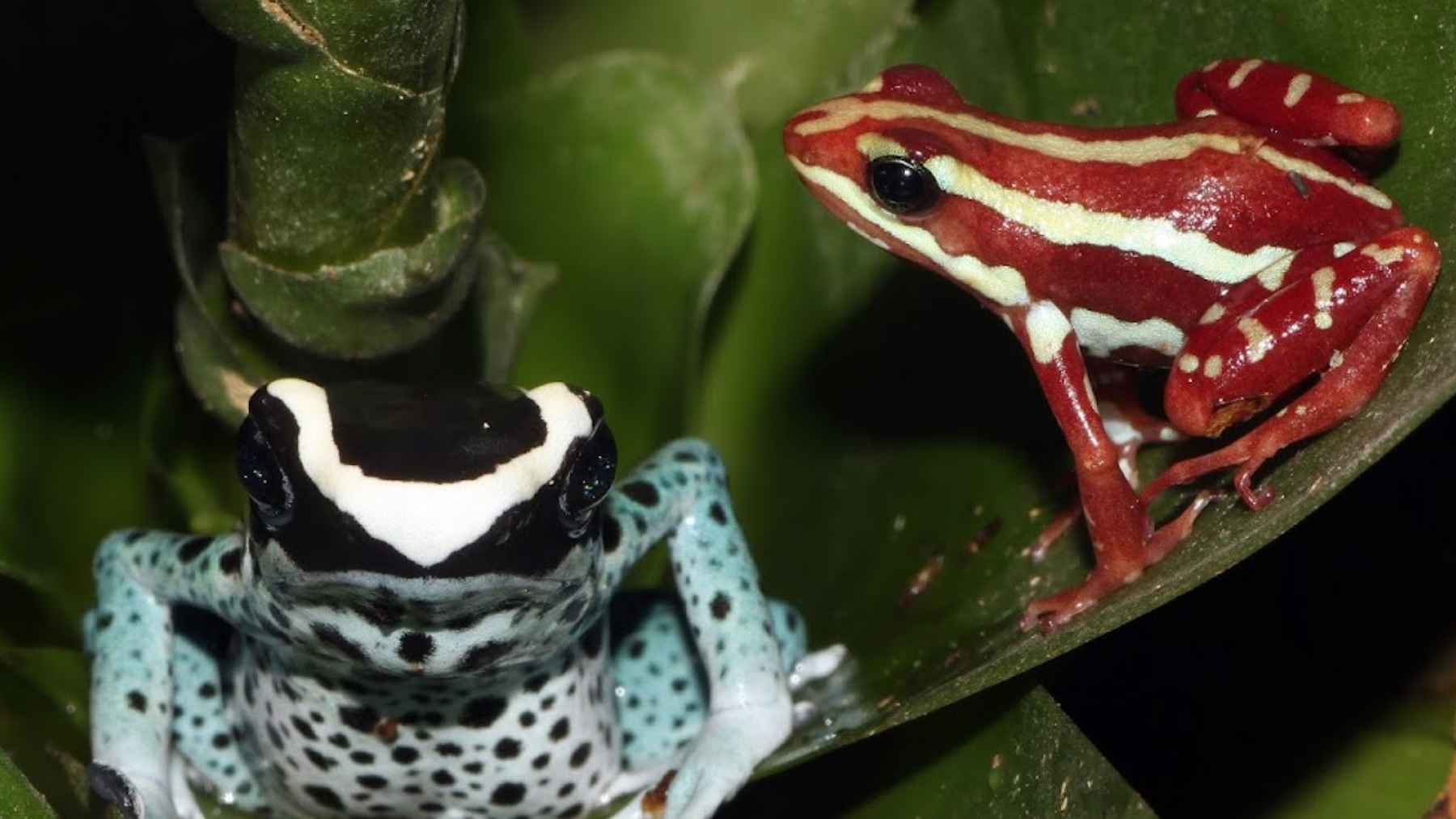
If you have ever pressed your face against the glass of a zoo terrarium to admire a neon blue or lemon yellow frog, you were looking at a walking chemistry experiment.
Those vivid colors are not just for show. They advertise a skin full of potent alkaloids that can make predators spit, stumble, or die. And according to a landmark comparative study led by Catherine R. Darst, that chemical shield is tightly linked to what these frogs eat, again and again across their family tree. In simple terms, poison frogs really are what they eat.
Borrowed poisons on tiny plates
Unlike snakes that manufacture venom inside their own bodies, many poison frogs borrow their defenses from the buffet crawling through the rainforest leaf litter. Decades of work show that most of their skin alkaloids come from small arthropods, especially ants and mites, along with beetles and millipedes.
These compounds are varied and powerful. More than five hundred distinct alkaloids have been identified in the skins of poison frogs, making them one of the most chemically diverse vertebrate groups known.
In captivity, when frogs are fed harmless crickets and fruit flies, they gradually lose their toxicity. That everyday detail from zoo collections is a strong hint that the animals do not synthesize these poisons themselves but instead sequester them from their food. So the big question becomes obvious. If diet fuels defense, did evolution repeatedly link specialized menus to stronger chemical armor?
Peering into stomachs and family trees
To tackle that question, Darst and colleagues focused on fifteen species of poison frogs from Ecuador, spanning both brightly colored, toxic species and more cryptic relatives. They combined three lines of evidence in a single analysis.
First, they examined the contents of each frog’s digestive tract under a microscope. Every intact prey item was identified and measured, then assigned to broad groups such as ants, mites, beetles, or flies. That allowed the team to calculate how narrow or broad each species’ diet really was and how heavily it relied on ants.
Second, they assessed chemical defense by extracting skin compounds into methanol and running thin layer chromatography. This technique separates alkaloids into visible bands and gives a rough fingerprint of how many types are present and in what amounts.
Finally, they mapped both diet and alkaloid data onto a genetic family tree of poison frogs. Using comparative statistics that account for shared ancestry, they asked whether shifts toward dietary specialization tend to move in step with gains in chemical defense.
The answer was yes, and not just once. Species that focused heavily on ants and had a narrow overall menu consistently showed richer alkaloid profiles. The pattern appeared at least four separate times in different branches of the dendrobatid family.
In other words, evolution kept rediscovering the same trick. Specialize on alkaloid packed prey, build up a chemical shield, and then advertise it with bright warning colors.
A fragile alliance between frogs and leaf litter
The story does not stop at clever evolutionary chemistry. It also has an ecological edge that matters for people who will never set foot in a tropical forest.
Because poison frogs depend on particular ants and mites to stay toxic, anything that reshapes leaf litter communities can weaken their defenses. Recent field studies in agricultural landscapes report that frogs living near cattle pastures and plantations often carry fewer or different alkaloids than those in intact forest, reflecting changes in the local ant fauna.
At the same time, many poison frog species across Central America and South America are already under pressure from deforestation, pollution, the pet trade, and a deadly fungal disease that has devastated amphibians worldwide.
Take away the frogs’ forest home and you also take away the intricate network of tiny arthropods that feed them and arm them. The bright animal on the forest floor and the almost invisible invertebrates beneath the leaves rise and fall together.
What this means for conservation
For the most part, conservation plans still focus on visible animals and big pieces of habitat. The poison frog diet story suggests that we also need to keep an eye on the small stuff. Protecting intact, humid forest does not just give frogs shade and breeding pools. It preserves the chemical supply chain that keeps them unpalatable to predators.
There is a human angle too. Alkaloids from poison frogs have inspired research into new tools for controlling crop pests and even guiding drug development. When we lose species or simplify their diets through land use change, we may also be closing the door on future discoveries.
Next time you see a poison frog, whether in a documentary or behind glass, it is worth remembering that the animal is carrying a record of its meals right in its skin. At the end of the day, its survival depends on a healthy forest pantry that keeps serving up the right kind of tiny, toxic snacks.
The study was published on The American Naturalist.