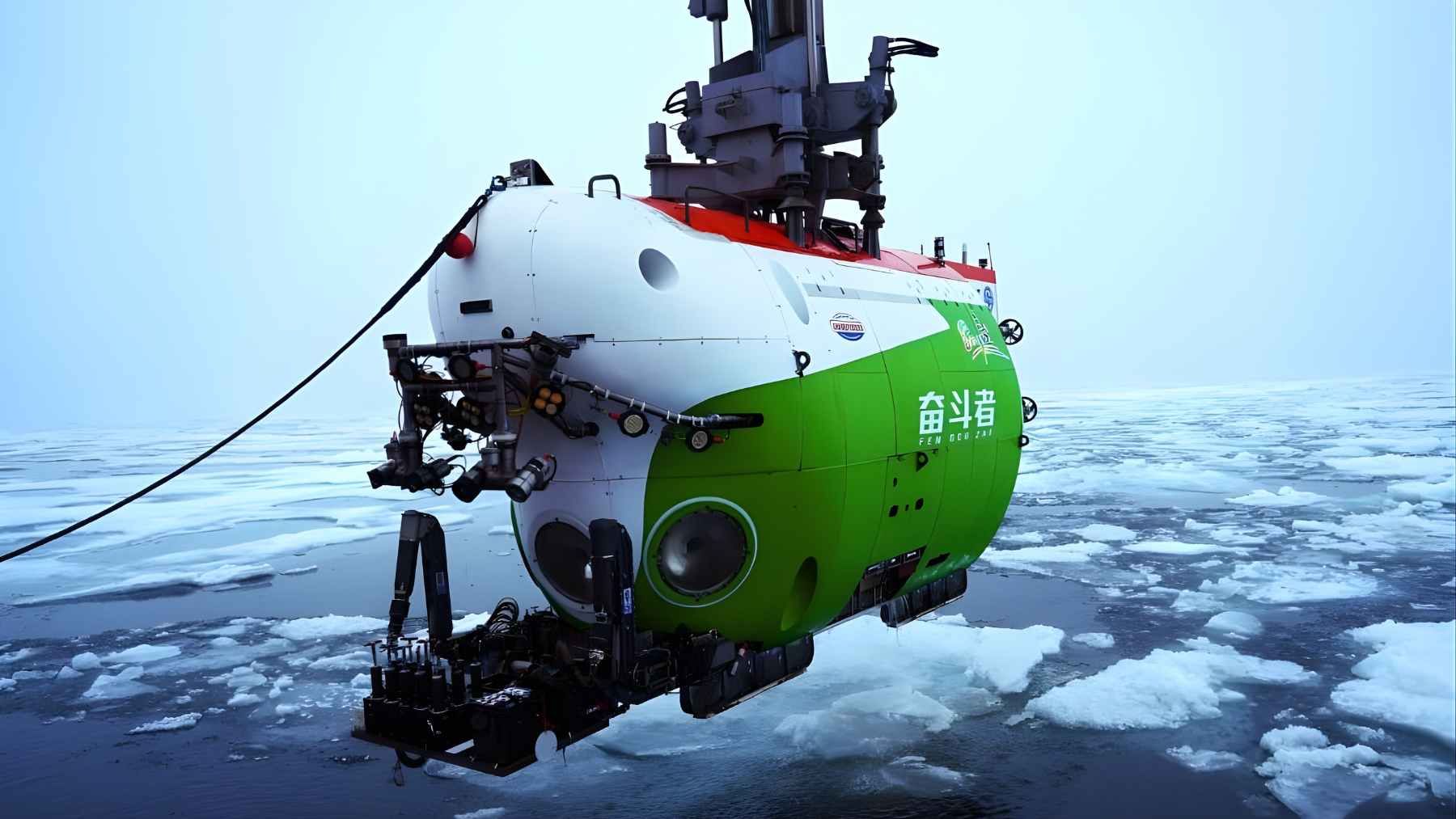
For the first time, scientists have used a crewed scientific submersible to slip beneath thick Arctic pack ice and reach a hidden mountain range on the ocean floor. A Chinese expedition used the deep-sea vessel Fendouzhe to dive 5,277 meters and survey the eastern Gakkel Ridge, a previously unseen stretch of seafloor between Greenland and Siberia.
Working from the new research ship Tan Suo San Hao, the team carried out 43 dives during a roughly three month voyage. Reports from Nature and from official Chinese science agencies say the mission opens a rare window on a region that could host unusual deep-sea life and reveal how a fast-warming Arctic is changing.
Reaching one of Earth’s last untouched seafloors
The Gakkel Ridge is an underwater volcanic mountain chain buried beneath sea ice that runs between Greenland and Siberia. It forms part of the global network of mid-ocean ridges where tectonic plates move apart and new ocean crust slowly forms, usually far from public attention.
Scientists had previously seen the ridge only on sonar maps and in a few short surveys with uncrewed vehicles. A 2003 Nature study on the western Gakkel Ridge revealed hot hydrothermal vents there, but the eastern side stayed off limits, so Huang has called this sector the last piece of the puzzle.
A new way to dive beneath drifting ice
To reach the ridge safely, the Ministry of Natural Resources and the Chinese Academy of Sciences ran a joint Arctic mission pairing Fendouzhe with the ice-capable research ship Tan Suo San Hao. The report describes a ship-submersible coordination method that let the crew work where sea ice covered over 80 percent of the water and Fendouzhe completed 32 dives.
Before each dive, the icebreaking ship opened a temporary pool in the pack ice so the submersible could slip into the sea and begin its descent. On the way back up, Fendouzhe paused below the surface, used sonar and cameras to search for open water, then rose through a gap or waited while the ship cleared one, with the Jiaolong submersible joining some dives to test cooperative work under ice.
Samples that could rewrite Arctic history
During almost one hundred days at sea, the team collected sediment cores, rocks, seawater, and biological samples along the ridge. They also mapped undersea hills and canyons with cameras and sonar, replacing blurred outlines on earlier maps with detailed footage from the seafloor.
One main goal is to see whether the eastern Gakkel Ridge has hydrothermal vents, underwater hot springs that feed animals living from chemical energy instead of sunlight. A 2003 Nature paper and a 2022 Nature Communications study on the western ridge already showed such life there, so the new samples may uncover similar extreme ecosystems and guide ideas about life in dark oceans on icy moons such as Europa.
Why this deep Arctic mission matters for the rest of us
On the surface, the expedition took place far from everyday worries like winter heating bills or slippery sidewalks after a snowstorm. Yet what happens along the Arctic seafloor feeds into the same climate system that shapes bitter cold snaps or oddly mild winters many people notice when they step outside to scrape ice from a windshield.
Mid-ocean ridges help move heat and chemicals through the deep ocean, and the Arctic is warming much faster than the global average. Detailed data from places like the Gakkel Ridge can sharpen climate models that guide long-term planning for coasts and cities, which eventually feeds into decisions about everything from flood defenses to building codes.
Experts stress that this mission is only a first step, and for the most part the raw samples and video will now sit in laboratories for years of detailed study. A hidden basin that no one had visited is now on the scientific map, and its secrets may slowly change how we think about Earth’s deep ocean and the changing Arctic above.
The official statement was published on “Chinese Academy of Sciences”.
Image credit: CAS -China Academy of Sciences