What if everything that ever happens in the cosmos could be written on the night sky like a hidden code?
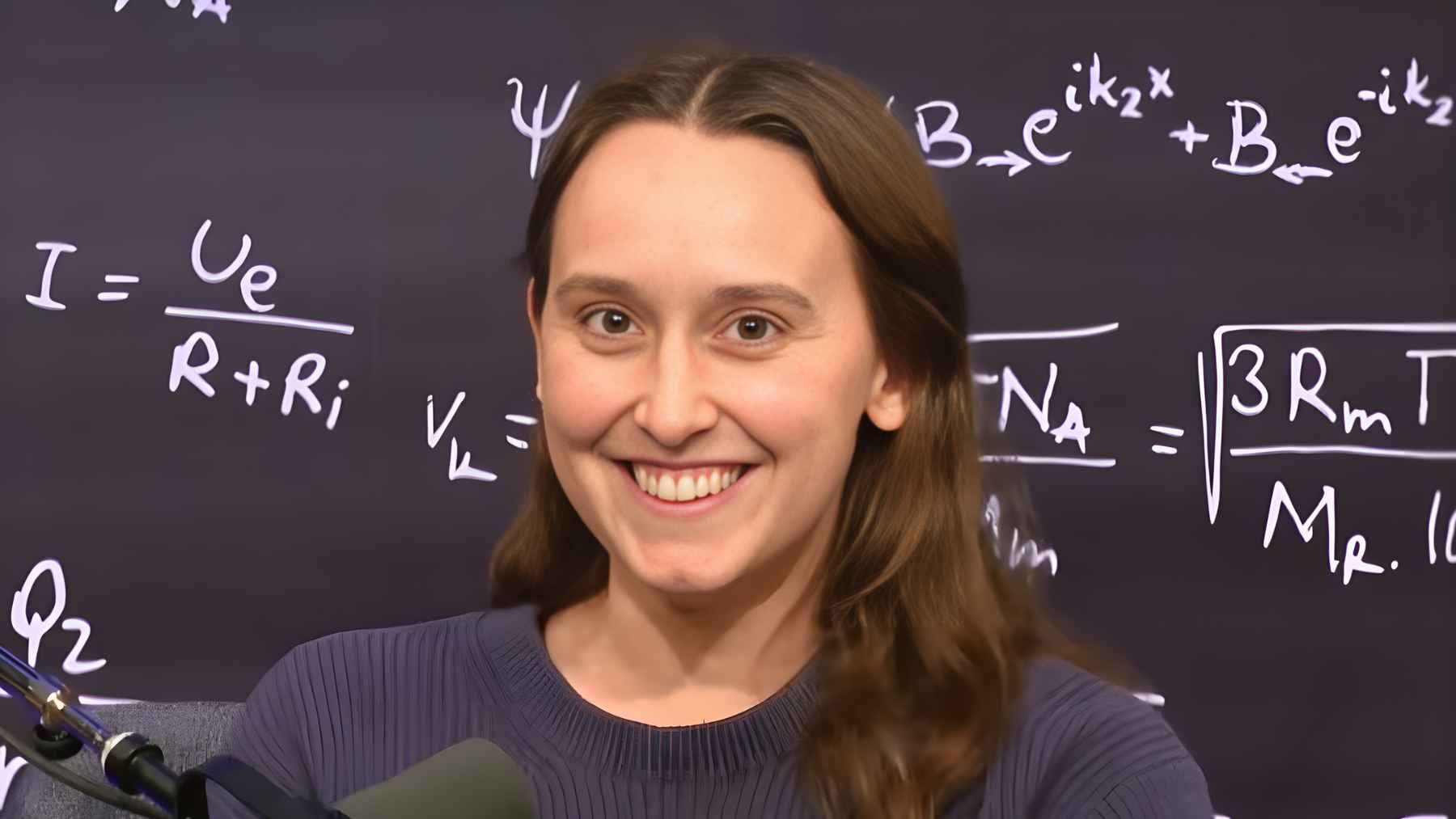
That is the kind of question guiding theoretical physicist Sabrina Gonzalez Pasterski, a Chicago-born scientist with Cuban roots who now works on one of the boldest ideas in modern physics. She leads a research effort called celestial holography that tries to describe our three-dimensional universe using a two-dimensional picture on the celestial sphere, the imaginary dome of the sky we see when we look up.
Her path there started far from any blackboard. As a child fascinated by flight, she received a small Cessna airplane from her grandfather and began flying lessons. By her early teens she had spent years building a kit aircraft and later flew solo as a teenager, an experience widely reported at the time and documented in her own notes and videos.
From aviation dreamer to high-energy theorist
That hands on work with thousands of tiny parts seems to have shaped how she thinks about physics. After attending the Illinois Mathematics and Science Academy, she went on to the Massachusetts Institute of Technology, where she completed a physics degree in three years and graduated at the top of her class with a perfect grade point average.
Graduate studies followed at Harvard University, where she worked with theorist Andrew Strominger on the deep structure of spacetime and gravity. Her 2019 doctoral thesis, titled “Implications of Superrotations,” continued that line of work.
Today she is a faculty member at the Perimeter Institute for Theoretical Physics in Canada and the founder and principal investigator of its Celestial Holography Initiative, a hub that brings together experts in quantum field theory, gravity and mathematical physics.
A new kind of memory in gravity
Her first major splash in the field came from an idea with an almost poetic name. In 2015 she co-authored a paper called “New Gravitational Memories,” which proposed a fresh type of gravitational memory dubbed the spin memory effect.

Gravitational waves are ripples in spacetime produced when massive objects such as black holes or neutron stars collide. The standard memory effect predicts a tiny but permanent shift in the distance between free-floating detectors after such a wave passes. Spin memory is different.
It predicts a lasting time delay between light beams that loop around a distant region in opposite directions after gravitational radiation carrying angular momentum has gone by. In plain language, the universe keeps a faint record of how things spun during violent cosmic events.
This idea has become part of the toolkit for researchers who study how gravitational waves might leave long-lived signatures in the fabric of spacetime, and it is referenced in current work on future observatories.
Why physicists talk about a hologram
To understand why celestial holography matters, it helps to step back to the 1970s. Physicists Jacob Bekenstein and Stephen Hawking showed that a black hole has entropy, a measure of information, that is proportional to the area of its event horizon rather than its volume.
That strange result led others, including Leonard Susskind, to formulate the holographic principle. The idea is that all the information inside a region of space can be encoded on its boundary, similar to how a three-dimensional hologram is stored on a flat film.
Most well known examples of this principle involve highly-curved universes that are quite different from our own. Celestial holography tries to apply the same logic to a universe like ours, which on large scales looks nearly flat and has a tiny cosmological constant.
The Celestial Holography Initiative works to map ordinary four-dimensional scattering processes, such as particle collisions, into a two-dimensional conformal field theory living on the celestial sphere, essentially the full sky that surrounds Earth.
In practical terms, that means rewriting the equations that describe particles and gravitational waves so they look like correlations on a cosmic screen. If that program succeeds, it could give physicists a new way to connect quantum mechanics and general relativity using a single, compressed set of rules.
Beyond the new Einstein label
Media profiles often lean on a catchy nickname and have called her the “next Einstein” or “Einstein of our generation” after her work was cited in a paper co-authored by Hawking. She has repeatedly pushed back on that framing, stressing that modern physics is a collective effort built on many people who contribute ideas over decades.
Her message to young scientists, especially girls and first generation students, is more down to earth. In interviews she has spoken about resisting pressure from others who want to script your career and about not letting self doubt erase your curiosity.
At the end of the day, celestial holography is still a work in progress. Observatories like the LIGO Scientific Collaboration are not yet measuring spin memory or testing full holographic models, and some predictions may remain out of reach for years. But the framework is already changing how researchers talk about the deep structure of spacetime and keeps feeding into new questions across modern physics.
For the rest of us, the story offers a different way to look at that familiar night sky. Those pinpoints of light can be seen as part of a vast recording surface where the universe quietly writes its own history.
The study was published on arXiv.