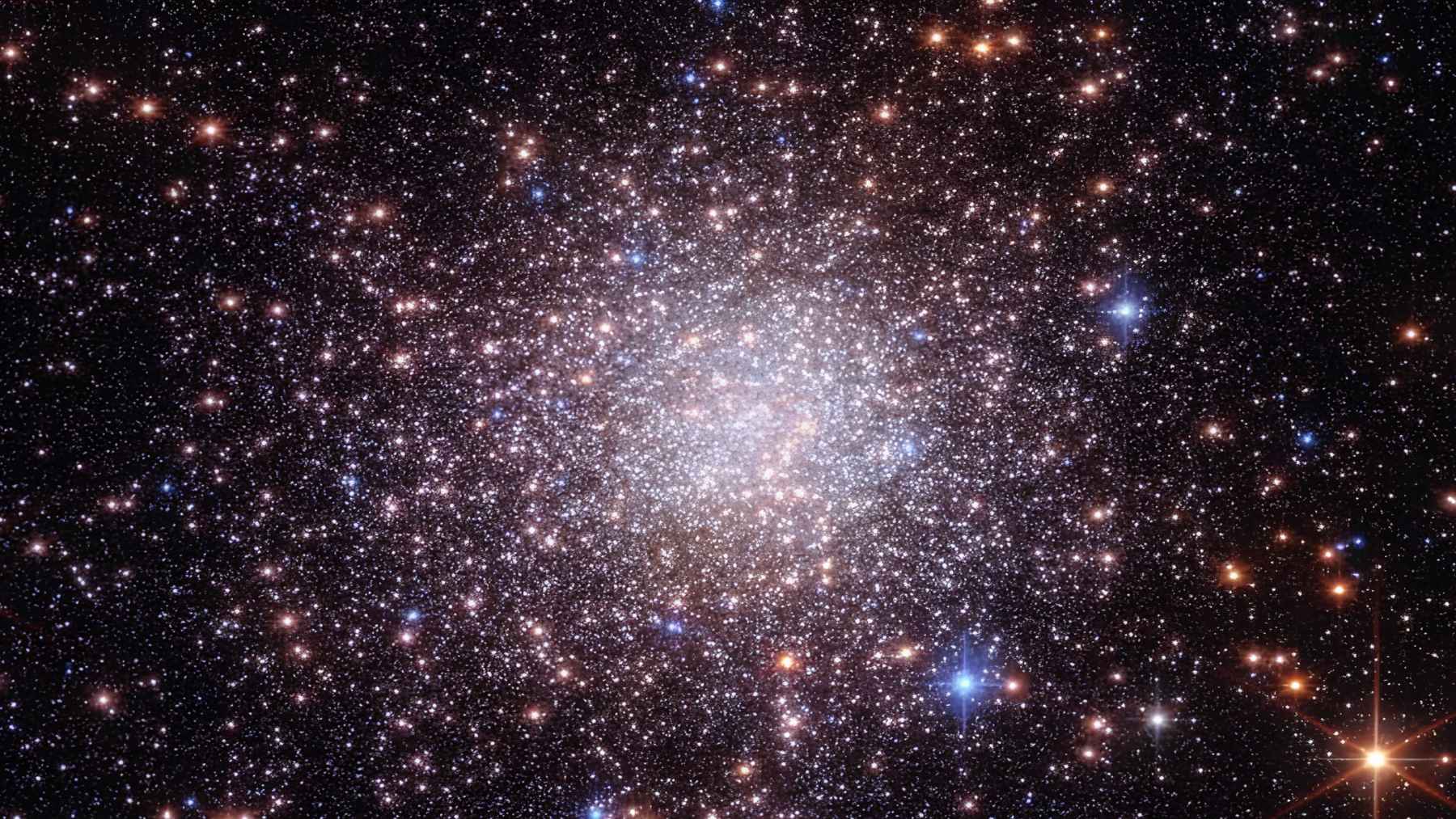
Terzan 5 has spent decades wearing the wrong label. Long treated as a globular star cluster, this crowded stellar system near the heart of the Milky Way now appears to be something far rarer, a surviving fossil from the era when our galaxy was still coming together.
New observations from NASA’s James Webb Space Telescope, combined with years of Hubble data, show that Terzan 5 contains up to four separate generations of stars. That finding changes the story. Instead of being a simple cluster of old stars, Terzan 5 looks more like a preserved chunk of the Milky Way’s ancient building material, still carrying the chemical fingerprints of its own long history.
A relic near the Milky Way’s heart
Terzan 5 orbits inside the Milky Way’s bulge, the dense central region packed with older stars, thick dust, and a lot of visual confusion for astronomers. Studying anything there is a bit like trying to spot a candle through smoke in a packed stadium.
For years, Terzan 5 looked enough like a globular cluster to be classified that way. But a typical globular cluster usually contains one ancient stellar population, while Terzan 5 now appears to have several. That is the big clue.
NASA says Webb and Hubble have now shown that Terzan 5 is a self-contained, self-enriching stellar system. In practical terms, it kept enough gas, dust, and heavy elements to make new stars again and again.
Four generations of stars
The story begins more than half a century ago. Terzan 5 was discovered in 1968 by astronomer Agop Terzan, and later studies began to show that this was no ordinary cluster.
In 2009, scientists found two distinct populations of stars in the system. In 2016, Hubble helped estimate their ages, suggesting one group formed roughly 12 billion years ago and another about 5 billion years ago.
Now the timeline is sharper. By combining Webb and Hubble data, researchers found evidence for two additional stellar populations, one about 3.8 billion years old and another just 2.5 billion years old. The two older populations were measured more precisely as 12.5 billion and 4.7 billion years old.
Why Webb changed the picture
So why did it take this long? Dust. Lots of it.
Terzan 5 sits in a heavily obscured region of the galaxy, where visible light struggles to get through. Webb’s infrared vision gave researchers a clearer way to peer through that dust and catalog more stars, including fainter ones that earlier studies could not easily separate.
Hubble played a different but equally important role. Because its observations were taken over a 12-year span, researchers could measure tiny stellar movements, known as proper motions. That helped them separate true Terzan 5 stars from unrelated stars in the Milky Way bulge.
A system that enriched itself
The four generations matter because they make a simpler explanation much less likely. With only two star groups, astronomers could still wonder whether Terzan 5 had picked up fresh gas from another object, such as a molecular cloud or another cluster.
With four generations, the picture changes. The system seems to have had its own internal cycle of star birth, stellar death, and chemical enrichment.
Powerful supernova explosions inside Terzan 5 likely forged heavier elements. Instead of losing that material to space, the system appears to have held onto it, letting later generations of stars form from increasingly enriched ingredients. As UCLA astronomer R. Michael Rich put it, the cluster preserves “a fossil record of progressive enrichment of heavy elements by supernovae.”
Not just a globular cluster
That is why researchers now describe Terzan 5 as a “bulge fossil fragment.” It is not simply a ball of old stars. It may be the remnant of a much more massive stellar system that formed 12.5 billion years ago and somehow avoided being fully mixed into the Milky Way’s central bulge.
“For some reason, this peculiar clump of stars formed separately from the bulge and was not destroyed as the bulge itself formed,” said Francesco R. Ferraro of the University of Bologna, principal investigator of the Webb observations.
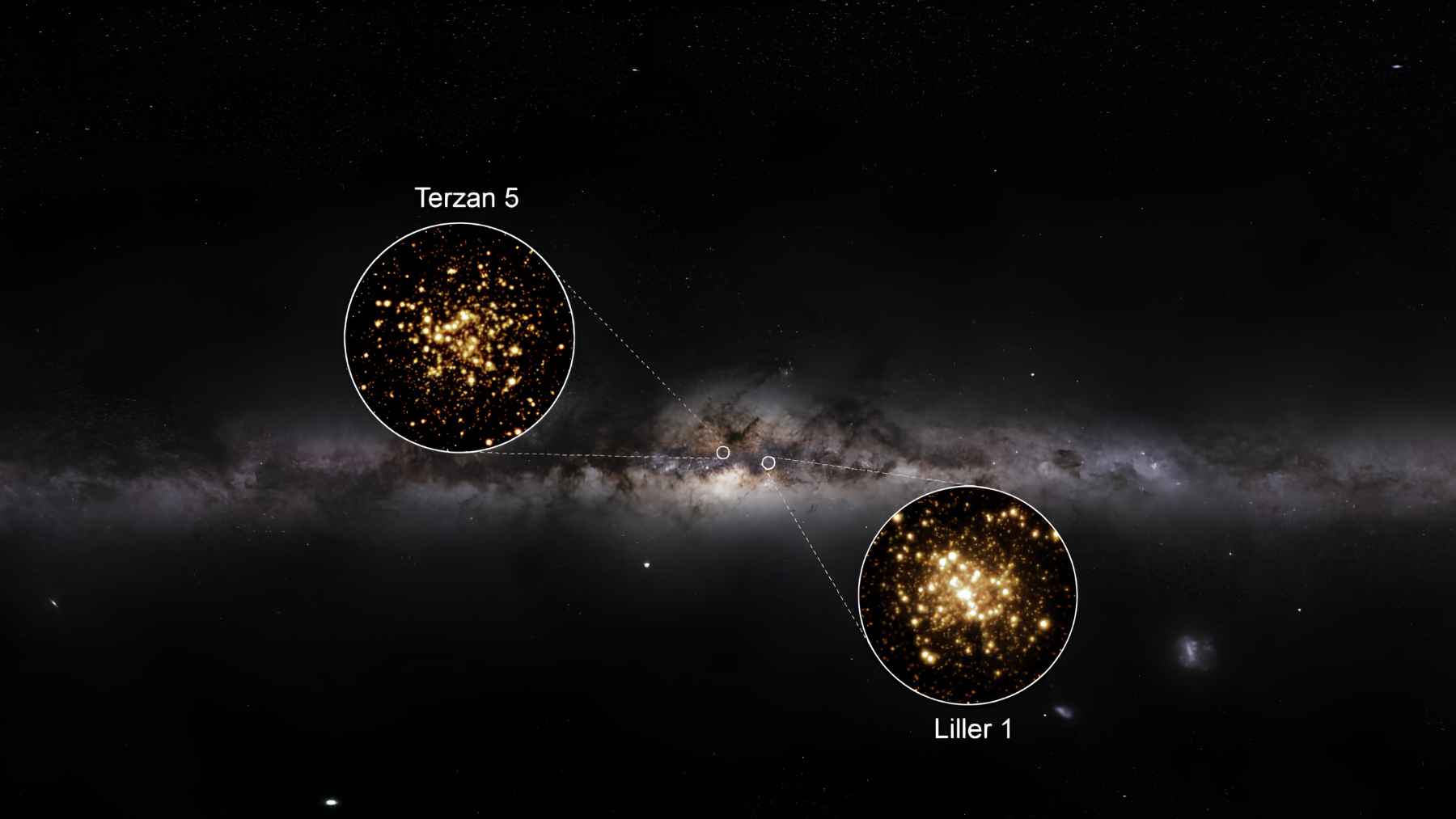
Only one other known object, Liller 1, has been reclassified in a similar way. Ferraro’s team plans to examine 40 to 50 additional globular clusters orbiting inside the bulge to see whether more hidden fossils are waiting there.
What it tells us about galaxies
At first glance, this may sound like a story about one obscure object in Sagittarius. But Terzan 5 could help answer a much larger question. How do galaxies build their crowded centers?
Researchers think early galaxies may have had huge gas disks that broke into clumps, formed stars, and then migrated toward the center. Many of those clumps likely merged to form galactic bulges. Terzan 5 may be one of the rare survivors that did not disappear into the mix.
“Terzan 5 may provide direct evidence that can help explain how bulges formed in galaxies throughout the universe,” said Barbara Lanzoni, a co-author of the work and associate professor at the University of Bologna. One small star system, in other words, may help explain a very big cosmic recipe.
A fossil with more to say
The full study, titled “The multi-age stellar populations of Terzan 5 as revealed by JWST,” was accepted for publication in Astronomy & Astrophysics and is listed with the journal reference A&A 709, A212 (2026).
For now, Terzan 5 gives astronomers something rare. Not just a snapshot of old stars, but a layered record of formation, destruction, and survival near the heart of our galaxy.
The official statement was published on NASA.