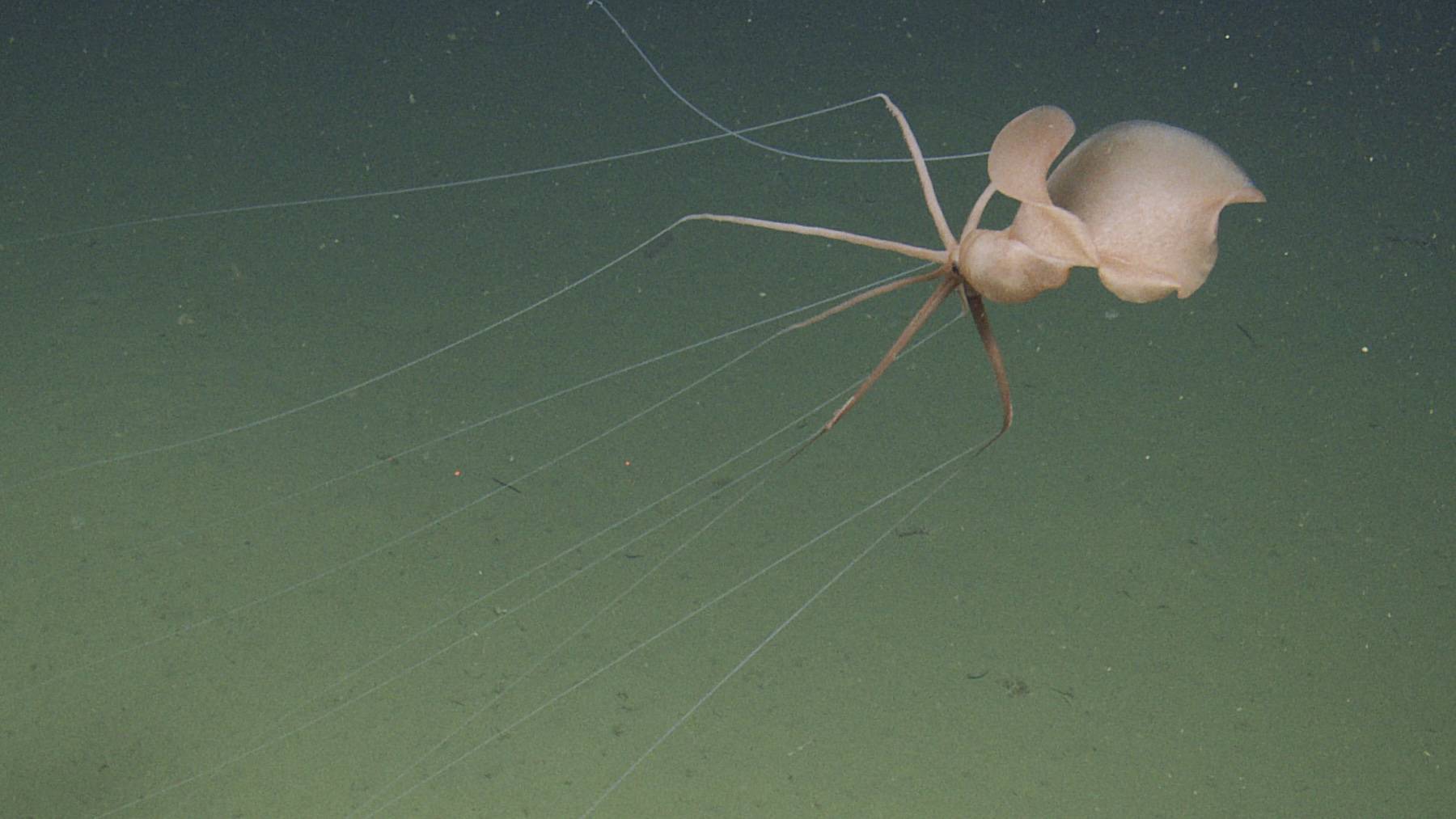
Olívia Soares Pereira was sitting beside the video screens aboard the research vessel David Packard when something pale drifted into the top corner of the feed. Before the rest of the animal had even come into view, she shouted the name of a bigfin squid, a deep-sea animal that, by MBARI’s count, has been observed or collected only about 70 times.
The sighting happened during MBARI’s August 3–12, 2026, Seamount Hotspots expedition near Davidson Seamount, an ancient undersea volcano about 80 miles (130 kilometers) southwest of Monterey, California. The remotely operated vehicle Doc Ricketts was about 10,751 feet (3,277 meters) down, and the Monterey Bay Aquarium Research Institute (MBARI) says it is the first confirmed live observation of this squid in the northeastern Pacific Ocean.
A jelly that turned into a squid
Pereira, a postdoctoral fellow at MBARI, told the story in the institute’s announcement of the sighting. “Every dive into the deep brings an opportunity to see something new. You never know what you’ll encounter,” she said.
“I was sitting right next to the screens in the control room when I saw what looked like tentacles coming into the top corner of the video. I thought it might be a cool jelly, but as soon as the little ‘elbows’ appeared, I knew exactly who this was and immediately screamed ‘Magnapinna!’ before the rest of the squid even came into the screen. It was incredibly exciting!”
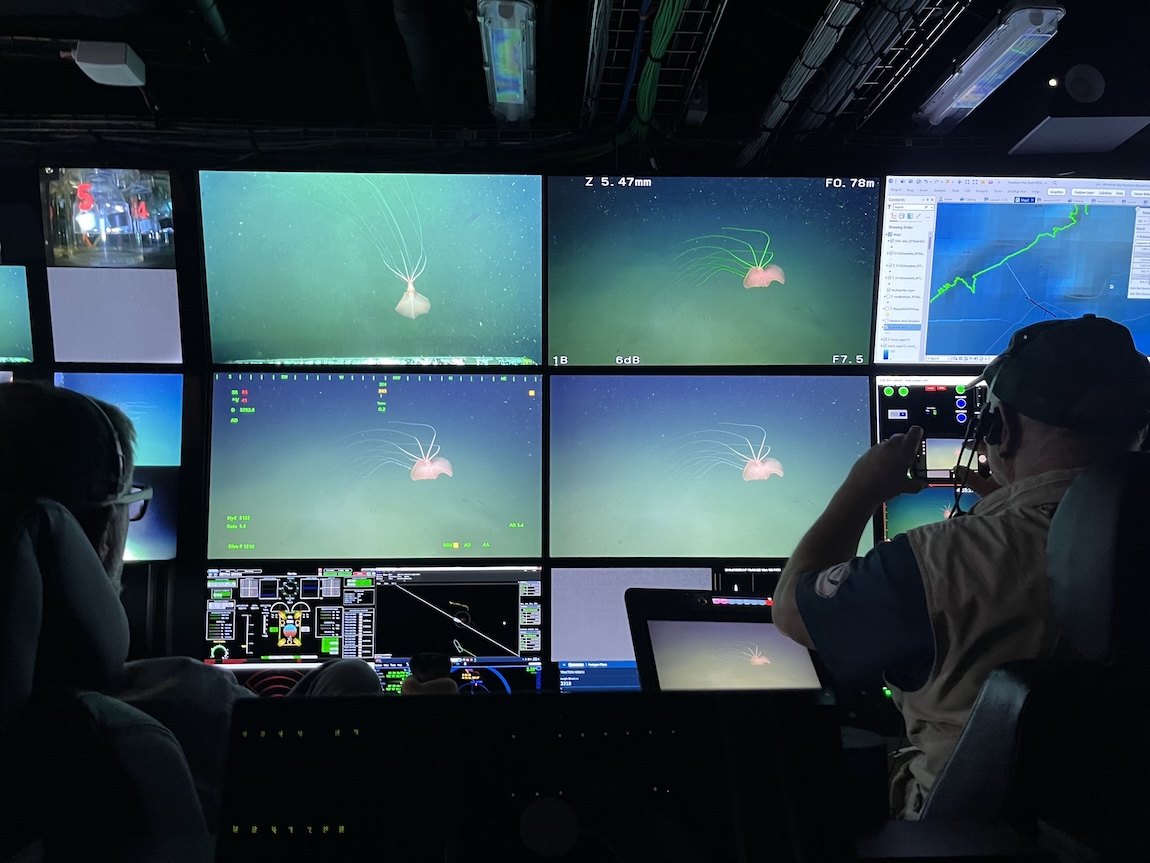
Magnapinna is the genus name of the bigfin squids, a small group of related species. Using the laser measuring system on Doc Ricketts, the team put this one at about 4.1 feet (1.25 meters) from the top of the body to the ends of the arms.
A scientist watching the seafloor
Andrew DeVogelaere, a research ecologist with NOAA’s Monterey Bay National Marine Sanctuary, was aboard as a collaborator. The team was there to find out whether mysterious furrows on the muddy seafloor were made by beaked whales feeding in the productive waters around the seamount, according to MBARI.
“I was focused on the seafloor and all of a sudden an elegant creature with undulating, angel-like ‘wings’ swam into view,” he recalled in the MBARI statement, calling it “the first confirmed bigfin squid sighting in Monterey Bay National Marine Sanctuary and a powerful reminder of what we still have to discover in the ocean’s depths. We live next door to a magical place.”
Arms that bend like elbows
In the footage, the squid hovers above the seafloor, undulating two large fins and trailing eight arms and two tentacles, according to MBARI.
The squid was a bonus. The 10-day expedition was there to study the communities of life on underwater mountains, and Davidson Seamount is home to “lush gardens of ancient deep-sea corals and a bustling deep-sea octopus nursery,” MBARI says.
Those octopuses live in the largest known octopus nursery, at the foot of the same old volcano. And deep-diving whales hunt squid, which is why sperm whales come up with scars.
Five more filmed off Australia
Bigfin squid have turned up on camera elsewhere, too. A team led by Deborah Osterhage of Australia’s national science agency, CSIRO, recorded five of them in the Great Australian Bight, at depths of 946 to 3,258 meters, and described the sightings in PLOS ONE in 2020.
Pereira had a similar run of luck this year on a Schmidt Ocean Institute expedition in the Atlantic. “After this recent sighting, I texted another MBARI scientist from the Doldrums expedition, ‘How many Magnapinna will I see this year?’ I never thought I’d see enough of them to actually make that joke!” she said.
Rare cephalopods keep turning up on camera, as when an Arctic bobtail squid was filmed alive for the first time.
What one squid can and cannot tell
One short encounter has limits. The animal was identified only as Magnapinna sp., its length is a laser estimate, and nothing was learned about what it eats or how it breeds.
The official account of the sighting was published by MBARI on September 2, 2026.
“Each sighting is such a privilege and highlights the incredible diversity of life that thrives in the unknown deep underwater and needs our protection,” Pereira said.
Image: © 2026 MBARI