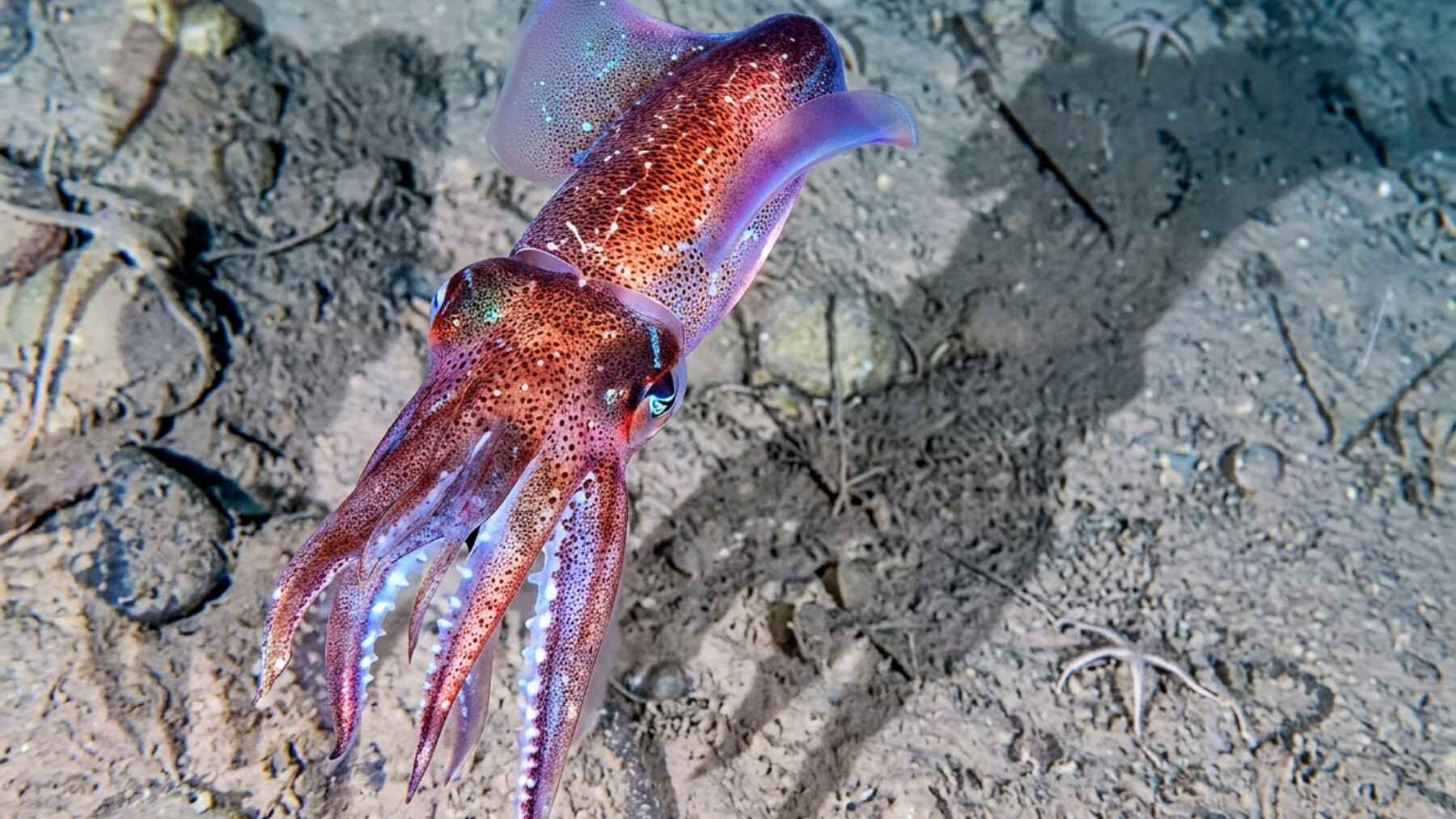
How much can one squid reveal about a marine region covering roughly 375,300 sq. miles? In Northeast Greenland National Park, a small animal has given scientists a rare answer. Researchers filmed a mature female Arctic bobtail squid in its natural North Atlantic habitat, with three clusters of eggs attached to the seafloor nearby.
The observation offers more than striking footage. It provides direct evidence that this little-known cephalopod is reproducing in a subzero Arctic fjord, while giving researchers a new reference point for measuring how a changing ocean affects life across the food web.
A four-inch squid in a vast blind spot
Northeast Greenland National Park is the largest national park on Earth, yet its waters remain among the least biologically documented in the Arctic. The new study notes that a search of a major ocean biodiversity database returned 14,497 marine records from within the park, but only seven were assigned to cephalopods, the group that includes squid and octopuses.
That gap matters. Without basic records showing which species live in a region, where they reproduce, and what conditions they tolerate, scientists have little chance of recognizing whether populations are stable or beginning to shift. The Arctic bobtail squid sighting is one small pin on a mostly blank map.
What the underwater robot recorded
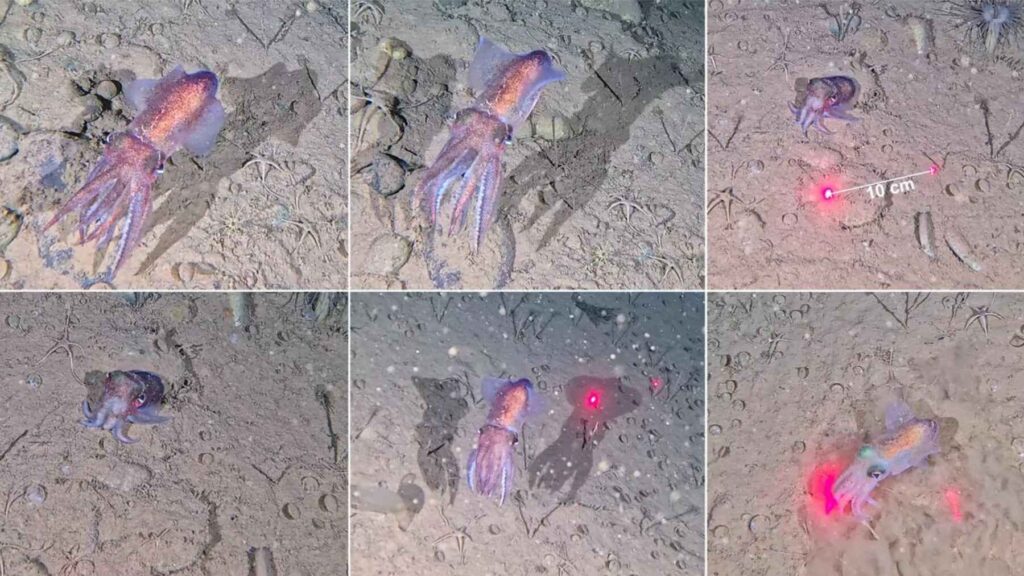
The discovery was made in September 2025 during an expedition in Kong Oscar Fjord. Researchers lowered a lightweight remotely operated vehicle fitted with a GoPro camera, floodlights, and paired laser markers that helped them estimate the animal’s size.
At a depth of 164 ft., the camera found a mature female Rossia moelleri resting and swimming close to the seafloor. She measured about 4 in. long, while three egg clusters were fixed directly to a hard surface nearby. Researchers estimated that the clusters held roughly 50, 33, and 22 eggs.
The water was about 44°F at the surface, but close to 29°F where the squid and eggs were recorded. Lead author Paige Maroni said the conditions highlighted the resilience of marine life in one of Earth’s most extreme environments.
Why the eggs changed the meaning of the sighting
Seeing an animal once confirms that it was present at that moment. Finding a mature female beside egg masses tells scientists something more important, namely that the fjord is being used for reproduction rather than simply crossed during movement or feeding.
The placement of the eggs also helped with identification. The capsules were relatively large and attached directly to a hard surface, a pattern consistent with Arctic bobtail squid. Related Arctic species often deposit smaller, smoother eggs inside sponges, so the reproductive details added another line of evidence.
Still, the researchers did not identify the squid from color or location alone. They compared its body shape, size, environmental setting, and egg characteristics with published descriptions of the three recognized Arctic Rossia species. Taken together, those clues most strongly supported Rossia moelleri, the largest and most cold-adapted of the group.
A small predator with a large ecological role
Bobtail squid may be small, but they sit in a busy part of the marine food web. They hunt other animals and are eaten by larger predators, helping move energy between life near the seafloor and animals swimming higher in the water.
What happens to them can therefore ripple outward. Cephalopods also tend to have short life spans and fast population turnover, which means changes in temperature, salinity, food supply, or breeding conditions can show up relatively quickly. In practical terms, they may act like early warning lights for wider ocean changes.
That does not mean one squid proves the local population is thriving or reveals how climate change has already affected it. The study instead establishes a baseline, a verified record against which later surveys can be compared. That distinction is important.
Why Arctic warming raises the stakes
East Greenland is undergoing rapid environmental change as sea ice retreats and glaciers lose mass. When glaciers that end in the ocean pull back onto land, they can reduce the upwelling that brings nutrient-rich water toward the surface, potentially changing plankton growth and the availability of prey for mid-level predators such as bobtail squid.
Warmer-water species may also move north, reshaping who eats whom in Arctic fjords. Could the Arctic bobtail squid remain in the same places, move farther north, or struggle if breeding conditions change? Scientists do not yet have enough observations to answer that question.
That is why the eggs are so valuable. They show active reproduction under the conditions recorded during the dive, creating a clear environmental snapshot from September 2025. Future footage can reveal whether the species returns, whether egg-laying sites persist, and whether the surrounding community looks different.
Small expeditions can fill major science gaps
Research in remote Arctic waters is expensive, and time aboard specialist vessels is limited. For this survey, scientists worked from a small expedition vessel with support from Secret Atlas and Yachts for Science, using a compact robot rather than a large research ship.
The approach cannot replace long-term monitoring, specimen collection, or full oceanographic surveys, yet it can reach fjords that larger ships may struggle to access and gather high-resolution footage with a relatively light footprint. Sometimes a small camera in the right place is enough to open a new line of research.
Maroni said that “even one verified observation can provide important insight into species distributions, reproduction, and resilience under climate change.”
The study was published in Polar Biology.