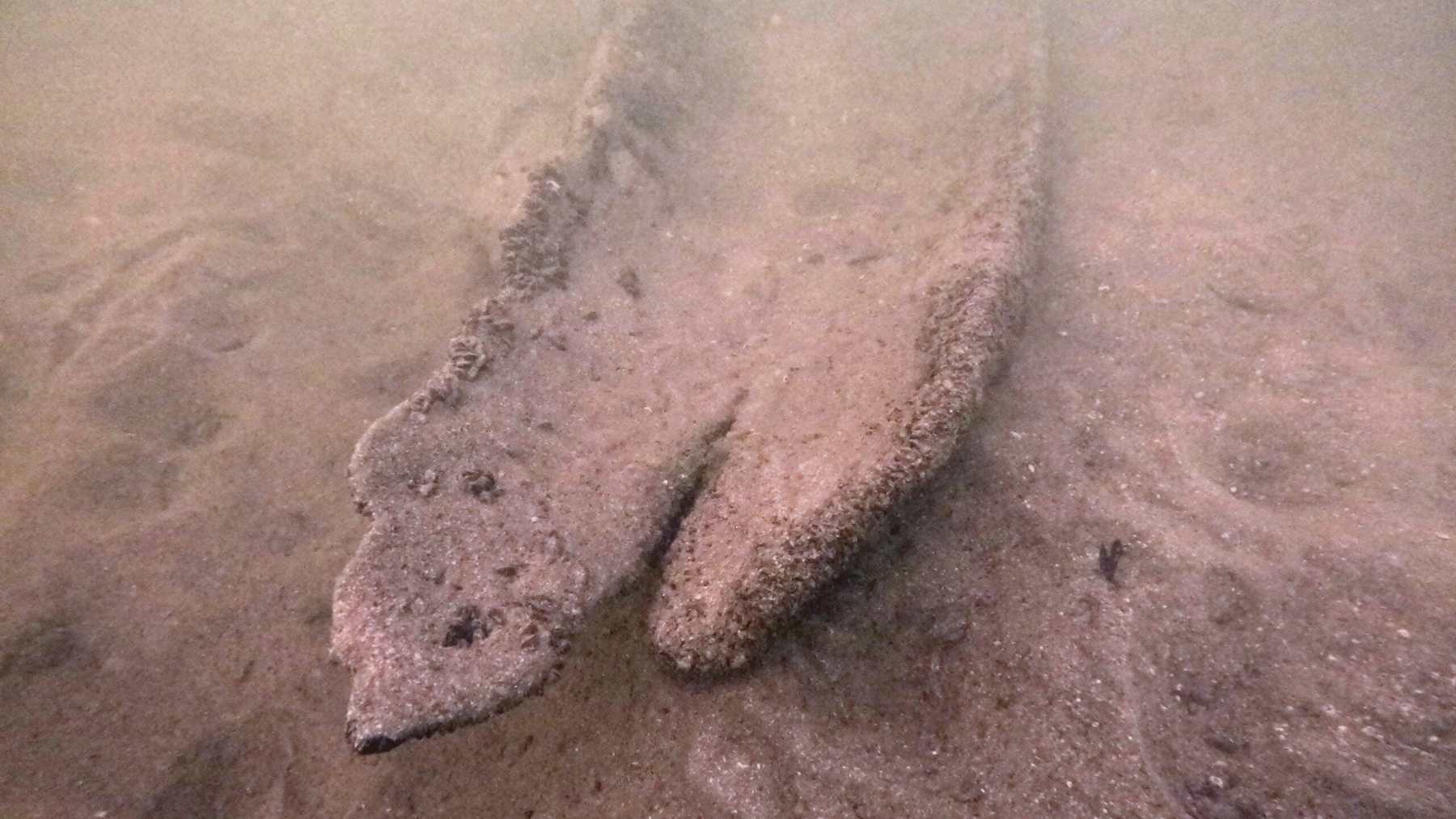
Volunteer diver Mark Schachtner was picking up trash in Wisconsin’s Pewaukee Lake on May 6, 2026, when he found a dugout canoe on the lakebed. Radiocarbon tests later showed the boat was most likely in use around 1,000 years ago, according to the Wisconsin Historical Society.
The white oak vessel sits under about 15 feet (4.6 meters) of water and is still fully intact. The society has no plans to raise it. Native Nations in Wisconsin want it left in place, and the wood would fall apart in open air without years of conservation.
A trash dive in Pewaukee Lake
Schachtner lives in Beaver Dam and volunteers with the Four Seasons Dive Club. He was taking part in a lake cleanup when he came across the long wooden shape, and he reported it right away to the State Historic Preservation Office.
According to the society’s fact sheet, he recognized the canoe because he had read about the ancient dugouts found and recovered in recent years from Lake Mendota in Madison.

Five days later, on May 11, maritime archaeologist Tamara Thomsen of the historical society dove the site with him. The pair collected measurements, images, video and wood samples.
Spring-fed Pewaukee Lake covers about 2,500 acres (roughly 1,000 hectares), some 20 miles (32 kilometers) west of Milwaukee, and it is the largest lake in Waukesha County. It was once important to the ice harvesting trade.
Radiocarbon points to A.D. 1000
The lab results came back in August. Michael Wiemann of the USDA Forest Products Laboratory identified the wood as white oak. Beta Analytic ran the radiocarbon dating, the same method that put a Scottish loch islet at 5,000 years old, paid for by a grant to the Wisconsin Canoe Project.
The lab reported an age of 1010 ± 30 radiocarbon years before present. Converted to calendar years, there is a 70 percent chance the wood dates to the years 992 to 1049. Smaller chances point to 1081 to 1135 (21 percent) and 1136 to 1152 (4 percent).
In simpler terms, the society says the canoe was likely in use around the late 10th to early 11th century. That is the end of Wisconsin’s Late Woodland period. Maize was a staple crop then, and effigy mound building took place across the region.
Around A.D. 950 to 1050, Cahokian people expanded into Wisconsin, according to the fact sheet. They set up fortified settlements such as Aztalan, now a state park.
Fire marks on oak walls
The canoe measures 17.3 feet (5.3 meters) long and 1.8 feet (55 centimeters) across at its widest point. Its walls are about 0.2 feet (6 centimeters) thick. The bottom is twice that, roughly 0.4 feet (12 centimeters).
The society says the hull shows evidence that fire was used to hollow and shape it. Most of the boat is embedded in the lake bottom, with only about 6 inches (15 centimeters) rising above the sediment.
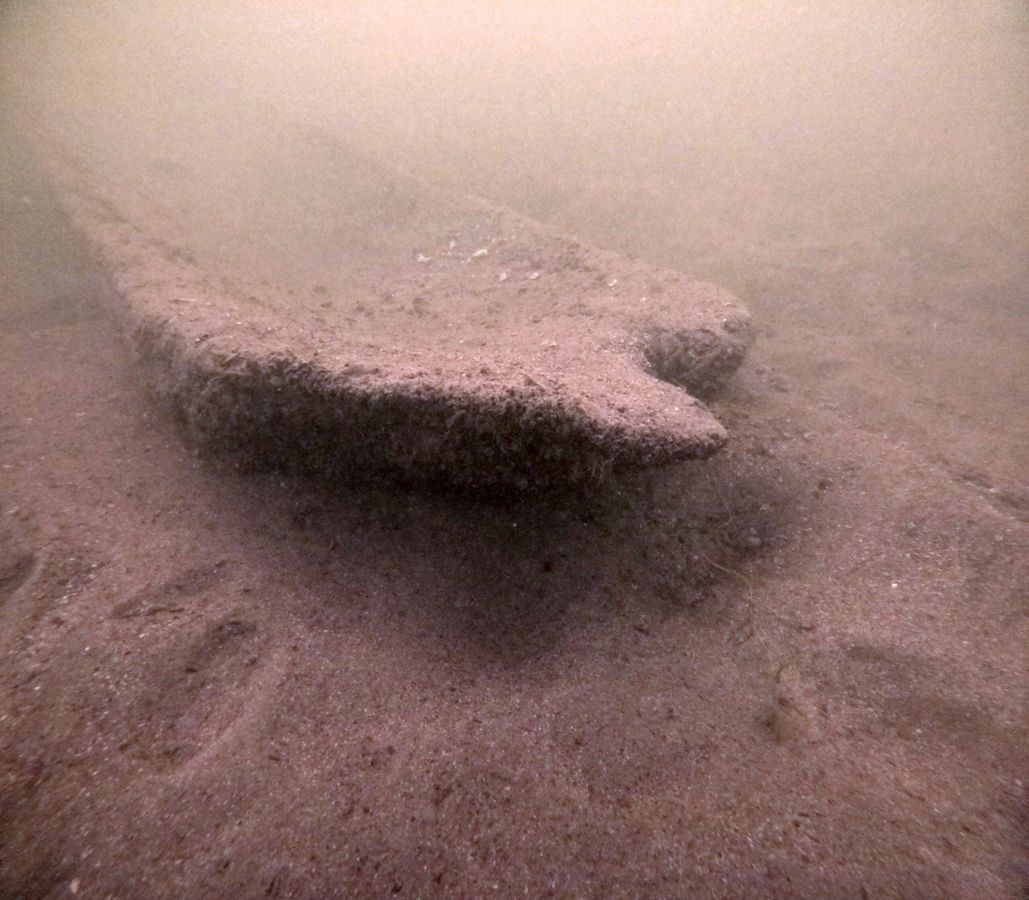
It is not alone in its choice of wood. Four dugout canoes recently identified in Lake Mendota from around the same era are also made of white oak, the fact sheet notes.
Why the canoe stays underwater
Native Nations in Wisconsin want the canoe left where it is. The society also warns that “if the canoe is exposed to air, it will disintegrate” without long and intensive conservation.
Two canoes pulled from Lake Mendota in 2021 and 2022 show what that involves. They have spent years soaking in polyethylene glycol, a waxy compound that stabilizes wet wood, before a freeze-drying stage. One is slated for display in the future Wisconsin History Center, due to open in early 2028.
Old wood that has sat in water can keep its shape and still be fragile, like other waterlogged finds from submerged settlements. In the society’s words, the canoe “is best preserved by the waters of Lake Pewaukee, which have kept it intact for a thousand years.”
The exact position is being kept private. The site has a number in Wisconsin’s archaeological database, and local DNR conservation wardens know where it is. Under state statute 44.47, removing, defacing, displacing or destroying artifacts there is a crime.
Wisconsin’s dugout count keeps climbing
The society is consulting on the find with Bill Quackenbush, the Ho-Chunk Nation’s retired tribal historic preservation officer. It is also working with Larry Plucinski, who holds that post for the Bad River Band of Lake Superior Chippewa.
On the society’s website, Plucinski says the Mendota canoes “reflect a deep relationship with the environment and the ingenuity of our ancestors.” Work with Indigenous communities also shaped underwater research elsewhere, as when Aboriginal ranger divers found stone tools in a drowned spring.
When the Wisconsin Dugout Canoe Survey began in 2018, only 11 dugouts were documented in the state. By February 2024 there were 95 reports, and the team had confirmed 73 of them.
The society now counts 16 canoes in Lake Mendota alone. The oldest was likely made around 3000 B.C.
Its builders left no names
Carbon dating tells archaeologists roughly when the white oak grew. It cannot say who carved the canoe, who paddled it or why it ended up 15 feet down. About a quarter of the probability points to the late 11th or the 12th century, so the 1,000-year figure is a rounded one.
Because the canoe stays put, it will not get the lab treatment given to the Mendota canoes, one of which came up with net sinkers on board. For now, the Wisconsin Historical Society fact sheet released in September 2026 is the main public record of the Pewaukee find.
Schachtner’s choice to note the spot and report it follows the same path as a metal detectorist near Cologne who called archaeologists.
Photo: Wisconsin Historical Society