Our search for renewable sources is already moving beyond efficiency alone to a combination of efficiency + low cost + beautiful design. This is because at a time when solar panels dominate rooftops around the world, a new proposal is gaining traction: vertical wind turbines for residential use. They are very different from the giants installed in open fields… these turbines were designed to fit into urban gardens or backyards, combining energy performance, low noise and an eye-catching design.
No more horizontal axis turbines
Let’s face it, most wind turbines we know rotate around a horizontal axis, we’re talking about those with large blades pointing towards the wind, seen in open and rural areas. However, when we think about urban or residential environments, this model doesn’t work so well. Why? Well, the wind in urban areas is turbulent, changes direction frequently and is affected by obstacles such as buildings, walls and trees.
It was with this in mind that experts began to create vertical-axis turbines (VAWT). They have a more versatile operation, capturing winds from any direction without needing to be reoriented. This is what makes them perfect for urban spaces, where the wind is neither predictable nor constant. Not to mention, these turbines are quieter and do not require as much maintenance, since their components rotate around a fixed and simpler axis. Therefore, in some scenarios, especially where the sun is irregular or roofs are not ideal for panels, vertical turbines can generate more annual energy than the traditional photovoltaic system, as is the case with this Italian innovation.
Another Italian wind turbine
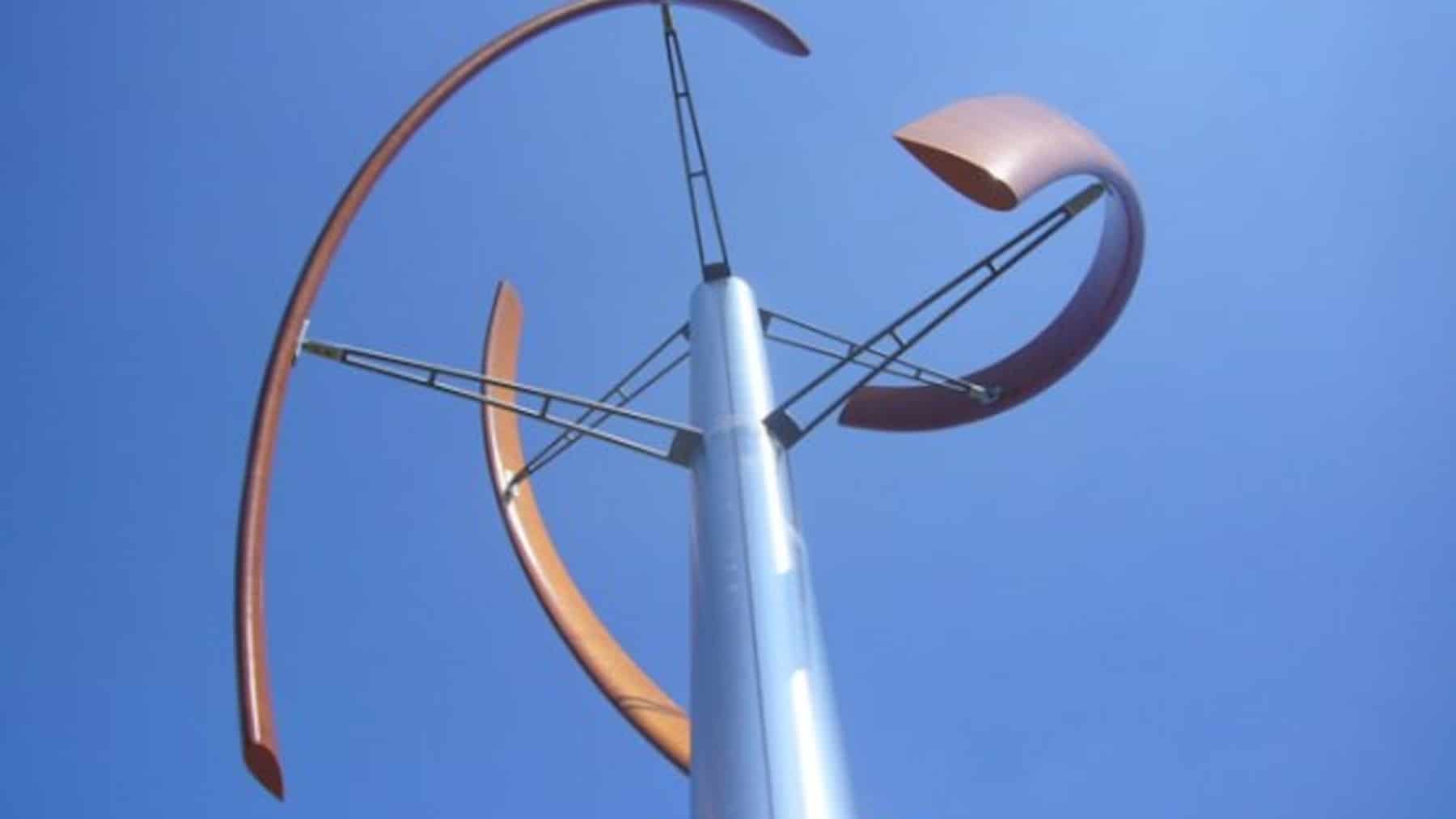
Well, this home wind turbine is Italian. To go into more detail, it was created in the heart of Italy (once again, Italy shows us that we are wasting our space with roof panels). We are talking about the Hercules Wind Generator, created by the company ENESSERE. It has a capacity of up to 5 kW and can produce an average of 5,550 kWh per year. That is enough to cover a good part of the energy consumption of a modern home. But the surprises don’t stop there…
What is most impressive is that the Hercules is made of cedar wood, carbon fiber, titanium and stainless steel. Its blades, designed based on aerodynamic studies, weigh just over 7 kg and are 3 meters long. In other words, it is light, durable and aesthetically impressive. In fact, as it is a vertical turbine, it operates silently, without the need to adjust to the wind.
And the most curious thing about all this is: it was also designed as a work of art. Exactly, ENESSERE considers that design is as important as performance, and for this reason, it invested in shapes inspired by the golden ratio, which is nothing more than a classic aesthetic reference that refers to the harmony found in nature.
Wind turbines can now be used as a decorative piece
To better understand this turbine, we must always remember that, unlike other energy solutions that need to be hidden on the roof or in the back of the property, it was designed to be displayed. The idea behind ENESSERE is that it truly be a symbol of the new era of clean energy. In other words, something that combines technological innovation, natural materials and aesthetic beauty.
Going into more detail, it is about 7 meters tall, and may even cause some controversy in residential areas… after all, it’s not every day that you see a wooden sculpture spinning in your neighbor’s yard. But its elegant visual proposal, with Paulownia or cedar wood finish, makes it a sustainable design piece. Perhaps it just doesn’t attract as much attention as this golden wind turbine.