Snow-covered Mount Etna erupted on December 27, sending thick columns of ash and smoke high above eastern Sicily while skiers continued carving turns on the slopes below. Italy’s National Institute of Geophysics and Volcanology reported that activity at the summit craters had intensified, with continuous ash emissions and a new vent feeding lava toward the barren Valle del Bove.
In response, scientists issued a red alert for aviation, the highest warning level used for volcanic ash, even as flights at nearby Catania airport continued operating under close monitoring. For anyone planning a winter getaway or watching the departure boards, it raises a simple question: how can a major volcano erupt while planes still land and people keep skiing?
A winter eruption on Europe’s most active volcano
Mount Etna towers above the east coast of Sicily and is one of the most active volcanoes in the world, as well as the most active in Europe. In the days before December 27, monitoring networks picked up elevated tremors and glowing bursts from the Northeast Crater and from the Bocca Nuova and Voragine craters near the summit. Volcanologist Boris Behncke of the National Institute of Geophysics and Volcanology described the episode as the dramatic return of the long-quiet Northeast Crater after almost three decades of relative calm.
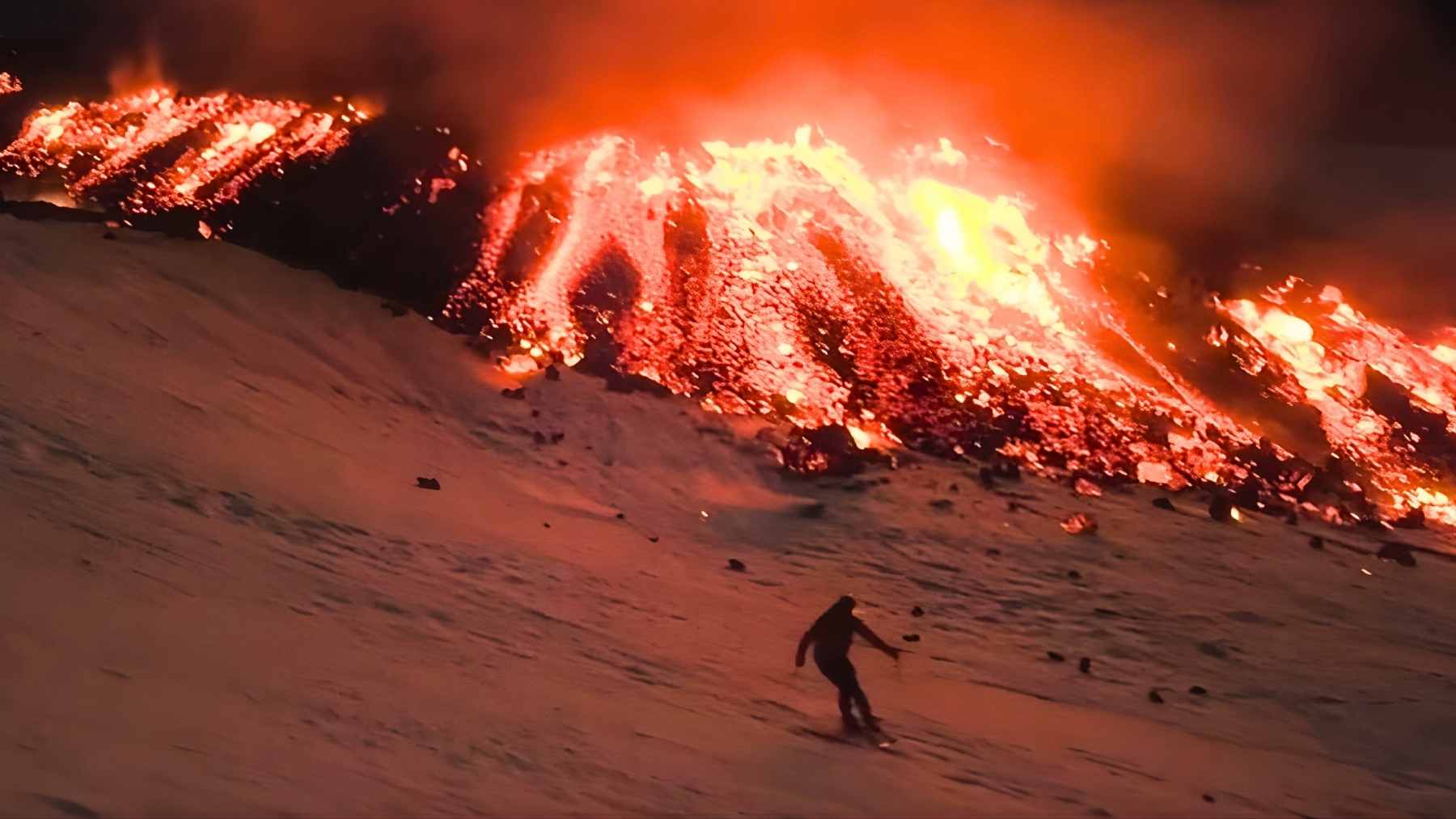
By the morning of December 27, lava fountains were shooting roughly 100 to 200 meters above the rim, building dense ash columns several kilometers high. Later that afternoon, a second intense burst sent fountains up to about 400 to 500 meters and a towering column that climbed more than ten kilometers above sea level, reaching the same cruising altitudes used by many airliners. At the same time, a vent on the eastern flank of the Voragine crater fed a lava flow that advanced for almost two kilometers toward the uninhabited Valle del Bove, spreading across the snow.
Scientists describe this behavior as Strombolian activity, a style of eruption where hot blobs of lava and gas rise and burst like a natural fireworks show instead of a single giant explosion. From the ski runs, that meant glowing bursts in the night and a steady haze of ash drifting away on the wind.
What the red aviation alert means in practice
When Etna began sending ash into the same layers of air used by commercial jets, the Toulouse Volcanic Ash Advisory Center and Italian experts raised the aviation color code for the volcano to red. In this system, red signals that an eruption is underway with significant ash in the atmosphere and tells pilots and controllers to keep aircraft out of contaminated airspace.
A red alert, however, does not automatically shut an airport. Discover Magazine, citing Italy’s ANSA news agency, noted that Catania’s international airport stayed open during this phase, while controllers watched ash forecasts closely and prepared to reroute traffic if clouds drifted over the runway. Italy’s Civil Protection Department also raised the ground alert level for Etna from green to yellow on December 27, a step that calls for higher vigilance in nearby towns without ordering evacuations.
Travel data from recent years show that earlier Etna eruptions in 2024 and early 2025 led mainly to short closures or temporary limits on traffic at Catania, with most passengers facing delays and reroutes rather than prolonged cancellations. For the most part, December’s red alert looks similar, adding waiting time and schedule changes to the holiday rush rather than shutting Sicily off from the rest of Europe.
Why Etna keeps coming back to life
Etna sits near the boundary where the African tectonic plate slowly pushes under the Eurasian plate, a collision zone that melts rock deep underground and feeds one of Earth’s most persistent magma systems. Over hundreds of thousands of years, repeated eruptions have built the broad cone that dominates eastern Sicily, and vents around the summit keep opening and closing as pressure shifts inside the volcano.
In 2025 alone, the mountain went through several distinct eruptive phases before the December events, including activity in February, in spring, and in late summer that produced lava flows on different flanks. Researchers at the National Institute of Geophysics and Volcanology document these patterns in detailed monitoring bulletins and public outreach articles and use them to refine models of how magma moves inside Etna.
Related research on Etna’s winter eruptions has examined how lava and ice interact, showing how hot flows carve channels into snow and cool into new layers of rock that can subtly reshape ski terrain over time. Earlier in February 2025, satellite images from the European Union’s Sentinel program captured a lava flow cutting across snow covered slopes, offering a preview of the fire and ice scenes now repeated in late December.
Skiing under an active volcano
The images that traveled around the world show skiers gliding downhill while dark ash plumes climb into the sky behind them, a scene shared in videos from local guide company EtnaWalk and international news agencies. On a normal winter day, these slopes are simply part of two small ski areas where families ride lifts, check their passes, and break for hot drinks between runs.
Volcanology experts point out that the prepared pistes lie well away from the summit craters and that authorities can quickly close higher trails or evacuate lifts if conditions change. Italian civil protection plans include detailed hazard maps, air quality checks, and rules for how close guides may approach active vents, so tourists watch the show from distances officials judge to be acceptable.
At the end of the day, living and skiing on Etna means accepting a certain level of background risk, much like booking a flight that might be nudged later by ash advisories. For most visitors, the reward is the chance to carve turns on snow while one of Earth’s most famous volcanoes reminds everyone that the ground beneath their skis is very much alive.
The official report was published on INGV Vulcani.