A Florida biologist fills ant nests with molten metal and plaster, and the casts show mature harvester ant colonies commonly reaching about 8 to 10 feet deep
Casts of Florida harvester ant nests show half the chamber area sits in the top quarter, and the ants rebuild nests that break their plan.

· 4 min read
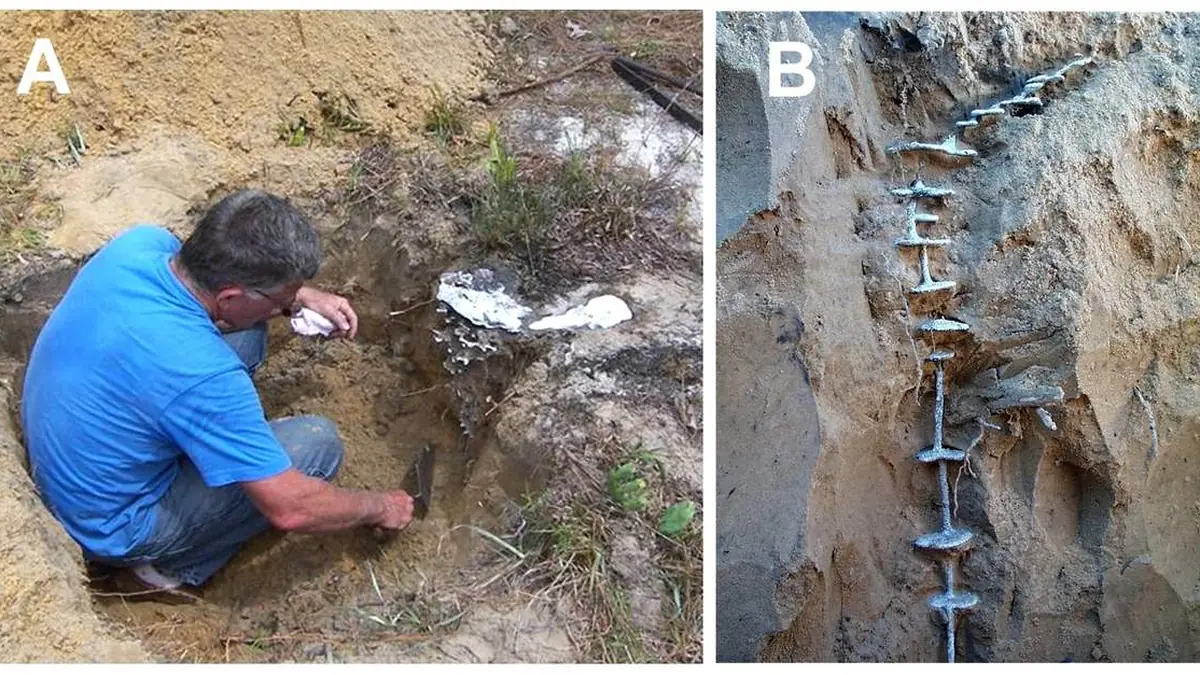
Most of an ant nest lies underground, out of sight. Florida State University emeritus professor Walter Tschinkel solves that by pouring dental plaster, molten aluminum, zinc, or wax into a nest, then digging up the hardened copy. Each material has trade-offs. Plaster is cheap but breaks, while metals come out strong but the ants cannot be recovered. His casts of Florida harvester ant nests show that new colonies reach about 40 to 50 centimeters deep. Mature colonies commonly reach 2.5 to 3 meters, or about 8 to 10 feet. Chambers are about one centimeter high, and about half of their area lies in the top quarter of the nest. In a later experiment, he buried ice shaped like chambers in a reversed order. The ants reworked most of them toward a natural layout, so Tschinkel concluded the ants "do have an opinion" about their nest design.
Key points
- Zinc can penetrate some distance into shafts as narrow as 1 mm.
- A dissolved plaster cast releases the trapped ants for counting.
- One colleague used $30 worth of pennies to cast nests.
- The ants rejected chambers shaped like equilateral triangles.
Most of what ant nests contain lies where no one can see it. Below the mound lies a network of shafts and chambers built in the dark. For a long time, most studies relied on sketches and measurements made while the nests were dug up.
Walter Tschinkel, an emeritus professor of biological science at Florida State University, found a better way to see them. He pours a liquid that hardens into the nest. Then he digs out the solid copy of the empty space the ants created.
Casting materials include dental plaster, molten metal, cement and wax, he wrote in a 2017 article in the journal Ecology. Once the hollow space is filled, "the cast reveals the smallest details of the space the ants created underground."
Four ways to copy a nest
Tschinkel described his methods in a 2010 paper in the Journal of Insect Science. He used four materials to make what he called perfect casts of underground ant nests, each with advantages and limitations.
Dental plaster is cheap, easy to use and needs little equipment. However, it does not fill very narrow shafts well. The cast always breaks when it is dug out, so the pieces have to be glued back together in the lab.
Plaster has a hidden benefit, though: after study, a cast can be broken apart and dissolved in running water over 4 to 6 weeks. That releases the ants trapped inside, so they can be counted.
Aluminum is light and strong and usually comes out in one piece. Zinc has a lower melting point and can penetrate some distance into shafts as narrow as 1 mm or even less. On the downside, zinc is heavy and brittle, and with either metal the ants cannot be recovered.
Paraffin wax, the fourth option, needs only a camp stove and a coffee pot, and the trapped ants can be recovered quickly by melting the cast. But wax is weak, so the cast may bend, and the liquid can seep into the soil.
A homemade furnace in the field
Melting metal in the woods takes some engineering. Tschinkel's first field kiln was a 20-gallon galvanized garbage can lined with a sand and fire clay mixture. It weighed more than 150 kg.
A fan taken from a car heater at an auto salvage yard, powered by a marine battery, supplied the draft. In a later version, a light refractory blanket replaced the sand and clay, so one person could move the kiln. A large charcoal kiln built from an 80-liter garbage can could melt up to 6 to 7 liters of aluminum or zinc.
Aluminum melts at dull red heat but is best heated to bright red before pouring, because hotter metal reaches deeper. A colleague named Rabeling reported using pennies, which are mostly a zinc alloy. Thirty dollars' worth was more than enough for the Trachymyrmex nests he was casting.
What the casts revealed
The casts helped Tschinkel describe the nest of the Florida harvester ant, Pogonomyrmex badius, in a 2004 study. Newly founded colonies were usually 40 to 50 cm deep, while mature colonies were commonly 2.5 to 3.0 meters deep, about 8 to 10 feet.
The nests are built from two basic units: descending shafts and horizontal chambers. The shafts form helices 4 to 6 cm wide, and the chambers are about 1 cm high whatever their area.
Chamber area is greatest near the top and shrinks with depth. About half of it lies in the top quarter of the nest. Each 10% of depth holds 25 to 40% less area than the layer above, no matter the size of the nest.
The age of the diggers matters too, the study found. Workers caught near the top of a mature nest, and therefore older, dug larger nests in escape-proof enclosures than young workers taken from the bottom. Most of the difference came from more of the older ants joining the digging.
Do the ants follow a plan?
That regular shape raised a question for his 2017 article. How do ants build such nests in the dark, without a leader and without an apparent plan? To find out, he froze water in copper molds shaped like nest chambers and buried the ice.
As the ice melted, it left a made-to-order nest. In a single replicate of the experiment, he compared the normal chamber order with a reversed one that put the largest, most complex chamber at the bottom.
The ants modified all but one chamber of the reversed nest, making it more like a natural one. In the normal-order nest, they did not change any chamber a great deal apart from enlarging the deepest one. Tschinkel concluded that "the ants do have an 'opinion' of what their nest architecture should be."
The ants are picky about shape as well. They did not accept chambers shaped like equilateral triangles, even when the total nest area was close to that of a natural nest, the article notes.
He has also written a book on the subject, Ant Architecture: The Wonder, Beauty and Science of Underground Nests, published by Princeton University Press, according to his faculty page at Florida State.
Image: Walter R. Tschinkel / Journal of Insect Science, CC BY 3.0
Javier Niño
Writer at ECOnewsJavier Niño has been a Spanish National Police officer since 2017 and a journalist specialising in employment, labour law and Social Security, with more than seven years of writing experience. At ECOnews he covers environment, energy and sustainability news, focusing on how new regulations and court rulings affect people in their everyday lives.
More from Javier NiñoComments · 0
Rules ›No comments yet. Be the first to share your view.