Forstmann Castle, the Catskills lodge built in 1915-1916 for a wool magnate and tied to a game preserve that eventually covered 7,000 acres, is now on the National Register of Historic Places
The 1915-1916 Catskills lodge of wool magnate Julius Forstmann, later Frost Valley YMCA, was listed on November 19, 2026.

· 4 min read
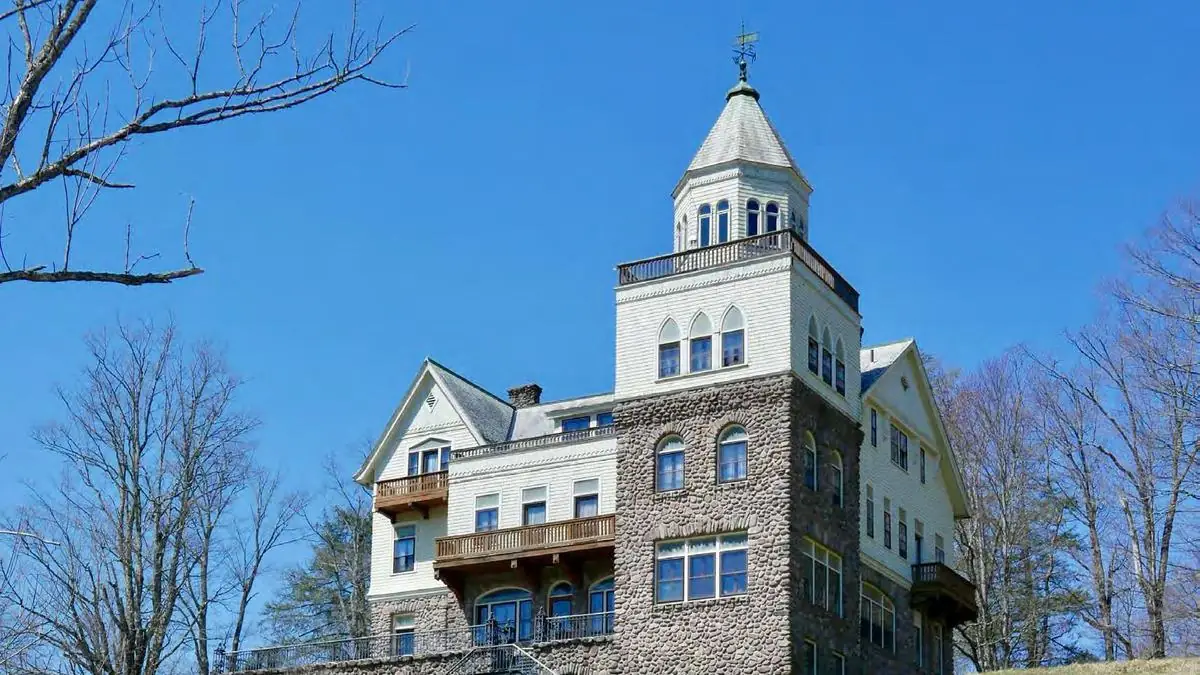
Forstmann Castle, a stone-and-shingle mountain lodge in New York's Catskill Mountains, has been listed in the National Register of Historic Places. The listing took effect on November nineteenth. Wool magnate Julius Forstmann of Passaic, New Jersey, had the lodge built in 1915 and 1916 as a family summer home. It stands in Denning, near the West Branch of the Neversink River. Its best-known feature is a corner tower topped by an octagonal observatory, which the nomination says was likely inspired by a basilica in Germany. Forstmann's game preserve eventually covered seven thousand acres, and it included a fenced deer park. The family used the lodge until 1956, and the YMCA bought the property in 1957. Today it is part of Frost Valley YMCA, a summer camp, and the nomination says the lodge has seen no major changes apart from an elevator and a few stairways.
Key points
- The 1915-1916 lodge has a reinforced concrete frame hidden under stone and shingles, likely to reduce fire risk, its nomination says.
- In 1918 Forstmann hired a Tompkins County game protector to run a preserve that eventually covered 7,000 acres.
- In April 1957 the YMCA bought the 2,200-acre property for $130,000 and made it a permanent home for Camp Wawayanda.
Forstmann Castle, a stone-and-shingle mountain lodge in New York's Catskill Mountains, was listed in the National Register of Historic Places on November 19, 2026. The listing appears in the National Park Service's weekly list dated November 20.
The lodge stands in Denning, Ulster County, on a grassy knoll near the West Branch of the Neversink River. Julius Forstmann, a wool magnate from Passaic, New Jersey, had it built in 1915-1916 as a summer home for his family. Today it is part of Frost Valley YMCA, a summer camp surrounded by state-owned forestland.
The history below comes from the nomination form that New York's State Review Board took up on September 9, 2026. It was prepared by historic preservation consultant Marissa Marvelli.
A lodge with a castle tower
The nomination describes a three- and four-story, multi-volume lodge clad in cobblestones and shingles. It calls the building an intact example of an eccentric mountain lodge, locally significant for its architecture.
Its most notable feature is a corner tower topped by an octagonal observatory. According to the form, the tower is undoubtedly inspired by the stone Basilica of Saint Ludger in Essen-Werden, Germany. The basilica is part of an abbey complex that, the form says, was at least partly owned by four generations of the Forstmann family, who made wool there.
Beneath the wood, stone and plaster, the superstructure is reinforced concrete. The nomination says this more expensive approach was likely taken to reduce fire risk, a common threat to remote seasonal retreats.
Inside, the form highlights rustic river stone fireplaces, maple-paneled walls and seventeen bedrooms. A large Steinway piano owned by the Forstmanns still sits in the music room.
Hemlocks, tanneries and trout
The valley had already been through hard use, the nomination recounts. Settlers arrived in the mid-nineteenth century to harvest hardwood for lumber.
Tanners followed and cut down vast amounts of hemlock for its bark, which was used to tan leather. The town's population peaked at 1,100 before the Civil War and then fell significantly, largely because of hemlock deforestation and the shift to steam power, according to the form.
By the late nineteenth century, wealthy buyers were acquiring forests and small farms in the southwest Catskills. Early buyers were drawn by the trout-filled streams and fly-fishing, the nomination says. They formed sportsmen's clubs and kept private game and fishing reserves.
In 1889, Martin R. Cook of Bayonne, New Jersey, began buying land along the West Branch of the Neversink. His property became the nucleus of the future Forstmann estate.
A preserve that reached 7,000 acres
Forstmann bought the Cook property and more land after a fishing trip to the area in 1914. Later accounts say he brought German masons and carpenters to build the lodge, according to the form.
The estate included a working farm with barns, livestock, pastures and crop fields, staffed year-round. Forstmann hired locals to guard his land against people who wanted to hunt, fish or cut timber on it.
In 1918, he hired the game protector for Tompkins County to run his preserve, which eventually covered 7,000 acres. He also developed a fenced deer park holding twenty-seven imported deer for hunting. At the time, the native deer population of the Catskill region had been severely depleted, the nomination notes.
A photo in the form, credited to the New York State Archives, shows Forstmann with his sons and members of the New York State Conservation Commission around 1920.
From private estate to camp
Forstmann died in Manhattan on October 27, 1939. His widow, Adolfine, kept visiting the lodge, and an elevator was installed for her in 1951. She died in 1953.
The family used the lodge as a seasonal residence until 1956. In April 1957, the YMCA bought a 2,200-acre property with the lodge, twelve farm buildings and livestock for $130,000, the form says. It became the permanent home of Camp Wawayanda, a boys' camp that had been in northern New Jersey.
The lodge was renamed "the Castle" and used for private events and lodging to raise money for the camp. The first campers arrived in 1958, and girls were welcomed beginning in the early 1960s.
What the listing covers
Apart from the 1951 elevator, a 1990s emergency fire stair and an entry stairway on the north side, the nomination says, no major changes have been made. Several first-floor service rooms were converted into camp housing.
The nomination counts the lodge as a contributing building, along with an ice house, a root cellar, a bridge, pond steps, retaining walls, a garden font and a gazebo from around 1940. Newer camp buildings, including a 1992 chapel and a 2013 lodge, are not considered contributing.
The National Register is the federal government's official list of buildings, sites and districts considered worthy of preservation. It is maintained by the National Park Service.
Marissa Marvelli / National Register nomination (NY State Parks, Division for Historic Preservation)
Glossary for this story
- Deforestation
- Clearing forests, usually for farming, ranching, logging or building, which releases carbon and destroys habitats.
ECOnews Newsroom
Writer at ECOnewsA team of journalists specializing in socio-environmental news, sustainability, climate change, the environment, responsible consumption, and innovation. At EcoNews, we provide clear, reliable, and relevant coverage of the environmental and social challenges shaping our era.
More from ECOnews NewsroomComments · 0
Rules ›No comments yet. Be the first to share your view.