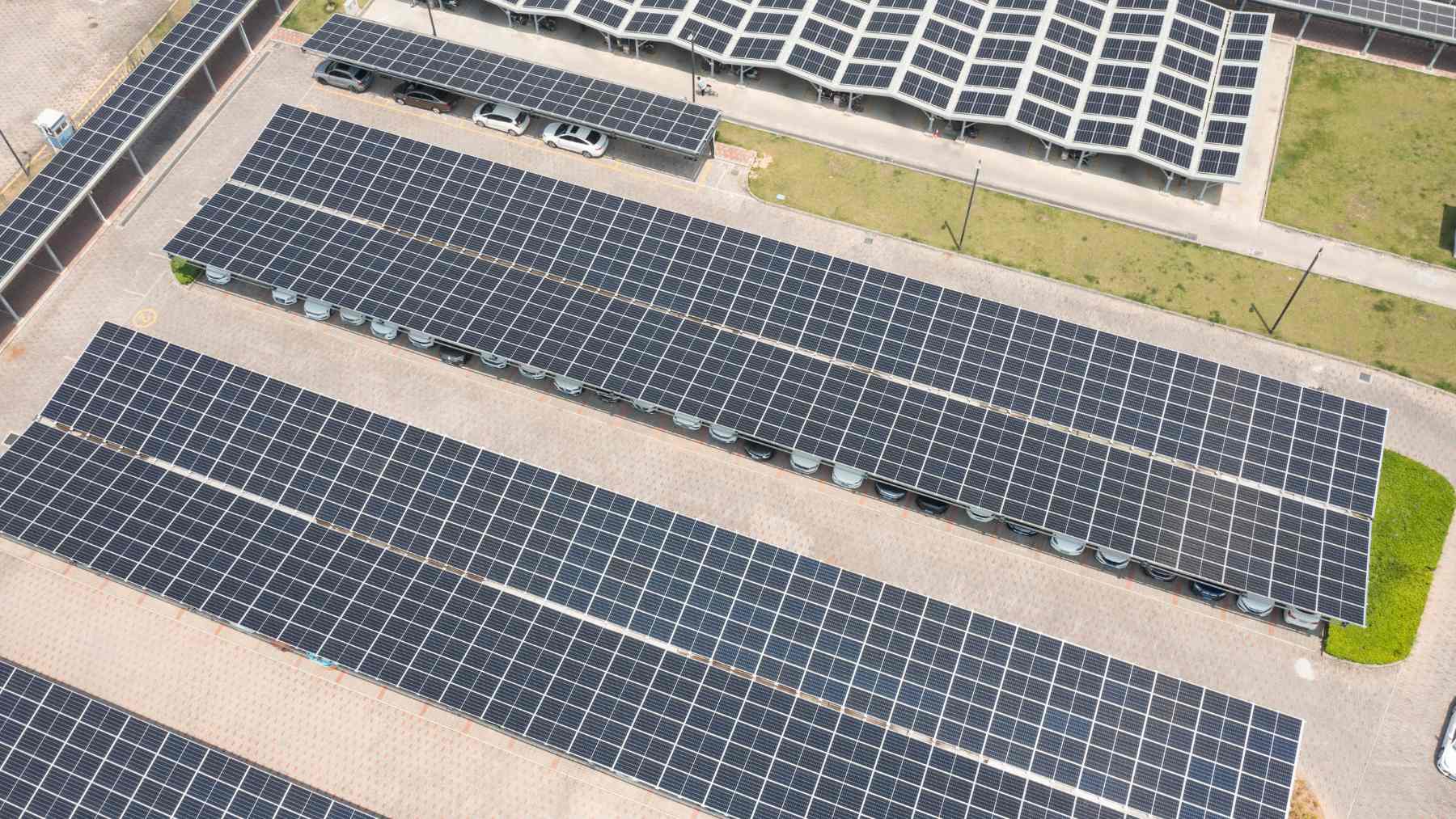
Anyone with rooftop solar knows the awkward truth. Panels work hardest in the middle of the day while many homes and offices use the most electricity after sunset, when lights, TVs, and air conditioners all kick in. That gap is usually filled by separate battery packs, which add cost and complexity to a system and, in many cases, to your electric bill too.
Now researchers at Nanjing Tech University in China have built a lab-scale device that tackles both jobs at once. Their prototype solar redox flow battery collects sunlight and stores the resulting energy in liquid chemicals, then releases it later as electricity. In tests, it reached an average solar-to-electricity efficiency of about 4.2 percent and ran through more than fifteen charge and discharge cycles while being charged only by light.
How this hybrid solar battery works
The team describes its invention as a solar redox flow battery, often shortened to SRFB. In simple terms, it is a small solar cell directly wired into a special kind of battery that stores energy in flowing liquids instead of solid electrodes. That means the same device can both turn light into energy and park that energy in chemical form for later use.
In a standard flow battery, two different liquids sit in separate tanks and are pumped through a central cell where they trade electrons. Those liquids contain redox couples, chemical pairs that can gain or lose electrons reversibly, which lets the system charge and discharge many times. The Nanjing Tech group chose an organic molecule called 2,6-DBEAQ on one side and a compound known as K4[Fe(CN)6] on the other, both dissolved in water.
The twist in this design is the light absorber. Instead of using a normal solar panel that feeds a separate battery through external wiring, the researchers attached a triple junction amorphous silicon photoelectrode directly to the flow cell. When light hits this multilayer silicon structure, it generates enough voltage to drive electrons into the redox liquids, so the battery charges itself as soon as the sun shines.
What the Nanjing Tech team tested
The work, led by Chengyu He with first author Kaige Ding and colleagues at Nanjing Tech University, focused on a small experimental device. They cut commercial triple junction amorphous silicon cells into tiny pieces about two centimeters on a side and coupled one of these chips to a flow cell with a carbon felt electrode and a Nafion membrane separating the two liquids. Before testing, the team bubbled argon gas through the electrolytes to remove dissolved oxygen that could interfere with the reactions.
For charging tests, the device sat under a xenon lamp adjusted to mimic standard midday sunshine, about 100 milliwatts of light on each square centimeter of the cell surface. During this step it was charged only by light, with no extra power source pushing current into the system. In everyday language, the solar cell side acted like a tiny built-in charger for the battery.
When the researchers switched to discharge mode, they pulled current from the device at 10 milliamps per square centimeter and repeated the charge and discharge cycle more than fifteen times. Across these experiments, the system delivered an average solar-to-electricity efficiency of roughly 4.2 percent, which the authors report as one of the best results so far for solar redox flow batteries that rely on anthraquinone-based liquids.
How impressive is a 4.2 percent efficiency?
For most rooftop systems, a single number gets a lot of attention. Modern commercial silicon panels usually convert around 15 to 22 percent of incoming sunlight into electricity, with an average a bit above 20 percent. On that scale, 4.2 percent may sound underwhelming at first glance.
The comparison is not entirely fair, though. A regular panel needs a separate battery and power electronics to store energy for evening use, while this SRFB prototype handles conversion and storage in the same package. Earlier devices of this type using similar organic molecules managed efficiencies of around 1.7, 3.2, or 4.9 percent, and some alkaline systems reached only about 0.44 to 3.0 percent while suffering from corrosion or unstable chemicals.
A key choice here is the operating environment. Many earlier experiments pushed the chemistry in very strong acid or very strong base, which can eat away at photoelectrodes and break down ferrocyanide-based electrolytes. The Nanjing Tech device instead runs at pH 12, a milder alkaline condition that aims to keep both the silicon and the K4[Fe(CN)6] solution stable during repeated cycling.
Why the liquid chemistry matters for the future
The main organic molecule in the new battery, 2,6-DBEAQ, has its own backstory. It was originally designed by a team led by Michael Aziz to create long-lived aqueous flow batteries at pH 12, and that earlier work showed it could stay stable over many thousands of cycles while paired with potassium ferrocyanide. That long lifetime is one reason it is attractive for a solar device that needs to charge and discharge day after day.
More broadly, scientists around the world are exploring organic redox flow batteries as a safer, potentially cheaper alternative for large stationary storage. Reviews of these systems highlight anthraquinones and related molecules as especially promising because their structures can be tuned, they dissolve well in water, and they avoid toxic metals. In that context, the new SRFB from Nanjing Tech slots into a growing family of designs that aim to move beyond traditional lithium ion packs for grid-scale uses.
What this could mean for everyday solar power
In day-to-day life, the appeal of a device like this is straightforward. If one piece of hardware could both capture sunlight and store it, small solar systems on homes, schools, or offices might someday need less extra equipment, which could ease installation and maintenance. Flow batteries also scale capacity simply by using larger electrolyte tanks, so a similar concept could be adapted to solar farms that want hours of storage without building huge banks of solid batteries.
There are still big hurdles before anything like this reaches a rooftop or a commercial solar plant. The current prototype is tiny, its efficiency still trails far behind standard panels, and the team has tested only a modest number of cycles. Yet it offers a clear proof of concept for a hybrid device that might one day smooth out solar power so that the lights and appliances stay on long after that bright afternoon sun has faded.
The main study has been published in the journal Electrochimica Acta.