Fabien Knoll read the new paper on the tail bones from Teruel and liked what he saw. “Yes, the research is of high quality. It is well executed and adheres to international standards,” the researcher at Spain’s National Museum of Natural Sciences told Science Media Centre Spain. He is still not convinced the bones belong to Diplodocus.
The fossils are 14 tail vertebrae and several chevrons, the bones that hang beneath them, from La Tejería, a site in the village of El Castellar in Spain’s Teruel province. Paleontologists at the Dinópolis Foundation identified them as Diplodocus in a study published Sept. 15 in the Journal of Vertebrate Paleontology. They call it the first evidence of the genus outside North America.
“The fact that the material is compatible with this genus does not imply that it belongs to it,” Knoll said. More fieldwork in Spain and Portugal, and the formal publication of fossils already found, could confirm it, he said, or show that the animal from El Castellar was Supersaurus, Dinheirosaurus, another known genus or a new one.
A stretch of tail, not a skeleton
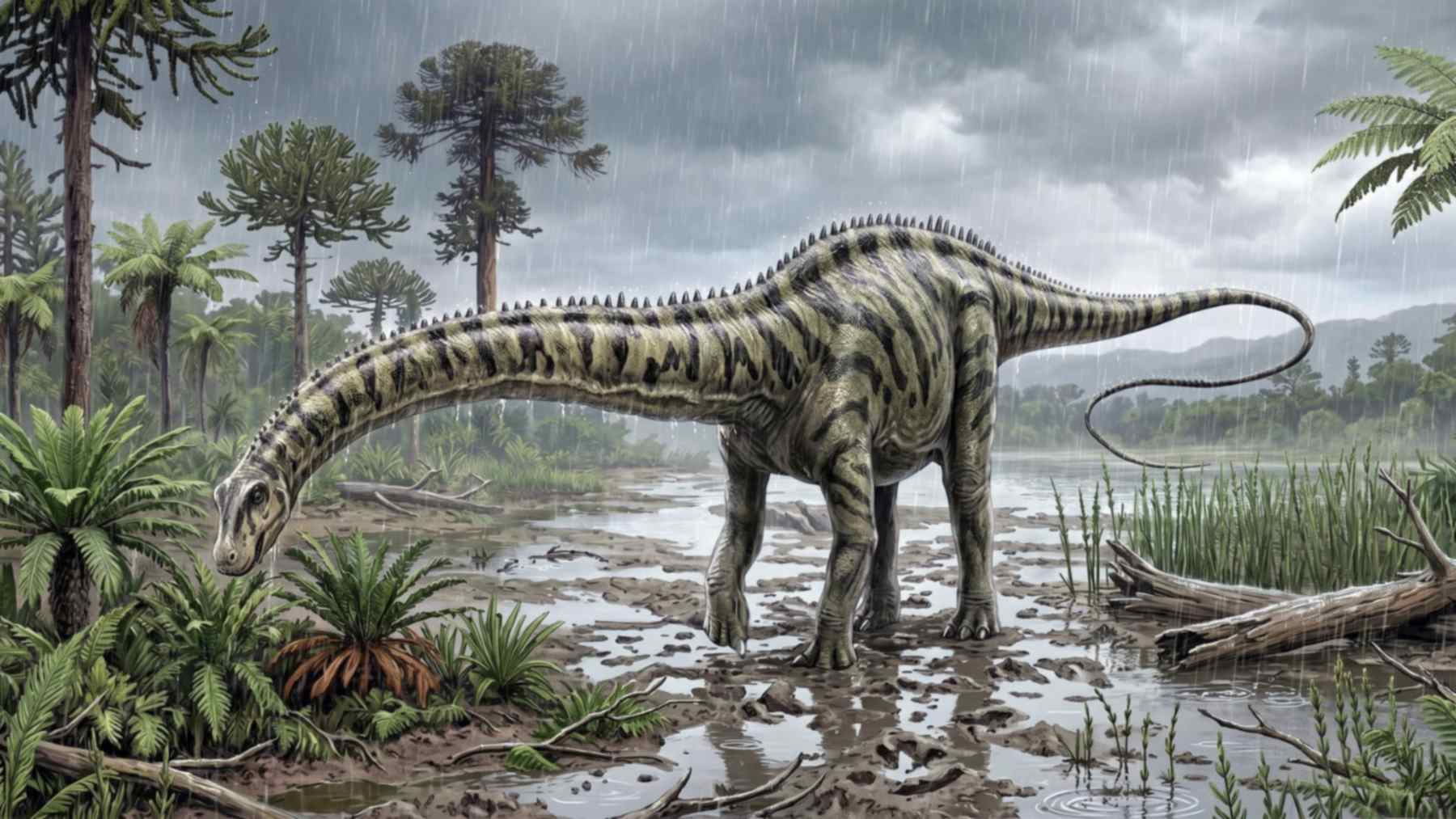
The animal lived about 150 million years ago and was roughly 25 meters (82 feet) long, according to Alberto Cobos, the foundation’s managing director and a co-author. The 14 vertebrae come from the middle and rear of the tail, so the team has a section of the animal rather than a skeleton. Even so, the paper calls it one of the most complete diplodocid skeletons found in Europe.
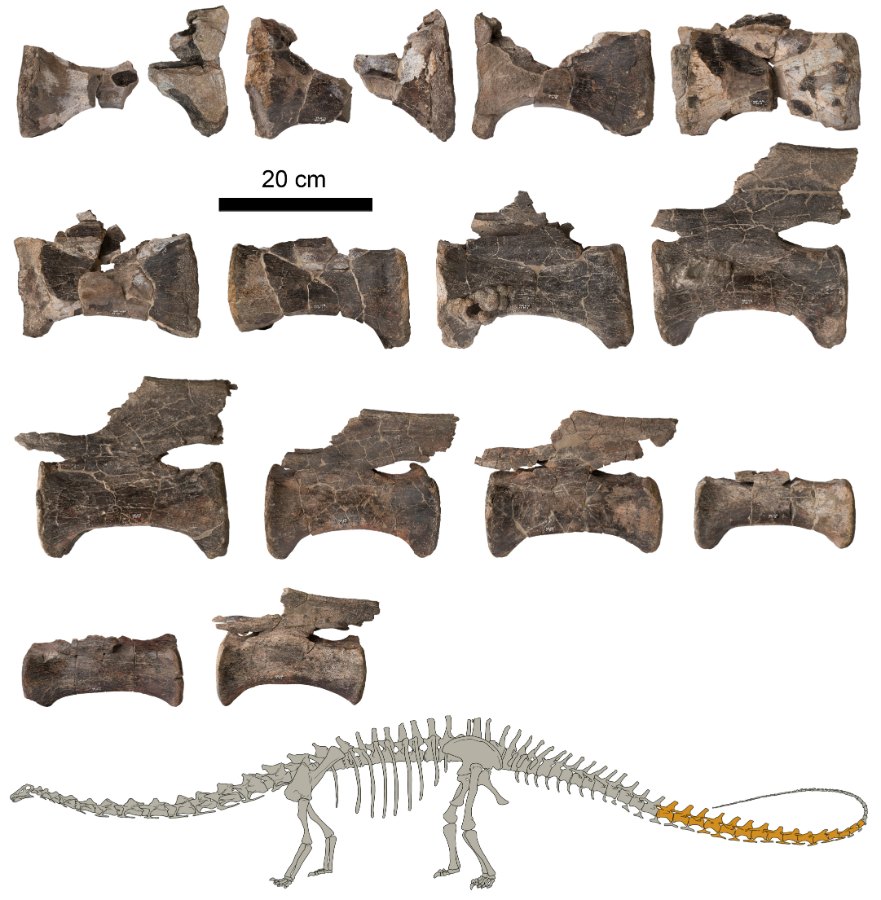
Four features of the tail pointed to Diplodocus, the foundation says: large air cavities inside the vertebrae, long vertebral bodies without side ridges, deep grooves along their undersides and forked chevrons. Two ways of building family trees, maximum parsimony and Bayesian inference, both placed the specimen inside Diplodocus. In one analysis it came out as the closest relative of Diplodocus hallorum, a species known from New Mexico, Utah and Wyoming, the paper says.
The team named it Diplodocus sp., meaning it could assign the genus but not a species. “The anatomical study and the evolutionary analyses we carried out allowed us to identify the El Castellar specimen as belonging to the genus Diplodocus,” lead author Sergio Sánchez Fenollosa said in the foundation’s statement, translated here from Spanish.
Five experts, two doubts
Science Media Centre Spain asked five paleontologists about the study, and all five spoke well of the work. Two doubted the identification.
José Ignacio Canudo, a professor of paleontology at the University of Zaragoza, said he believes the remains, which are only tail vertebrae, are too fragmentary to assign to Diplodocus. The conclusion about links between Europe and North America could have been reached without such a precise classification, he said, “the accuracy of which only time will tell.”
Pedro Mocho of the University of Lisbon reads the bones the other way. The specimen is fragmentary, he said, but “it retains sufficient information to attribute it with a fair degree of certainty to the genus Diplodocus.”
An Atlantic dinosaurs could cross
The authors call the find one of the strongest pieces of evidence that animals moved between North America and Europe across the young North Atlantic in the Late Jurassic. Canudo said that idea “is not new,” but that this is the first time it has been shown with a sauropod.
“At that time, the Atlantic was much narrower than it is today, and until very recently there was land connection between the North American and European coasts,” said Francisco Ortega, a professor of paleontology at Spain’s distance-learning university, UNED.
“The discovery adds to the list of other dinosaur genera known to have inhabited both regions during the Late Jurassic, such as the theropods Allosaurus, Ceratosaurus and Torvosaurus, and the stegosaur Stegosaurus,” Mocho said.
Ortega put it another way. “With the addition of Diplodocus to the already known Allosaurus and Stegosaurus, we are assembling the ‘complete set of dinosaur trading cards’ from the 1940s in the United States on the Iberian Peninsula,” he said.
Other giants from the same rocks
In the foundation’s statement, Cobos calls the animal “another of the great giant sauropods of the Jurassic of Spain,” a translation from the Spanish. He lists it with other giant sauropods from Teruel that looked very different, such as Turiasaurus and Losillasaurus. Losillasaurus was first found in the neighboring province of Valencia, in the same rock formation, the paper shows.
The real bones are in the dinosaur hall of the Museo Aragonés de Paleontología at Dinópolis, in Teruel. El Castellar has replicas of some of them.
Xabier Pereda Suberbiola of the University of the Basque Country was asked whether textbooks need to change. “No, but that doesn’t mean this isn’t a highly interesting piece of research,” he said. He added a detail about the young scientist behind it: Sánchez Fenollosa will soon defend his doctoral thesis.
Image: Fundación Dinópolis