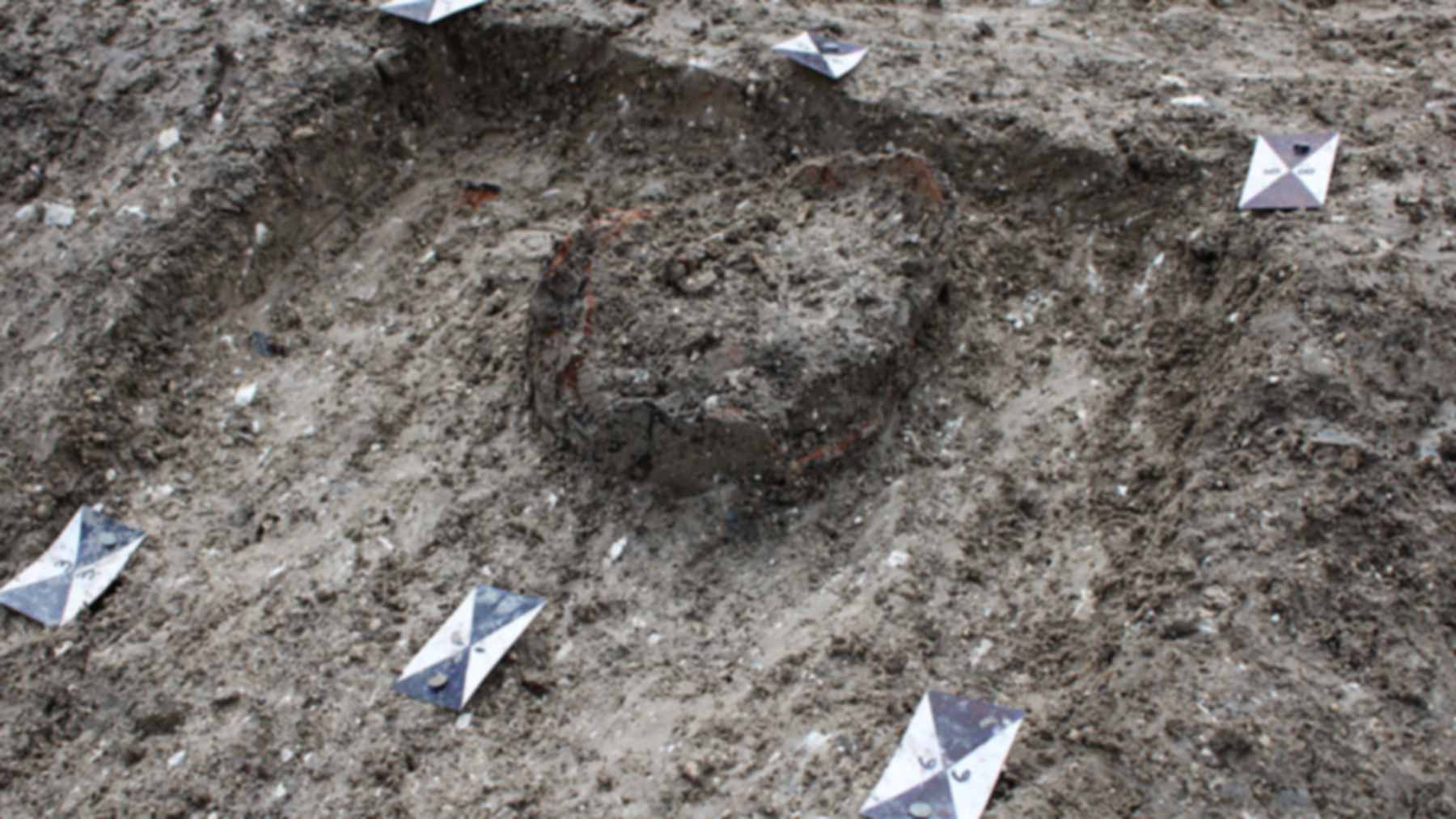
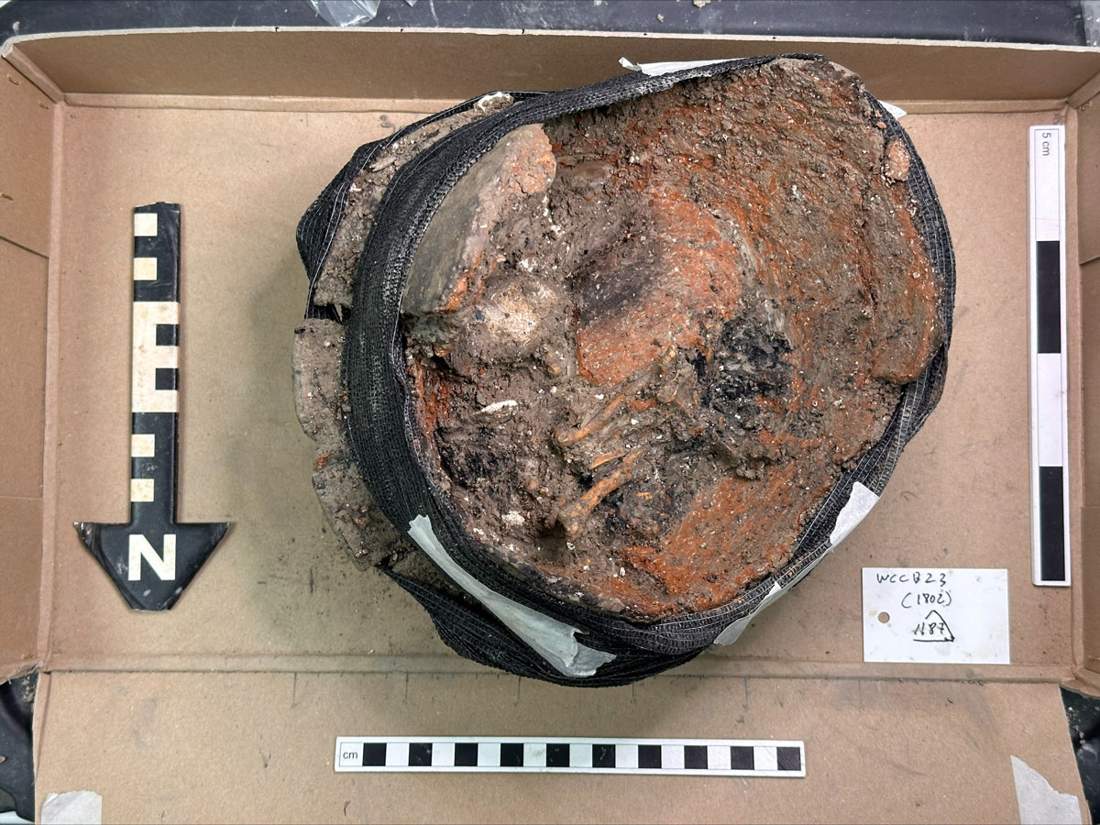
A Roman baby placed inside a pottery jar, which was then turned upside down and buried, has been found in Wendover, Buckinghamshire. Cotswold Archaeology says the burial is potentially a first for Britain.
The nine-month-old infant was found with the remains of a mature hen and a small perching bird. The excavation took place in 2024, ahead of the construction of the new Wendover Cricket Ground.
A jar turned upside down
The vessel was a shell-tempered jar with an everted rim, meaning its rim turned outward. The infant was placed inside it, and the jar was then inverted and buried.
The hen and the small bird lay at the jar’s entrance. An earlier update from the team described the smaller bird as the wings of a small bird.
Because the jar was upside down, the infant ended up at the highest point in the ground. Later activity on the site damaged the burial, so the remains were not complete.
Dating the hen and the baby
Radiocarbon dating placed the chicken between AD 237 and 346. The infant was dated to between AD 131 and 329. Taken together, the dates suggest the burial belongs to the early third to early fourth century AD, the archaeologists say.
Chickens often turn up with burials in Roman cemeteries, according to the archaeologists. They are thought to have served as food for the dead and as votive offerings.
The birds were also regarded as a luxury food, from an exotic, recently introduced species.
A possible Mediterranean custom
Across the Roman Empire, placing infants in pottery vessels was a more common funerary practice. It was especially common around the Mediterranean, most often with amphorae. The jars may have been symbols of the womb, the archaeologists say.
This kind of burial is very rare in Britain. So the team suggests the parents might have come from the Mediterranean region, following a custom they already knew.
The settlement did have links far beyond Wendover. Most of its pots were made locally. Still, an earlier update on the dig lists small amounts of amphora from southern Spain and Samian ware from Gaul, in what is now France.
Nine burials in one settlement
The jar was one of nine Roman-period burials found inside the settlement. Five were burials of young children and infants, and four were cremation burials of adults.
Small numbers of burials within a Roman settlement are fairly common, the team says, but these were rather exceptional. Babies under a year old were often buried in and around homes rather than in cemeteries.
Very close to the jar lay a newborn in a separate grave. A 6-month-old was buried about three meters away. Other sites have produced infants laid to rest in different ways, such as seven babies buried around a monumental structure without graves or pots.
Another child, aged around 3 to 4 years, had been buried with a small pottery cup. It was a thick-walled Oxfordshire white ware vessel dating to the fourth century. The four adults were cremated and placed in pottery urns, one of them with a red-slipped beaker from Oxfordshire.
Buried beside the corn dryers
These three infant burials all lay quite close to the settlement’s corn dryers. Across Roman sites, researchers have noted that infant burials and corn dryers appear together too often to be a coincidence.
One idea is that rituals tied to harvesting, threshing and fermentation were associated with fertility. That may explain why infant burials and corn dryers so often appear together, the archaeologists say.
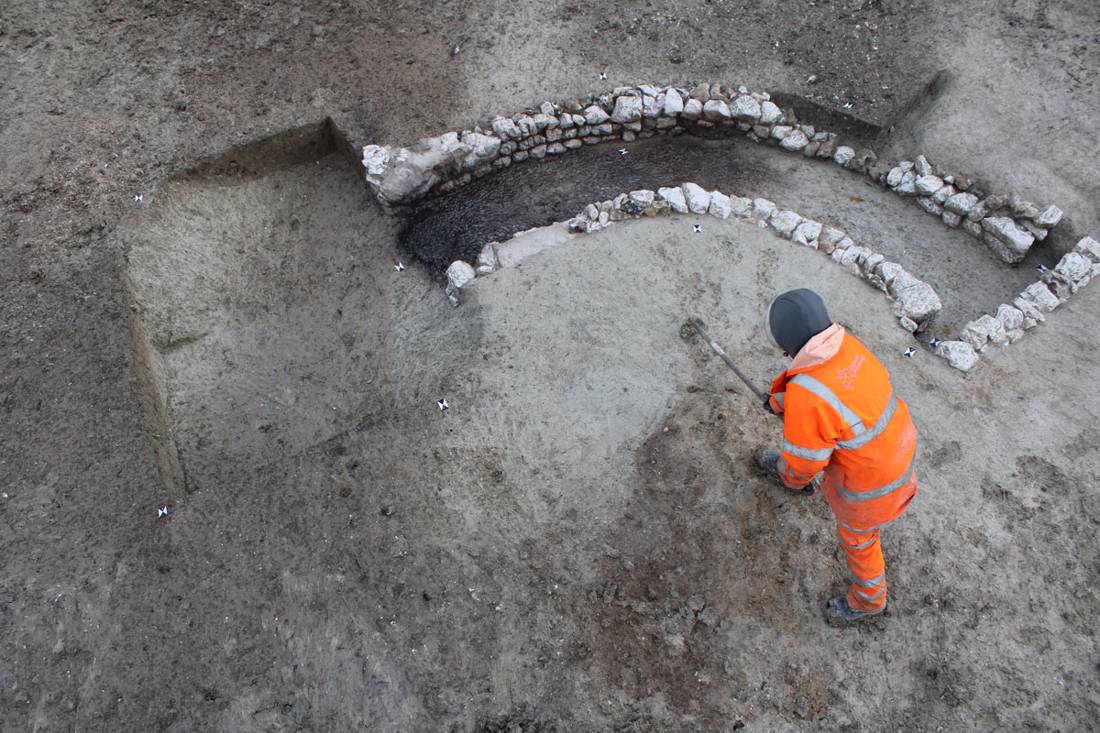
To use a corn dryer, people lit a fire in a stokehole. Hot air then traveled along a flue into a drying chamber. Dried grain lasted longer and helped families store food through the winter.
A settlement beside an ancient route
The site lies north of the Upper Icknield Way, a cross-country route thought to be prehistoric. The excavation was carried out on behalf of HS2. It uncovered the eastern edge of a Late Iron Age and Roman settlement.
The team found wells, a possible building and three stone-built corn dryers. It also recovered more than 28 kilograms of Late Iron Age and Roman pottery. Digs elsewhere in Roman Britain keep turning up surprises, including more than 8,000 frog bones in a single Roman ditch near Cambridge.
Two of the Wendover dryers had an unusual curved, almost J-shaped flue. It may have been designed to slow the heat. Rome’s reach went far beyond Britain, from a forest fort in Germany where Roman soldiers kept guard for 150 years to the Mediterranean customs this burial may echo.
Photo: Cotswold Archaeology