Anyone who has seen a wind turbine blade inch through a sharp highway ramp on a special truck knows the scene feels tense. Now imagine that blade is more than 100 meters long. At that size, many land routes simply stop working. A Colorado-based aerospace and energy company Radia thinks the answer is not a bigger truck, but a bigger airplane.
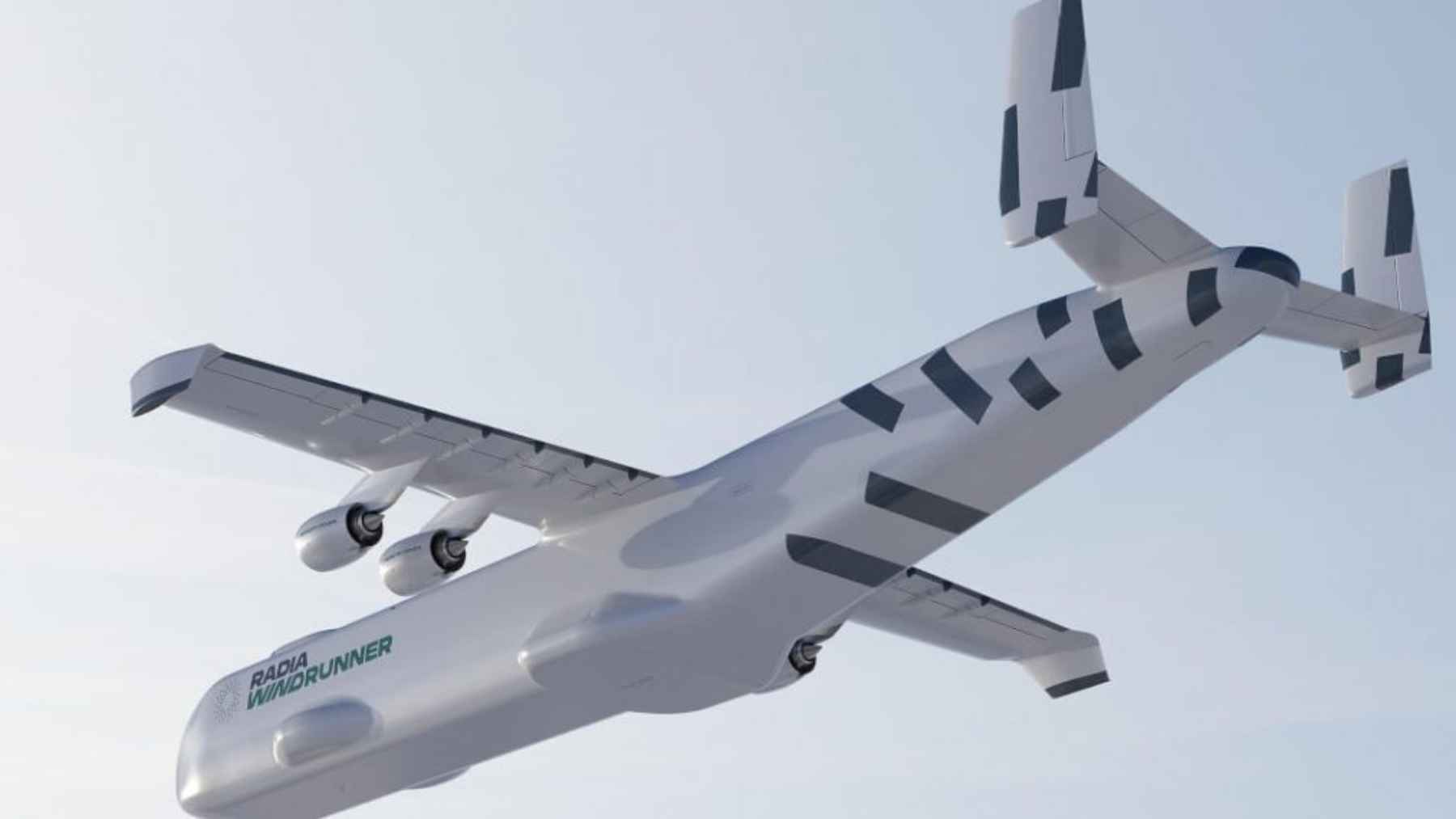
The firm is developing WindRunner, an ultra-large cargo aircraft designed almost like a flying warehouse for wind components.
According to company specifications, the plane would be about 109 meters long, 24 meters tall and 80 meters across the wings, with a payload bay able to swallow blades up to 105 meters in length. It is designed to carry one 105 meter blade, two blades of about 95 meters, or three blades of 80 meters and still fly roughly 2,000 kilometers from a regional hub.
Why blades are stuck on the road
Onshore wind technology has been on a steady growth curve. Taller towers and longer blades capture steadier winds higher above the ground, which pushes down the cost of each kilowatt hour. A 2025 analysis led by Columbia University researchers found that onshore wind costs fell about 70% between 2010 and 2023, largely because turbines became bigger and more efficient.
Yet turbine blades on land usually top out near 70 meters while offshore machines already use blades longer than 100 meters. One reason sits far from the lab or the wind tunnel. It is the everyday world of bridge clearances, tight corners, power lines and small town main streets.
Studies for the US National Renewable Energy Laboratory show that transportation and logistics constraints now set hard limits on the size of land-based turbines that can realistically be deployed.
As rotor diameters grow, costs for escort vehicles, route surveys, temporary removal of signs and even moving houses near ramps rise sharply and can quickly kill projects in promising wind regions.
Paul Hanna, marketing vice president at Radia, told the Royal Aeronautical Society that planning a single move for the largest current blades can take well over a year because of these obstacles. It is the kind of headache that never shows up on a household electric bill but quietly shapes where wind farms are built.
A flying solution for 100 meter blades
WindRunner tries to sidestep that tangle by going over it. The aircraft uses a high mounted straight wing and four turbofan engines so it can land at relatively low speeds on semi prepared airstrips as short as about 1,800 meters, including compacted dirt or gravel near factories or future wind farms.
The nose hinges upward to create a 10-by-10-meter opening so blades can slide in at ground level. The cockpit sits on top of the forward fuselage to keep the entire interior free for cargo. That layout, along with a huge cylindrical body, gives the aircraft a payload volume on the order of 6 800 cubic meters, many times more than a typical jumbo freighter.
Its founder and chief executive Mark Lundstrom often sums up the problem in simple terms. In an interview he said that it is the inability to move big things that basically blocks the industry from building larger onshore turbines. WindRunner is his attempt to remove that block.
Bigger turbines, cheaper and cleaner power
Radia uses the term GigaWind for the next generation of very large onshore turbines that WindRunner is meant to unlock.
A study by consulting firm DeSolve for Radia modeled what would happen if these machines could be deployed across the United States without transport limits. In that scenario, GigaWind turbines could add up to about 216 gigawatts of capacity and supply as much as 40% of US electricity, while lowering average power prices by up to 16%.
The same modeling suggests a potential reduction of 15% to 31% in grid emissions, with up to 760 million metric tons of carbon dioxide avoided each year if GigaWind scales as assumed. Those figures depend on policy, market behavior and many technical assumptions, so they are best read as a scenario rather than a promise.
Still, they hint at why an oversized aircraft that never carries passengers could matter to people trying to keep their lights on and their bills manageable.
There is also the question of the plane’s own footprint. Building and flying a fleet of very large jets is not exactly a low-carbon activity. Radia argues that the numbers still come out strongly in favor of bigger turbines.
The company estimates that transport today accounts for roughly 7% of a typical wind farm’s life cycle emissions and that delivering GigaWind turbines with WindRunner running on sustainable aviation fuel could cut that share to about 4%. The rest comes mostly from steel, concrete and composite materials, which are needed in any case.
Money, advisers and open questions
Radia has never built an aircraft, so it has recruited partners from across the aerospace world. The company lists advisers that include former US energy secretary Ernest Moniz and former Australian prime minister Malcolm Turnbull along with ex senior figures from Boeing, Rolls Royce and the US Federal Aviation Administration.
Structural and aerodynamic studies are reported to be complete, and Radia expects a first flight before the end of this decade, followed by certification under standard large transport rules. Independent commentators, though, note that many giant aircraft projects have struggled to pay for themselves and see an aggressive schedule and a highly specialized mission that may be hard to finance at scale.
For now, WindRunner exists as designs, models and computer renderings rather than metal on a runway. The project sits at the crossroads of three big trends: larger turbines, falling wind costs and the urgent push to cut emissions.
Whether this flying giant ever carries its first 100 meter blade will depend on investors, regulators and the wind industry deciding that taking to the air is the most practical way to keep clean power growing on the ground.
The study was published on Radia.