
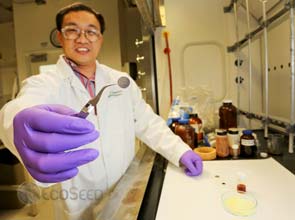
A lithium-sulfur battery developed at the Department of Energy’s Oak Ridge National Laboratory could outlast the best of the commercially available lithium-ion batteries.
The lab researchers have designed and tested their battery, which uses the abundant and low-cost element sulfur, and found that it has approximately four times the energy density of a lithium-ion battery.
The concept of lithium-sulfur batteries has been around for some time now, but there has yet to be a commercial version. The reason for this is a problem inherent to the batteries use of liquid electrolytes.
The liquid electrolytes in a lithium-sulfur battery help conduct ions through the battery by allowing lithium polysulfide compounds to dissolve. However, the same dissolution process causes the battery to prematurely breakdown.
The O.R.N.L. team went around these problems by using a solid electrolyte material as well as a new cathode and lithium anode for an energy-dense, all-solid battery.
The cathode is made by synthesizing a new class of sulfur-rich material that can conduct ions. It enabled the O.R.N.L. battery to maintain a capacity of 1200 milliamp-hours per gram after 300 charge-discharge cycles. In comparison, a traditional lithium-ion battery cathode has an average capacity of 140-170 mAh/g.
Aside from its energy density, one of the biggest advantages in the O.R.N.L. battery is its use of sulfur, which is a plentiful industrial byproduct of petroleum processing.
“Sulfur is practically free,” noted Chengdu Liang, who led the research team. “Not only does sulfur store much more energy than the transition metal compounds used in lithium-ion battery cathodes, but a lithium-sulfur device could help recycle a waste product into a useful technology.”
Although the technology is still in the demonstration stage, the team believes that the research can be quickly scaled for commercial applications. A patent on the design is pending.
“Our battery design has real potential to reduce cost, increase energy density and improve safety compared with existing lithium-ion technologies,” Mr. Liang concluded. – EcoSeed Staff