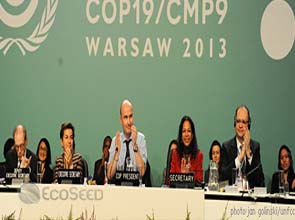
The nineteenth Conference of Parties in Warsaw concluded last week and,at its closing, the event has garnered mixed reactions from various bodies and personalities.
Though there has been some success in reaching an agreement, there is still a lot to be done said its critics.
According to statement made by the United Nations Secretary-General Ban Ki-moon’s spokesperson, Mr. Ban “welcomes the outcome” of the conference.
“The decisions adopted in Warsaw serve as an important stepping stone toward a universal agreement in 2015,” said in the statement. “The Secretary-General welcomes the decision by Parties to intensify immediate actions to fight climate change and to come forward with their national contributions to the agreement well before its finalization in 2015.”
Despite Mr. Ban welcoming the decision, he noted that much more needs to be done over the coming two years to achieve the ambitious agreement necessary to keep the global temperature rise below two degrees Celsius.
Just like Mr. Ban noting that much more still needs to be done, Jake Schmidt, the International Climate Policy Director at the Natural Resources Defense Council, who attended the conference said that world leaders should get their act together quickly.
“If they show up empty-handed in 2015 and don’t secure a strong international agreement, they’ll be known as the generation that clearly saw the growing threat of global climate change, and failed to try to stop it,” Mr. Schmidt said.
Achim Steiner, the executive director of the United Nations Environment Program, pointed out that in order for progress to be made, partnerships must be made.
“Climate Action has to be centered on promoting effective partnerships between the public and private sector by helping to create dialogue and knowledge transfer between corporate, international governments and N.G.O.s, with the acceleration of the inclusive green economy the ultimate aim,” Mr. Steiner said.
Though the United Nations were more receptive to the outcome of the conference, some organizations expressed their disappointment with what has transpired in Warsaw.
“We’re appalled at the lack of concrete actions on the table. We were expecting the tragedy in the Philippines to inject a sense of urgency into these talks, but instead it has been business as usual,” said Natasha Hurley, Global Environment Campaigner with the Environmental Investigation Agency.
“A solution to the current deadlock hinges on countries’ abilities to take concrete actions to address climate change now. Accelerating an agreement on a global phase-down of HFCs under the Montreal Protocol would help build trust and a sense that the global climate talks really can deliver,” added Ms. Hurley.
Greenpeace, one of the organizations that walked out in disappointment during the conference (see related story), also expressed disdain with the conclusion of the conference, wanting to see more actions from developed countries.
“This was a shame. It was supposed to be about increasing emission cuts, but what we saw was the opposite – Japan lowering its target, Australia rolling back its climate legislation and Brazil reporting a 28 percent increase of its deforestation rate,” Greenpeace Executive Director Kumi Naidoo enumerated.
“Furthermore, the complete failure of rich countries to deliver on existing promises on long-term finance is putting the most vulnerable people at risk,” he added.
With much frustration with the result of the conference, more people are looking towards the climate summit that will happen in September 2014. – L. Polintan