The Rubin Observatory in Chile has just started operating and promises to revolutionize the way we observe the cosmos. As you read this article, stars are exploding, black holes are releasing jets of plasma and asteroids are crossing the sky at incredible speeds… yes, the Universe in which we live is constantly evolving. And the most impressive thing is to think that, until recently, all of this was happening without witnesses. However, this is about to change radically.
Have you heard of the Rubin Observatory?
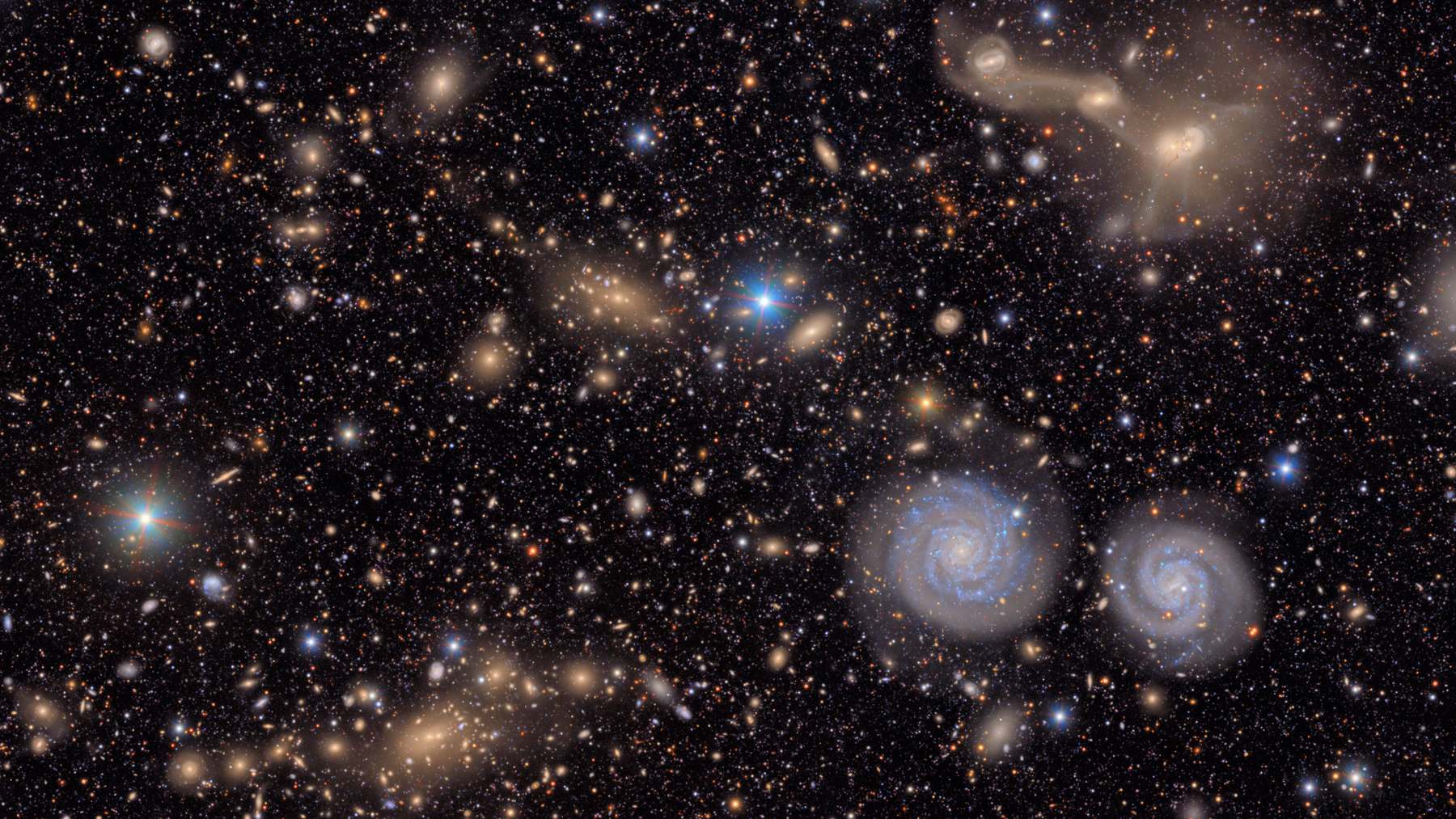
If this is the first time you’ve heard about the Vera C. Rubin Observatory, here’s a little information about it. Rubin is actually part of an ambitious project called the Legacy Survey of Space and Time (LSST), which over the course of 10 years aims to capture images of every region of the sky in the southern hemisphere up to 800 times. What will make all of this possible is the LSSTCam camera. It’s known as the largest digital camera in the world, with 3.2 gigapixels. Just to give you an idea, each image is so detailed that it would require 400 TV screens to display in real size.
And the best part of all this is that when we compare recent images with a “background model” built in the first months of operation, the system identifies everything that changes, that is, the emergence of supernovae, the movement of asteroids, and variations in the brightness of stars are detected. The result? A daily tsunami of data, with around 10,000 changes detected per image, totaling up to 10 million alerts per night.
What can Rubin bring to us?
What can we really discover with this observatory? Well, the scientific possibilities are endless. After all, Rubin is expected to triple the number of known asteroids in the solar system. The plan is to discover about 70% of them in the first two years alone. And the most impressive thing is that we won’t need to make specific observations; everything will be possible just by processing routine images.
Not only that, the observatory will be a crucial tool for studying phenomena that are difficult to observe (like James Webb, who just made a historic discovery in the Milky Way). For example, we will be able to delve deeper into dark matter, which does not emit light but distorts the light around it due to gravitational effects. By mapping these distortions, scientists hope to better understand the distribution of this mysterious matter in the universe.
Another important point: we will also be able to react to unpredictable events, such as stellar explosions, cosmic collisions, or optical counterparts of gravitational waves, something that was not even possible or a priority ten years ago, but which is now the center of attention.
Let’s democratize astronomy
Okay, so how do you handle all this data? Let’s face it, all this power would be useless without easy access to the data. That’s why Rubin was designed from the beginning to run in the cloud. How so? Well, the Rubin Science Platform allows any scientist to access, query, and analyze data directly over the web. The best part is that the heavy processing is done on the servers, and the user can interact with the data without needing a supercomputer.
And the positive points go beyond that: the alert system is completely public and in real-time. The expectation is that the data will also feed open platforms such as Zooniverse, as well as educational materials for use in schools. The goal here is to truly democratize astronomy. It is no wonder that we are already looking forward to his discovery of planet nine.