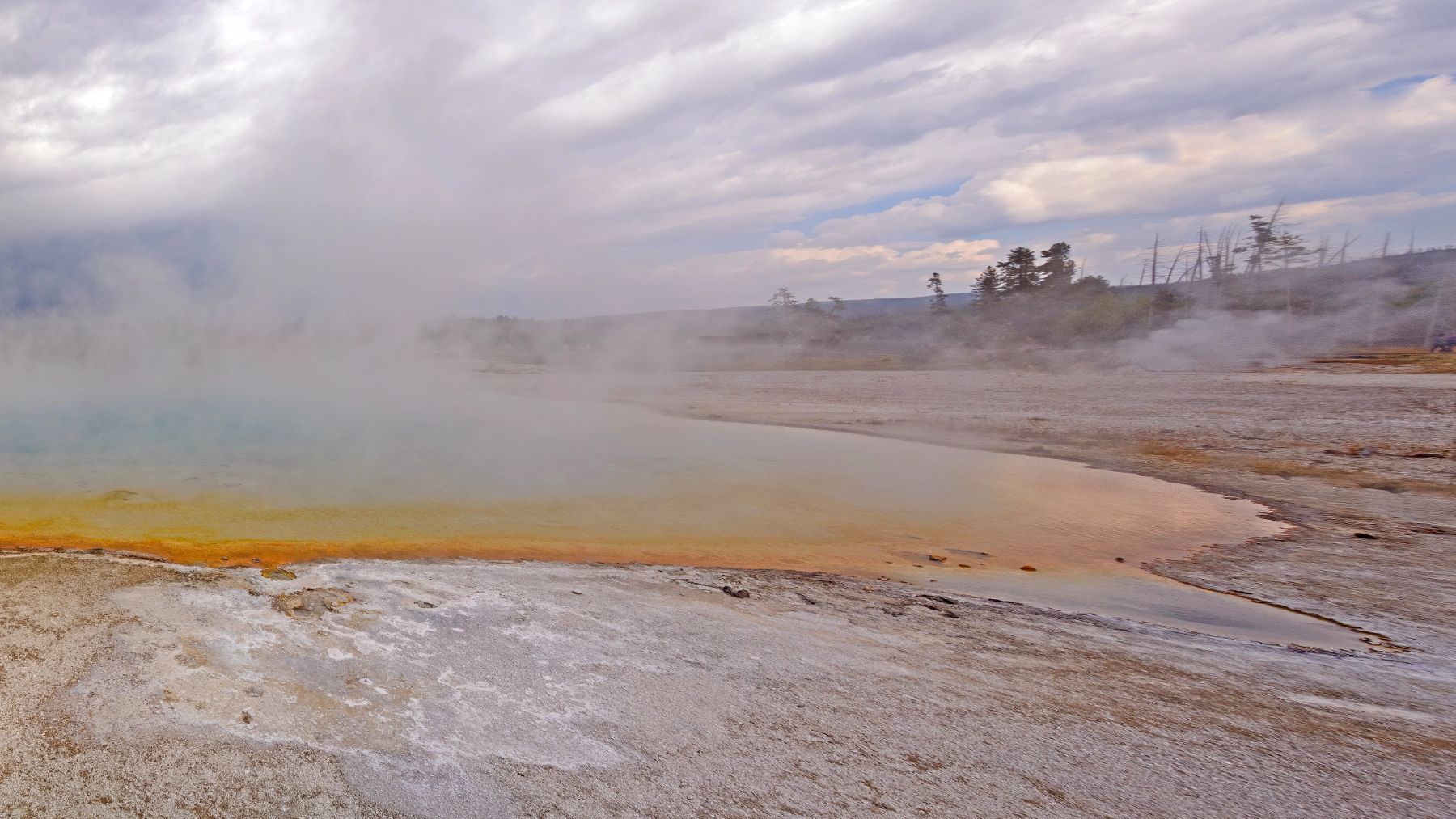
While Yellowstone is the centre of attention when the issue of supervolcanoes arises, scientists are focusing on another Californian behemoth. The Long Valley Caldera in northern California is waking up, and scientists are monitoring it. This supervolcano, whose last blast was some 100,000 years ago, isn’t leading up to another monstrous blow, but what’s going on with it isn’t exactly lying in repose.
This ancient eruption buried Los Angeles in a kilometre of ash.
The Long Valley Caldera comprises a vast caldera from the supereruption some 760,000 years ago, during which the Bishop Tuff extruded and the caldera, 10 miles by 20 miles in size, was created. The supereruption so ravaged the area that the modern city of Los Angeles existed under a kilometer-thickness layer of ash. In the modern day, the caldera covers the hot springs, the fumaroles, and the vast geothermal system, fueling the Casa Diablo power plant and lighting 40,000 homes.
The caldera lies 2,600 meters (8,530 feet) above the ground in Mono County. It comprises volcanic rocks, from the rhyolite to the basalts, and was most volcanically active 16,000 to 17,000 years ago. The town, bordering the town of the Mammoth Lakes, also lies in the same area near the volcanically active site ( similar to this volcanic activity). The caldera has a high threat potential regarding activity and records.
New research reveals why this volcano is shaking and rising.
A new report by the California Institute of Technology (CIT) identifies the Long Valley Caldera as cooling, resulting in ground deformation and seismicity. A 100-kilometre-long piece of fibre optic cable was employed to monitor activity in terms of half-year and duration and record in the neighbourhood of 2,000 seismic events. The record was later passed through a machine algorithm to give a high-resolution image of the caldera and the volcano underneath.
The study concluded that seismic activity in the area is the product of cooling and not heating the deep magma reservoir. The gases and the liquids are reaching the surface, causing earthquakes and inflation. The surface at the head of the magma reservoir is covered by a hardened cap of crystallizing rock, evidence of the cooling. The cooling, says Geophysicist Zhongwen Zhan, “We don’t believe the area is building up to another super-eruption; the cooling, however, could produce enough gas and liquid to produce earthquakes and mini-eruptions.”
Scientists are using new tools to track every shake and rise.
The Long Valley Caldera also has a record of significant seismic activity. During the 1970s, a chain of earthquakes began emanating from the caldera, causing the ground to experience episodes of pronounced unrest and to blow up and collapse. The frequency in the area during May 1980 included four magnitude six earthquakes, suggesting the seismicity’s capacity to produce significant earthquakes.
The U.S. Geological Survey (USGS) closely monitors the caldera, using closely spaced ground-based instrumentation to collect real-time data to track unrest and assess hazards. The caldera remains thermally active, with many hot springs and fumaroles, and has exhibited significant deformation, seismicity, and other unrest in recent years.
What’s next? Here’s what scientists are planning to do
While the Long Valley Caldera isn’t predicted to see a supervolcanic eruption in the immediate future, the restlessness serves as a reminder of the earth’s constantly changing geology. The cooling in the magma chamber could also continue to cause seismic activity and mini-eruptions. Still, the activity isn’t predicted to significantly threaten the populations in the immediate vicinity. Future research will also focus on enhancing monitoring. The Centre for Interoperability and Testing team will augment the coverage by installing a 200-kilometre-long seismic cable to monitor the bottom parts of the caldera.
The ongoing Long Valley Caldera unrest provides a good demonstration of the mechanisms for controlling volcanic activity. Not to end in cataclysm, seismicity and ground deformation are good reminders to monitor and research further. Deformation suggests the dynamical character of the Earth’s crust (also read about this volcanic activity) and the necessity to interpret the subsurface magmatic processes. By monitoring the signs closely, scientists are in a position to develop predictive models and assess possible hazards.