Ever since we began mapping the Universe, we’ve accepted that much of the normal matter—that is, the stuff made of protons, neutrons, and electrons—would simply not show up in our telescopes. The so-called baryonic matter that makes up stars, planets, and even ourselves was incomplete in all observational models, with about 50 percent of it missing… until now. It seems this decades-old cosmic puzzle has just been solved.
It’s not just the dark matter in the universe that we don’t understand
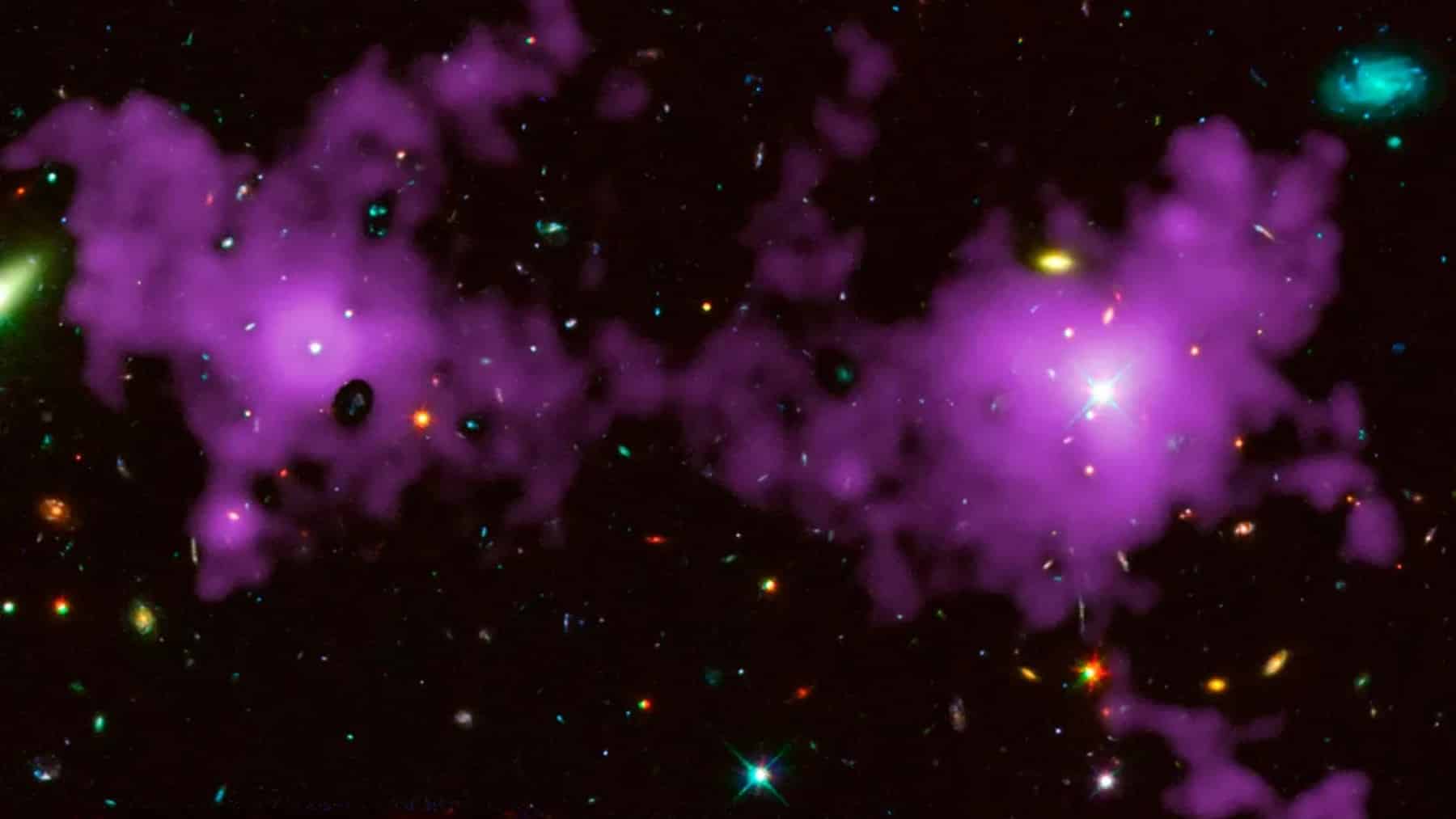
I thought it was only dark matter that caused us doubts… you must be wondering. And you’re not wrong. Dark matter and dark energy remain two great mysteries, but even ordinary matter, the kind we can theoretically observe, left us confused. This is because cosmology models predicted that there should be twice the amount of visible matter than what instruments could capture. In fact, the explanation, which lasted for many years, was only in the realm of speculation. We thought that this matter would be diluted in very thin filaments of heated gas that connect galaxies, but their low density and inadequate temperature made them invisible to traditional observation methods, such as X-ray telescopes.
Now, everything has changed, as two groups, one from the University of Edinburgh, in the United Kingdom, and another from the Orsay Institute of Space Astrophysics, in France, have managed to prove its existence. They had to use a phenomenon called the Sunyaev-Zel’dovich effect, which occurs when the light left over from the Big Bang passes through regions of hot gas, undergoing small distortions. Then, by combining this data with 3D maps of the universe and images from the European Space Agency’s Planck satellite, the researchers stacked information from thousands of pairs of galaxies. And that’s how they were finally able to see the hidden baryon filaments.
It looks like we have hidden highways between galaxies
The results obtained by these researchers were impressive. The French team analyzed more than 260,000 pairs of galaxies and identified filaments with a density three times greater than the average in the universe. The Scottish experts analyzed more than 1 million pairs and found structures six times denser. This is enough density to prove that these were indeed material connections between galaxies.
And in the midst of all this, another independent study detected a colossal filament of hot gas connecting four galaxy clusters, with a mass 10 times greater than the Milky Way and an extension of 23 million light-years. This structure belongs to the Shapley Supercluster, which is one of the largest concentrations of matter in the local universe. That’s right, this cosmic web is composed of trillions of baryonic particles that form real invisible highways (unlike this highway to Mars) between the galaxy clusters. In other words, they connect not only stellar systems, but also validate decades of astrophysical simulations on the formation of large-scale structures in the universe.
We just needed the right tools
It’s impossible not to be impressed by these discoveries, after all, they not only solve the missing matter puzzle, but also reinforce the accuracy of the cosmological models we use today. When observational data and large-scale simulations agree, it only shows that we were on the right track and just needed the tools to see it.
In other words, this combination of observations from different telescopes, such as XMM-Newton (Europe) and Suzaku (Japan), was essential to separate the weak radiation from the filaments from contamination generated by sources such as black holes and nearby galaxies. The process raised the standard for how these structures should be identified in the future. And this has been happening frequently; it is no wonder that the James Webb Telescope has just found more than 800,000 galaxies in the darkness.