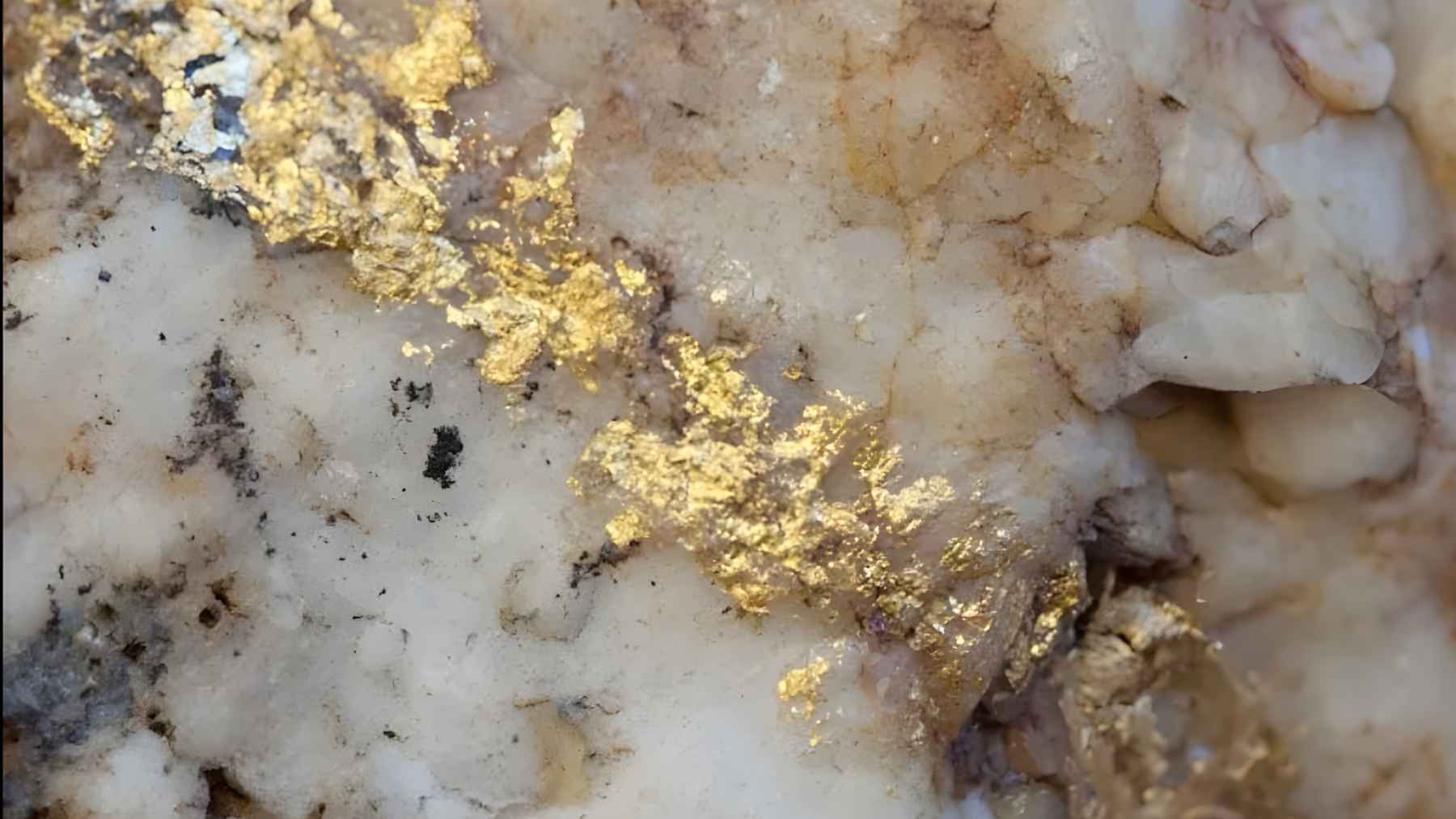
Most of us have seen gold in a wedding ring, a coin, or the tiny connectors inside a phone, but few people stop to ask how that metal ever reached the surface. So how did it get there in the first place? Deep inside our planet, gold is far more common than in the rocks miners actually dig, which has puzzled scientists for decades.
An international team led by Deng-Yang He at China University of Geosciences in Beijing, working with Adam Simon at the University of Michigan and colleagues in Switzerland, Australia, and France, now thinks it has an answer. Their new study points to a special gold-sulfur combo that forms far beneath volcanoes and turns hidden metal into rich deposits that companies can mine.
Gold is common inside Earth but scarce where we can reach it
Gold is surprisingly abundant when you consider the whole Earth, yet most of it is locked away in the deep mantle. Near the surface, it shows up in narrow veins and scattered clusters that prospectors chase from one mountain range to another.
The mantle is the thick rocky layer beneath the crust, hotter than any home oven yet still mostly solid. In certain places, part of this mantle melts into magma and carries bits of metal upward, and for years geologists argued over how enough gold could hitch a ride in that molten rock to create a useful deposit.
A gold-sulfur complex becomes a fast track to the surface
The new research focuses on mantle rocks roughly 50 to 80 kilometers below active volcanoes, where pressure and temperature are extreme and some rock has melted into magma. Pure gold does not react much in this environment, yet when sulfur-rich fluids arrive from the sinking tectonic plate, the metal bonds with three sulfur ions to form a mobile gold-trisulfur complex that dissolves easily in the melt.
To test this idea, the team created artificial magma in the lab and carefully controlled temperature and pressure, then used those results to build a numerical thermodynamic model on a computer.
Earlier work had hinted that sulfur radicals help move gold in hot fluids closer to the surface, and a 2015 study showed that some sulfur ions can carry high amounts of gold in solution, so this new model pushes that chemistry deeper and connects it to giant deposits.
Subduction zones and the Ring of Fire as Earth’s gold pipeline
The key setting for this process is a subduction zone, the place where one tectonic plate slowly dives beneath another and sinks back into the mantle. As the descending plate heats up, it releases water and sulfur rich fluids into the overlying mantle wedge, changing the chemistry and making it easier for gold to form the mobile trisulfur complex.
Around the Pacific Ocean, these zones create the Ring of Fire, a chain of volcanoes running through regions such as New Zealand, Indonesia, Japan, Alaska, and the Pacific Northwest. As magma loaded with gold rises beneath these arcs, it cools, releases gas, and drives hot hydrothermal fluids through cracks in the crust, which drop their gold in veins and clusters that concentrate the metal far above its original level in the mantle.
Why this model matters for future gold exploration
The new thermodynamic model shows that only certain combinations of sulfur, water, and oxidation in a subduction zone mantle will produce especially gold-rich magmas. In practical terms, that means not every arc volcano is a good bet for big deposits, even if it looks dramatic on the skyline.
By comparing their model with real-world data from known ore districts, the researchers can start to flag which regions have the right deep conditions and which do not.
For people far from the lab or the mine, the payoff is easy to picture, because the gold in a ring, a necklace, or a circuit board may have started its journey in a dark patch of mantle beneath a noisy volcanic arc, carried upward by an invisible partnership between gold and sulfur.
The study was published in the Proceedings of the National Academy of Sciences.