For much of the last century, the story of cave art has centered on Europe, from the painted halls of Lascaux Cave to the lions and rhinos of Chauvet Cave. A new discovery in Indonesia now pushes that story thousands of miles east and more than a thousand years further back in time.
In a limestone cave on Muna Island in southeastern Sulawesi, researchers have dated a faint red hand stencil to at least 67,800 years old, making it the oldest reliably-dated cave painting yet found on Earth.
The work, described in the journal Nature, suggests that early modern humans were living in these islands much earlier than scientists could previously prove and that they carried complex culture with them as they moved toward ancient Australia.
A ghostly handprint older than European cave art
The handprint was found in Liang Metanduno, a cave in the tropical karst landscape of Muna, just off the larger island of Sulawesi. The stencil was made by someone pressing a hand against the rock and blowing red pigment around it, leaving behind a pale outline that has slowly faded under a thin crust of minerals.
Using uranium series dating of that mineral crust, an international team led by Indonesian archaeologist Adhi Agus Oktaviana and archaeologist and geochemist Maxime Aubert calculated that the stencil must be at least 67,800 years old.
That makes it slightly older than the 66,700 year minimum age for a hand stencil in Maltravieso Cave in Spain, which had held the previous record for the world’s oldest cave art.
The Sulawesi hand is not simply a flat print of a palm. One finger appears deliberately narrowed, giving the outline a claw-like look that so far has only been documented in this region and may hint at a symbolic meaning that researchers cannot yet decode.
In an article for The Conversation, members of the team called this style unique to Sulawesi and asked how many more very old images might still be hiding in little visited caves on nearby islands. That open question is part of what makes a single faded hand so intriguing.
How scientists read the age written in stone
In this study the team did not try to date the pigment itself, which contains almost no radioactive elements. Instead, they sampled the paper-thin layers of calcium carbonate that formed on top of the painting when mineral-rich water trickled down the cave wall and hardened.
Those layers include traces of uranium, which slowly turns into another element called thorium at a well-known rate. By measuring how much uranium and thorium were present in each layer, the researchers could estimate when the crust formed and set a minimum age for the art beneath it, knowing that the handprint must be older than the mineral skin that covers it.
For the Sulawesi work, uranium series measurements were carried out in the BIOMICS laboratory at Southern Cross University using a laser-based method that maps the chemistry of each sample in fine detail.
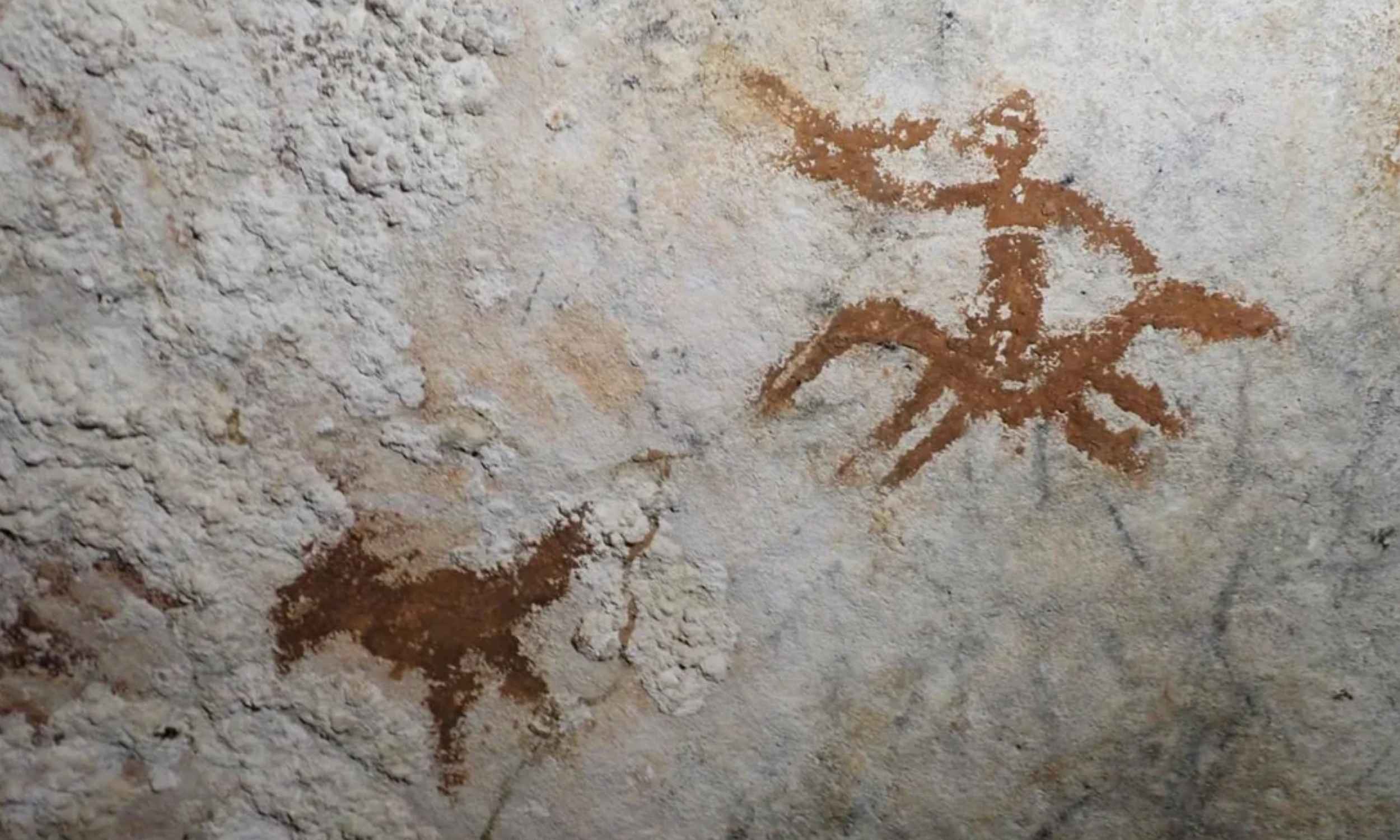
The same approach helped the team previously date a dramatic hunting scene in another Sulawesi cave to at least 51,200 years ago, which is currently viewed as the oldest known example of narrative art anywhere in the world.
Tracing a route from Asia to ancient Australia
Geographically, Sulawesi sits in Wallacea, the chain of islands that separates the Southeast Asian landmass once known as Sunda from the ancient continent of Sahul. During the last Ice Age, sea levels were lower, so Sunda and Sahul formed broad pieces of land separated by deep channels that never completely dried out.
The new hand stencil sits along the most likely northern island-hopping route that early modern humans used to reach Sahul. As rock art specialist Dr Oktaviana puts it, “It is very likely that the people who made these paintings in Sulawesi later spread through the region and reached Australia,” and the dates line up with evidence that the ancestors of today’s First Australians were already in Sahul around 65,000 years ago.
To get there, groups had to plan sea crossings, build watercraft, and navigate currents between islands rather than simply walk across dry land. In practical terms, that means the same people who left a handprint in a humid cave were also capable sailors who treated the island chain like a stepping stone path across the ocean.
A challenge to Eurocentric stories about art
For many years, schoolbooks pointed to Ice Age art in France and Spain as the birthplace of human creativity. That view shifted when a 2018 study in the journal Science showed that cave paintings in Iberia, including a red hand stencil in Maltravieso Cave, are more than 64,800 years old and were probably made by Neanderthals rather than modern humans.
Finds from Indonesia have pushed that rethink even further. The 67,800 year old Sulawesi handprint and the 51,200 year old scene at Leang Karampuang together show that people in this part of the world were experimenting with complex images and storytelling tens of thousands of years before many famous European sites were decorated.
A distant artist’s hand in our everyday lives
Seen from outside, Liang Metanduno is just another cave in humid tropical forest, a place most travelers would pass without a second glance while checking a weather app or thinking about their next flight. Inside, someone pressed a hand to the wall almost 68,000 years ago and left a mark that still speaks to us today.
Professor Aubert notes that “Sulawesi was home to one of the world’s richest and most longstanding artistic cultures,” which means the people moving through these islands were not only surviving but also sharing ideas and beliefs through images.
At the end of the day, that ghostly handprint works a bit like a very ancient selfie, reminding us that long before phones and photo walls, humans were already finding ways to say “we were here.”
The main study has been published in the Nature.