A new astronomy study has turned a big question into a practical shortlist. After analyzing data on more than 6,000 known exoplanets, researchers identified 45 rocky worlds in their stars’ habitable zones as top places to look next for signs of life.
This is not an announcement that we have found a second Earth. It is a road map for telescope time that helps scientists test a bigger idea, namely where habitability starts, where it ends, and why climates fail on some worlds but stay stable on others.
From thousands of worlds to a manageable list
Exoplanet discoveries keep coming, but most planets found so far are not especially Earth-like. That is why the team, led by Cornell astronomer Lisa Kaltenegger at the Carl Sagan Institute, focused on rocky planets that sit in the habitable zone, rather than chasing every new detection.
They used ESA’s Gaia Data Release 3 alongside the NASA Exoplanet Archive, then sorted planets into categories that could help answer specific questions about surface habitability. You can think of it as triage for a crowded observing schedule, because even the best telescopes cannot look everywhere at once.
The result is 45 rocky planets in an “empirical” habitable zone and 24 more in a narrower three-dimensional habitable zone, which makes more conservative assumptions about heat limits. The authors also highlight worlds near the inner and outer edges of the zone, plus planets on more elongated orbits that may swing between warmer and colder conditions.
What the habitable zone really means
The habitable zone is the region around a star that is not too hot and not too cold. In plain language, it is where a rocky planet is more likely to keep liquid water on its surface, which remains a basic requirement for life as we know it.
But a habitable zone label is not a promise. The study notes that a planet’s ability to hold an atmosphere is a major wildcard, because without air, surface water can be lost, frozen out, or boiled away more easily.
That uncertainty is the point of the catalog. By including planets that test the boundaries of habitability, the researchers hope new observations will show whether current assumptions about those boundaries need updating.
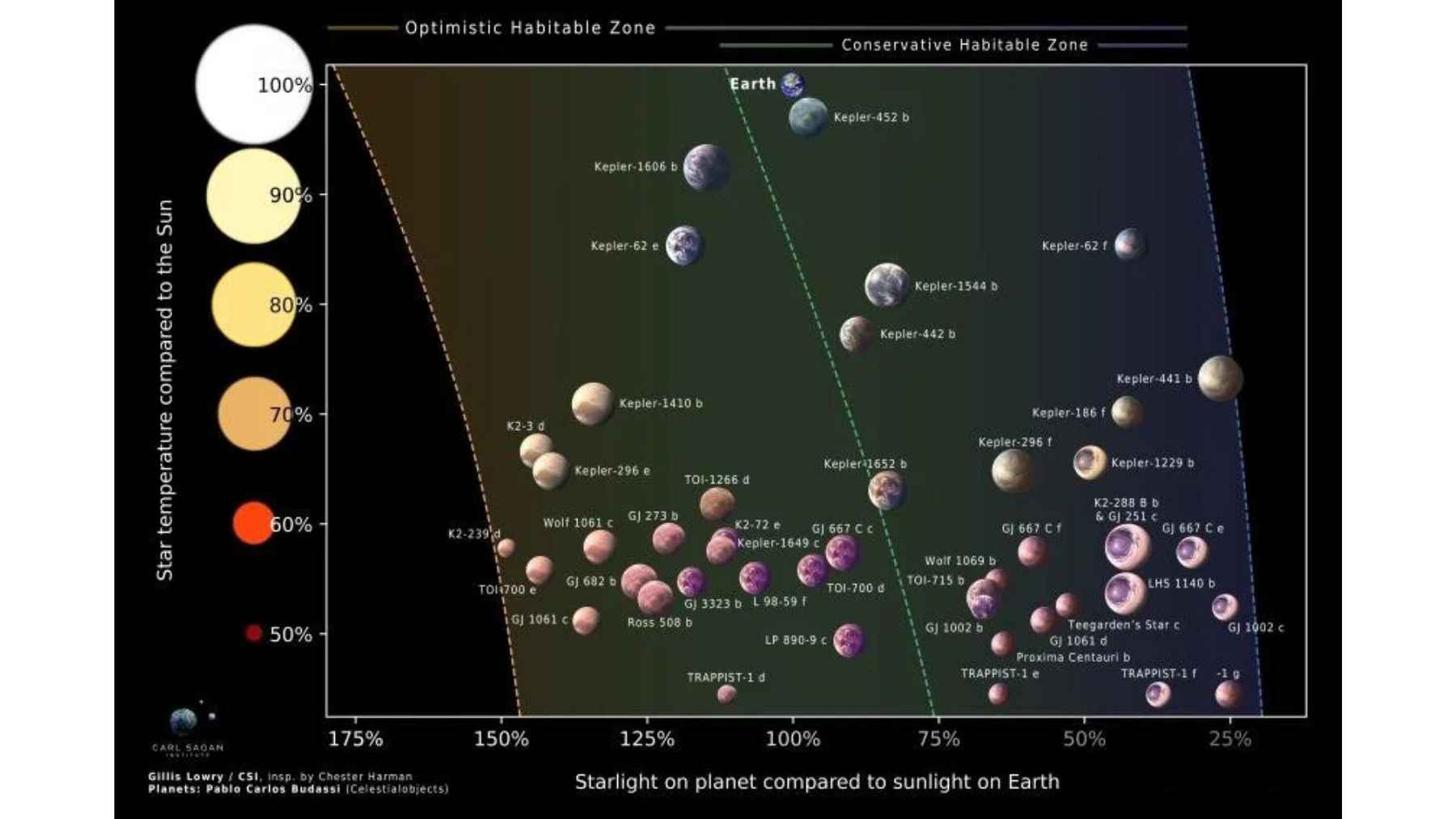
A comparative chart maps dozens of exoplanets by starlight and star temperature, highlighting those within habitable zones.
The standout targets are close enough to study
Among the most interesting picks are TRAPPIST-1 d, e, f, and g, a set of rocky planets around a red dwarf star about 40 light years away, or roughly 235 trillion miles. Scientists have studied TRAPPIST-1 for years because it offers multiple Earth-sized worlds in one system.
The list also includes Proxima Centauri b, a famous nearby candidate, plus several planets the authors say receive starlight levels most similar to what modern Earth gets from the Sun. TRAPPIST-1 e appears again in that “Earth-like energy” group, along with targets such as TOI-715 b and Kepler-442 b.
Another highlighted world is LHS 1140 b, about 48 light years away, or around 282 trillion miles. The researchers stress that whether it can host liquid water depends in part on whether it can retain an atmosphere, which is exactly the kind of question follow-up observations can probe.
How scientists will check for atmospheres and possible biosignatures
So what comes after a planet makes the list? The paper prioritizes targets for methods such as transmission observations during transits, light curve measurements, and direct imaging, because each technique can reveal different pieces of a planet’s story.
Right now, the James Webb Space Telescope is a major player for this work, with a 6.5-meter primary mirror that is about 21 feet 4 inches across. That mirror helps Webb collect enough faint infrared light to tease out atmospheric chemistry.
More capability is on the way. NASA says the Nancy Grace Roman Space Telescope is slated to launch by May 2027, with the project tracking for a possible earlier launch window in fall 2026, and its field of view will be at least 100 times larger than Hubble’s.
On the ground, ESO’s Extremely Large Telescope will use a 39-meter primary mirror, about 128 feet across, and ESO now expects its first scientific observations in December 2030, while NASA is building technology toward a Habitable Worlds Observatory concept for the 2040s.
Habitability is a climate story in disguise
What makes this catalog different is its focus on limits. By comparing planets near the inner and outer edges of the habitable zone and those with more eccentric orbits, the authors want to test whether a world must stay in the zone all the time to remain habitable.
That may sound distant from everyday environmental news, but the physics is familiar. Planetary climates depend on energy in, energy out, and an atmosphere that can act like insulation or like a vent, and small differences can add up over time.
If you have ever watched a heat wave linger for days, you already know how stubborn temperature patterns can be. Studying other planets’ tipping points gives researchers more test cases for understanding climate stability, including the conditions that allow oceans and water cycles to persist.
A reality check on “backup planets”
Some coverage has compared the work to the “Project Hail Mary” storyline, which imagines a desperate trip to another system to help save Earth. It is a catchy reference, but the study is really about prioritizing observations, not planning a rescue mission.
No telescope has detected life on any of these worlds, and distance alone keeps them firmly in the science category rather than the travel category. Still, a well-chosen target list can speed up the next step, figuring out which rocky planets truly have atmospheres and which are just look-alikes.
That is the real message.
The study was published in Monthly Notices of the Royal Astronomical Society.