If you twist a strip of paper and tape the ends together, you get a Möbius loop, a shape that flips what “inside” and “outside” even mean. In March 2026, researchers reported a molecule whose electrons follow a related kind of twist, but in a way not previously observed in a single molecule.
The international collaboration included IBM and researchers at the University of Manchester, the University of Oxford, the University of Regensburg, ETH Zurich, and EPFL.
They built a tiny ring made of 13 carbon atoms with two chlorine atoms attached, then showed its electrons move in a “half-Möbius” pattern that can be switched between three states. It is a fundamental result, but it also raises a very normal question: what could this ever be good for?
What “half Möbius” means
In everyday language, topology is about how something stays connected when you bend it, stretch it, or twist it. In this case, “electronic topology” describes how an electron pattern is connected as it loops around a molecular ring.
A classic Möbius strip uses a half twist to make one continuous surface. Here, the electron pattern rotates by 90 degrees each time it travels around the ring, so it takes four full trips to return to the same orientation. That is why the team calls it a half-Möbius electronic topology.
This matters because electrons help decide how a molecule reacts and how it conducts electricity. If scientists can design the electron “path” as deliberately as the atoms, it adds a new way to control matter.
An extreme lab build
The molecule did not come from a standard chemical reaction in a flask. It was assembled atom by atom on a thin layer of sodium chloride, the same compound as table salt, under ultrahigh vacuum and at temperatures near absolute zero, about minus 460 degrees Fahrenheit.
The team started with a custom precursor molecule and used tiny voltage pulses to remove selected atoms one by one until the ring structure was left behind. This relies on a scanning probe microscope, essentially a needle-like tip that can manipulate single atoms with careful nudges.
For now, that also sets limits on what the molecule can do outside the lab. A structure that needs near-freezing temperatures and an almost airless chamber is unlikely to show up in everyday technology soon.
How they checked the twist
To confirm the structure, the researchers used scanning tunneling microscopy to map where electrons are likely to be. They also used atomic force microscopy, which traces a molecule’s shape by sensing tiny forces, almost like reading Braille at the atomic scale.
Those measurements showed the ring is chiral, meaning it comes in left-handed and right-handed forms, like mirrored gloves. The electron pattern they mapped follows a helical, corkscrew-like path around the ring, matching the half Möbius idea.
The team could also switch the molecule between a clockwise-twisted state, a counterclockwise-twisted state, and an untwisted state by applying controlled voltage pulses. It is a small reminder that “switching” does not have to mean a bulky mechanical button.
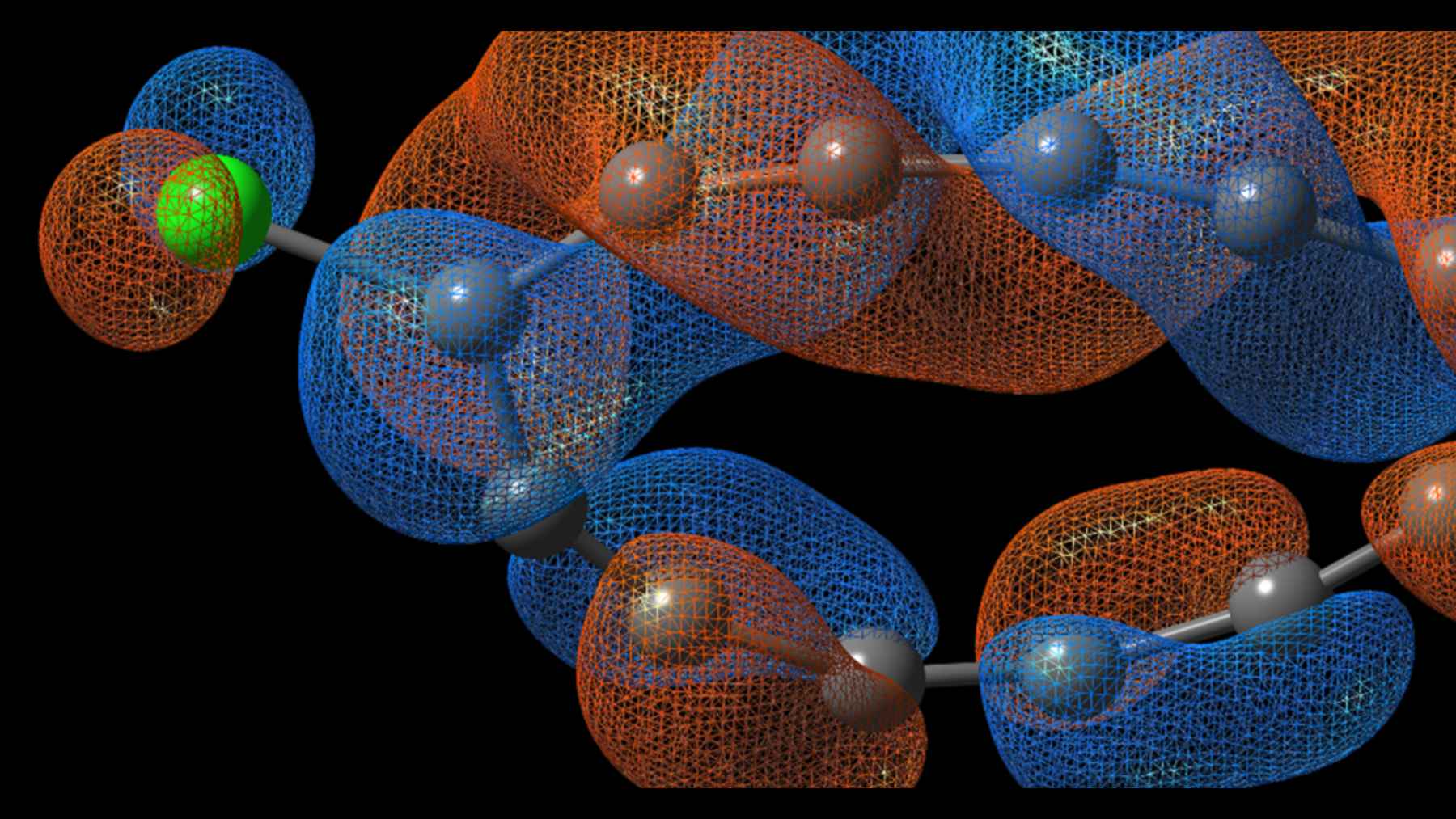
A quantum simulation visualizes the twisted electron density in a lab-built carbon ring, revealing a rare half Möbius topology.
Quantum computing as a new lab tool
Building the molecule was only half the story, explaining it was the hard part. The electrons in this ring interact strongly with each other, and the number of possible arrangements grows so fast that precise modeling can overwhelm classical computers.
Quantum computers work differently because their basic units are quantum objects too, so they can represent some electron behavior more directly. In this work, quantum calculations helped identify the twisted orbitals linked to the half Möbius pattern.
They also suggested the switching comes from a pseudo Jahn-Teller effect, a technical term for a molecule twisting to lower its energy when electron states mix.
Alessandro Curioni said, “First, we designed a molecule we thought could be created, then we built it, and then we validated it” with a quantum computer. He also nodded to Richard Feynman’s idea that there is “plenty of room at the bottom,” a reminder that big discoveries can come from very small systems.
A long path to Möbius chemistry
Chemists have chased Möbius-like electron loops for decades, partly because they challenge the usual rules for ring-shaped molecules. A Chemical Reviews article notes that a key moment came in 2003, when a team led by Doron Ajami reported a Möbius aromatic hydrocarbon in Nature.
This new study does not just revisit that idea – it expands it. Instead of a half twist per loop, the electron pattern shifts by a quarter turn per loop, which is why four loops are needed to repeat the pattern.
It is also different in how it is made and tested. Rather than producing a bulk chemical sample, the researchers engineered and examined single molecules on a surface, then used computation to explain what their microscopes saw.
What might come next
The clearest near-term impact is a new “degree of freedom” for chemistry and materials science, meaning another controllable feature besides which atoms are present. Igor Rončević said “topology can also serve as a switchable degree of freedom,” and the team argues this could open new routes for controlling material properties.
Still, the practical challenges are obvious. The half Möbius molecule was created under extreme conditions, so the next question is whether related designs can survive at warmer temperatures or in less pristine environments.
Quantum computing may be the part that scales sooner. If quantum simulations keep improving, they could help decode other “too complicated” molecules and materials, including ones tied to electronics, batteries, or even the power bill you see at home.
The main study has been published in Science.