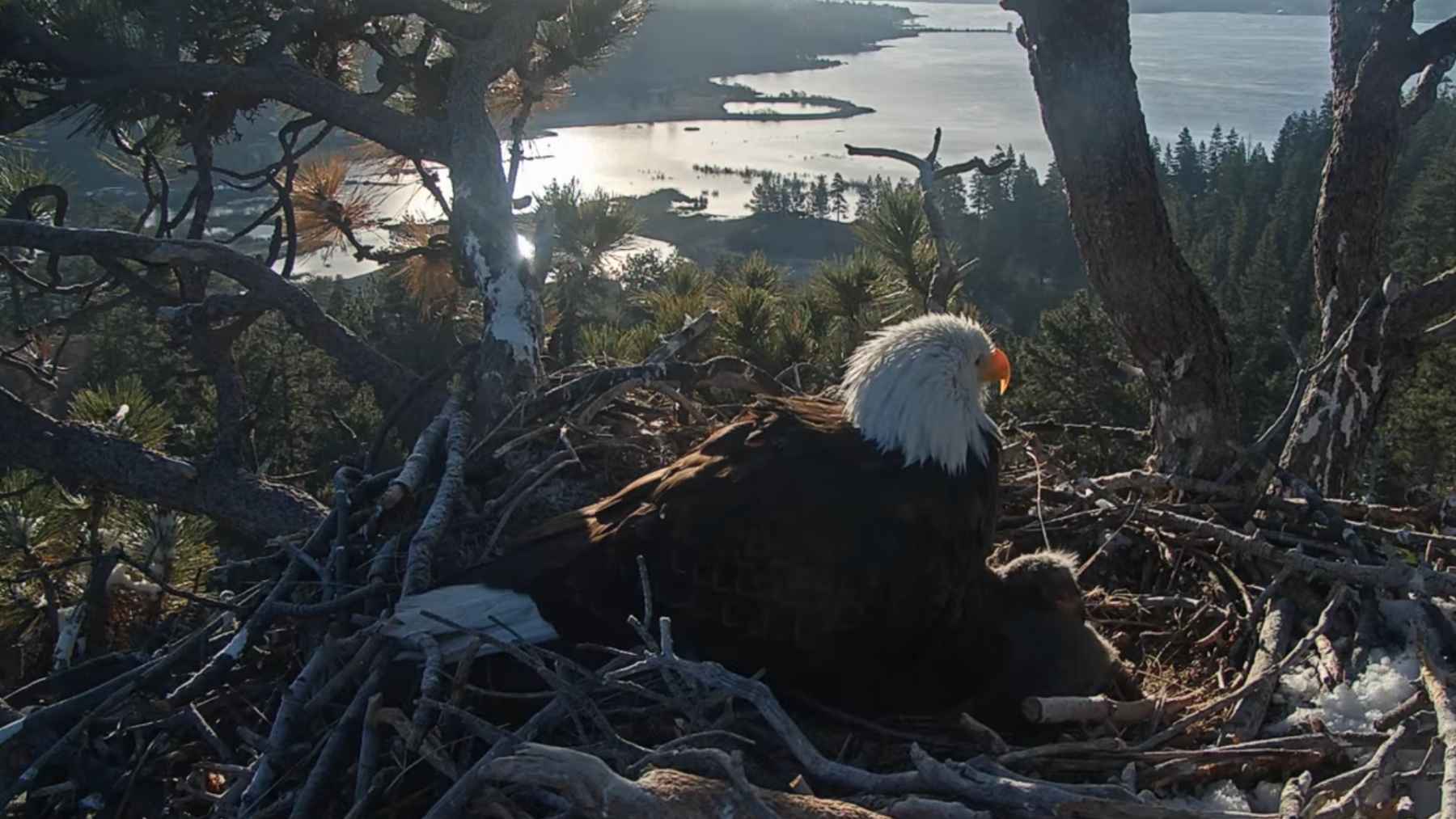
On March 16, 2026, a bald eagle known as Shadow snapped into defense above the Big Bear nest when a smaller bird rushed in from behind. Instead of peeling away, Shadow rolled in midair and raised his feet in a classic “talons up” posture, signaling that the airspace near the eggs was off-limits.
For people who check a live nest cam during a quick break, the scene was thrilling, but it also carried a practical message, the kind you notice when everything changes in a heartbeat.
Jackie and Shadow are still in full protection mode during incubation, and that can mean leaving the eggs for a moment if a threat is close, so guarding a nest is not always a sit-still job.
The moment Shadow turned in midair
The clip unfolds fast. Shadow had been scanning the sky on what looked like a routine patrol, then gained altitude above the nest tree.
Out of nowhere, a smaller bird swung in from behind and aimed straight at him. Shadow did not retreat – he twisted hard and flashed his talons upward in a split-second defensive roll.
The “talons up” moment hits about three minutes into the recording. The intruder slipped away, but the message was clear – Shadow was not letting anything test the nest airspace right now.
A nest season on high alert
Bald eagles defend their breeding territory from more than just other eagles. The Cornell Lab of Ornithology notes that during breeding season they may face trouble from raptors and ravens, along with other animals that wander too close to the nest area.
That is why moments like this are not just drama for viewers. Field work led by I.M. Jones with R.W. Butler and R.C. Ydenberg at the Centre for Wildlife Ecology at Simon Fraser University found that nesting bald eagles can actively repel intruding raptors and even other eagles in a buffer zone that can stretch hundreds of feet from the nest.
In their study, researchers recorded a step-up pattern in defensive behavior, from calls and hovering to flights, stoops, and talon displays. In plain terms, that means the aerial scuffle you just watched is part of a bigger strategy: keep threats at arm’s length before they get close enough to cause real harm.
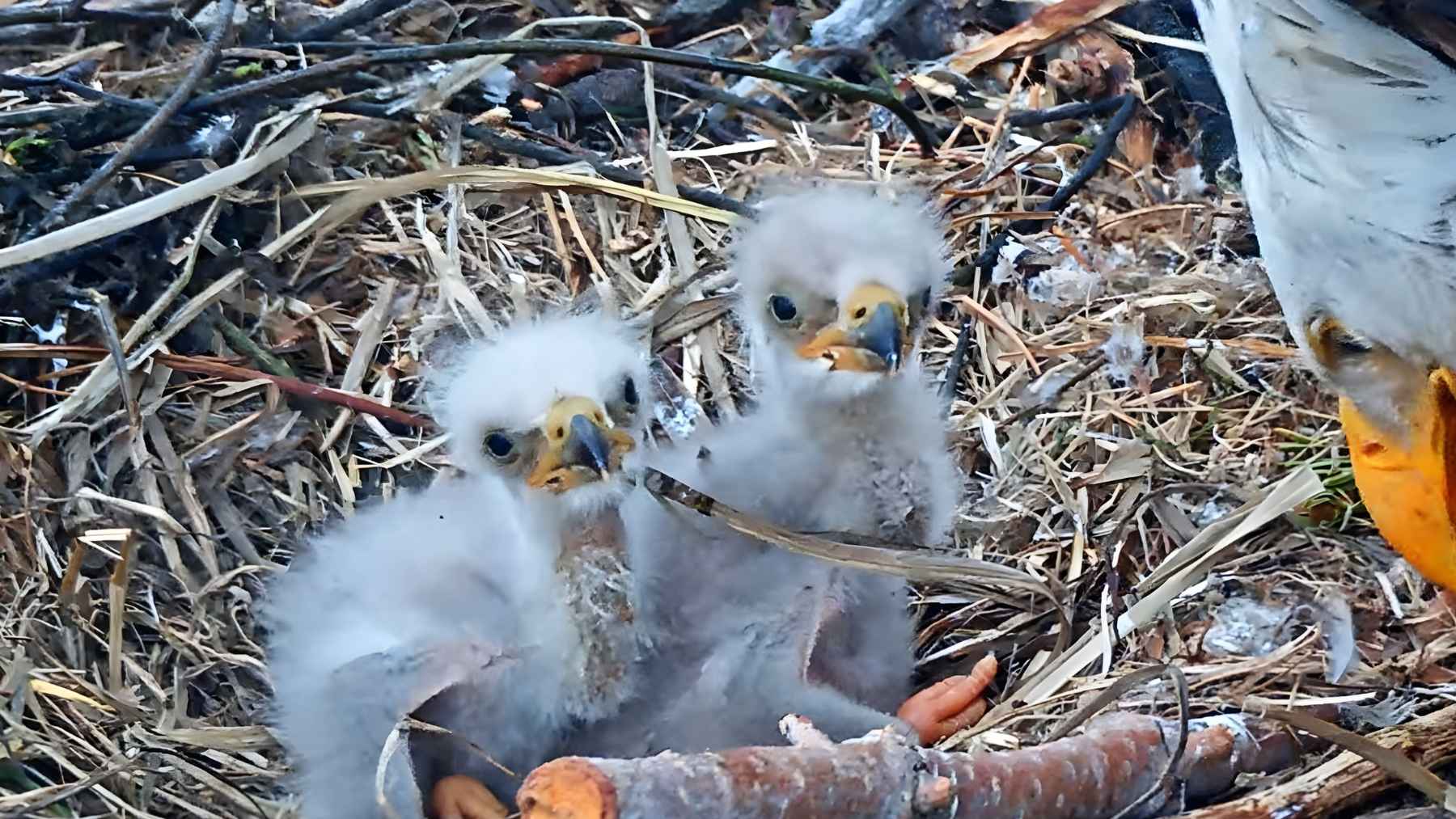
Two bald eagle chicks in a nest look up as an adult eagle feeds them, surrounded by twigs and natural debris.
Why an eagle leaves eggs during incubation
It can look risky when one adult lifts off while eggs are still in the nest cup. But when a threat is nearby, staying put can be the bigger gamble.
The U.S. Fish and Wildlife Service says bald eagles often have one or more alternate nests inside their breeding territory, and they can be intensely protective of the space around an active nest. If an intruder tests that boundary, a fast intercept can prevent repeat harassment later.
There is also a temperature angle that gets overlooked. The American Eagle Foundation explains that eggshells have tiny pores that let oxygen in and carbon dioxide out, and embryos generate heat as they develop, so a brief “egg break” can be less harmful than it looks, especially on warmer days.
From incubation to the first “pip”
Around this point in a season, viewers start hearing the term “Pip Watch.” A “pip” is the first small crack a chick makes in the shell, and it can be the moment everyone checks the cam like it is a live sports score.
East Tennessee State University’s eagle-cam guide describes how an eaglet uses an “egg tooth,” a small bump on the beak, to start cracking the shell from the inside. The full hatching process can take hours and sometimes more than a day.
For bald eagles, the bigger timeline is fairly steady. The U.S. Fish and Wildlife Service says adults typically lay one to three eggs, with hatching often around 35 days after incubation starts, though weather can stretch that window.
Warm days and the open beak signal
As spring temperatures rise, Jackie and Shadow have sometimes been seen with open beaks and a more restless posture. It can look like stress, but it is usually basic cooling, the same idea as a dog panting on a hot afternoon.
The Big Bear livestream project says this “panting” is normal for bald eagles, which do not sweat, and it can increase when temperatures climb. The Peregrine Fund notes that many raptors also use panting and “gular fluttering,” where throat muscles vibrate to speed up evaporation and dump heat.
Warmer weather can also change how long the eggs can be left safely. If the nest bowl is holding heat well, a short departure to chase off an intruder may not cool the eggs as quickly as it would during a cold snap.
What viewers can learn from nest cams
The drama can make it tempting to treat a nest cam like a reality show. But the better lens is ecology – this is what daily survival looks like when your home is a fixed point and rivals keep probing the edges.
Friends of Big Bear Valley runs the Big Bear Bald Eagle livestream and says its first nest camera was installed in 2015, with a wide-view camera added in 2021. Those cameras are built to be safe for wildlife and for the people who support the project.
The Big Bear Lake tourism update notes that the surrounding habitat is protected with a seasonal forest closure order that limits entry during nesting. For the humans, watching online is the low-impact option, and for the eagles, it is one less disturbance in a season when every interruption matters.
The original updates were published on the Friends of Big Bear Valley.