Astronauts aboard the International Space Station have switched on a newly upgraded NASA Cold Atom Lab, a minifridge-sized quantum physics facility controlled from Earth. The update should allow scientists to run experiments that are not possible on the ground and help test future quantum tools for space exploration and Earth science.
At the heart of the story is a simple but strange idea. When atoms are cooled to almost the coldest temperature nature allows, they stop acting like tiny bouncing balls and start behaving more like waves, opening a window into the rules that shape matter itself.
A tiny lab in orbit
The Cold Atom Lab is not huge. It is about the size of a minifridge, yet it performs work that would normally require a room full of lasers, mirrors, electronics, and careful vibration control.
That small size matters. Space aboard the station is limited, and every experiment has to earn its place. In practical terms, this lab turns part of the orbiting outpost into a testbed for quantum science.
Why cold atoms matter
Quantum science studies matter at very small scales, including atoms, electrons, and particles of light. At that level, nature can look odd, because particles can act like waves and may not follow the common-sense rules we see in everyday life.
The Cold Atom Lab chills atoms to below -459°F. That is just above absolute zero, the point where atomic motion comes close to stopping. At that extreme cold, atoms can gather into a Bose-Einstein condensate, a fifth state of matter beyond solids, liquids, gases, and plasma.
The fifth state
A Bose-Einstein condensate is sometimes described as a single large quantum object. That sounds strange, but the basic idea is easier to picture than the name suggests. Instead of many atoms moving around separately, the atoms begin to behave like one shared wave.
Why is that useful? Because scientists can observe quantum behavior on a larger scale than usual. It is a little like turning up the volume on a quiet song so you can finally hear the details.
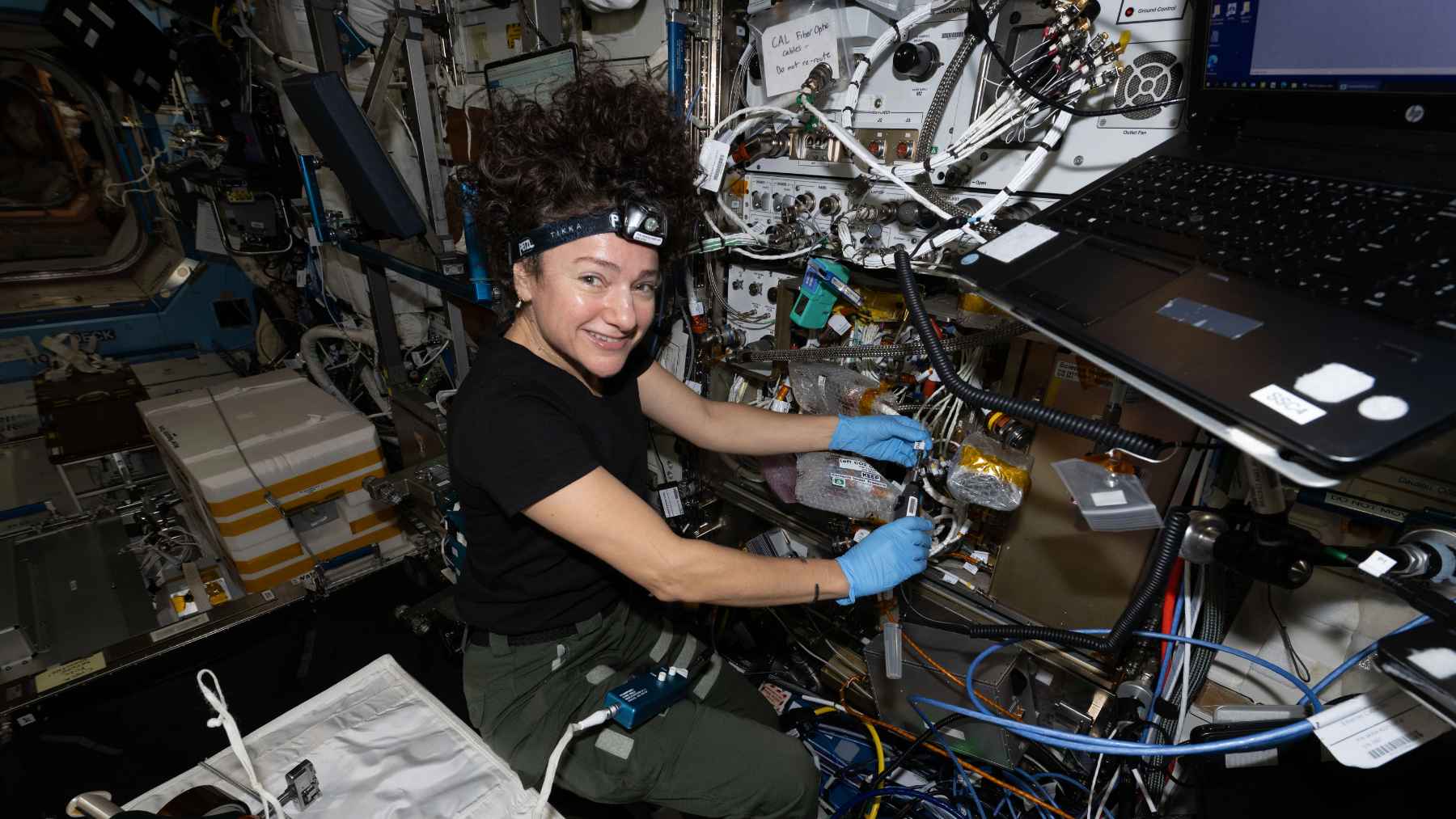
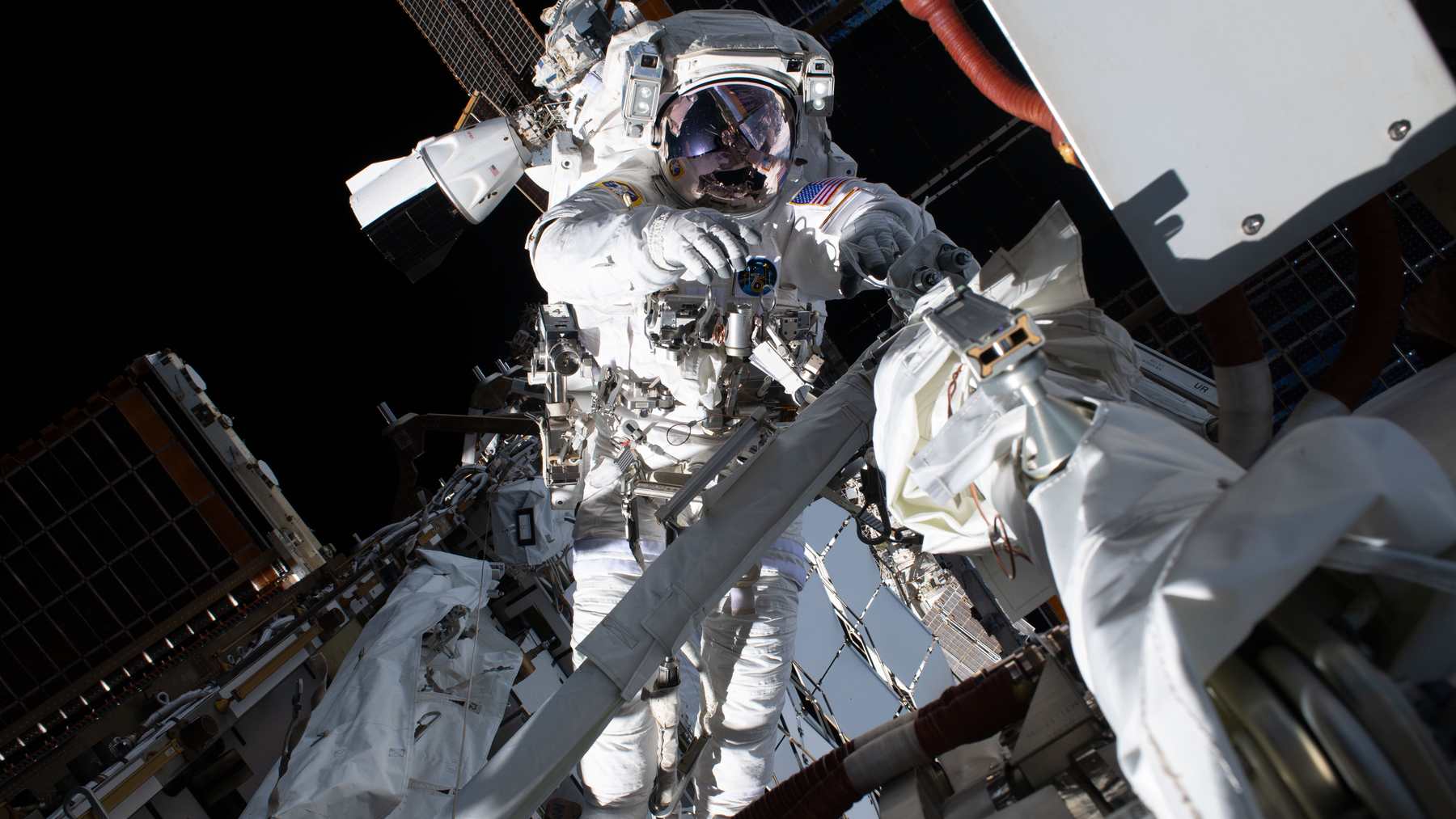
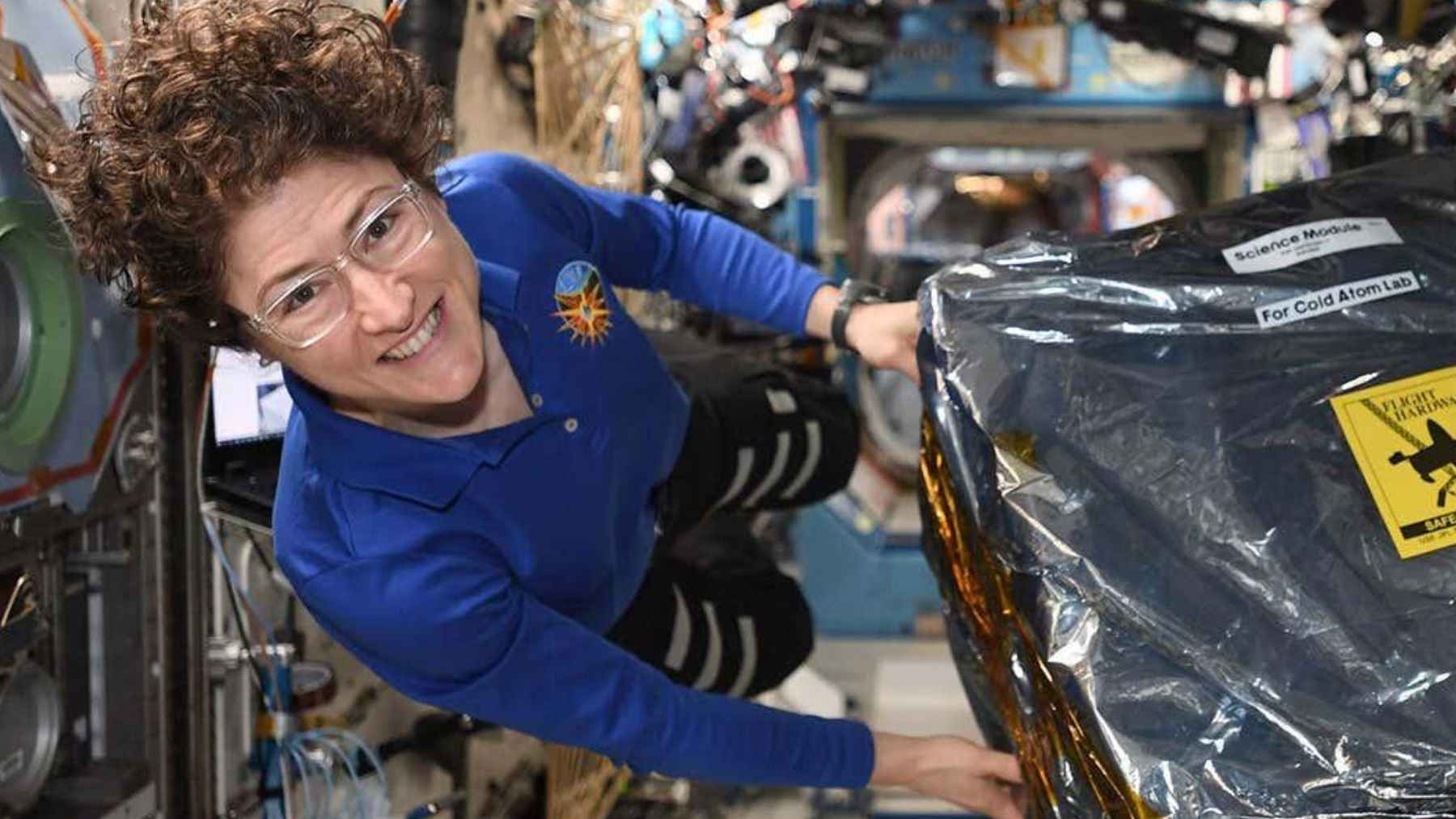
Astronaut Jessica Meir works on NASA’s Cold Atom Lab aboard the International Space Station, installing hardware upgrades that enable longer and more advanced quantum experiments in microgravity.
Microgravity changes the game
Cold atom experiments already exist on Earth, but gravity gets in the way. On the space station, microgravity lets the atom clouds stay together longer and spread into larger quantum waves. That gives researchers more time to study how the atoms behave.
This is where the orbiting lab has an edge. Low gravity does not make the science simple, but it removes one of the biggest obstacles. At the end of the day, the station gives physicists a cleaner stage for watching matter at its most unusual.
How the lab works
For each experiment, the system heats a thin strip of rubidium or potassium metal to about 750°F. That heat creates a gas inside the lab’s vacuum chamber, where lasers then slow the atoms down by draining away their energy.
After that first cooling stage, a magnetic trap holds the gas in place. Step by step, the lab lowers the atom cloud’s energy until it is moving very slowly, giving scientists more time to study it in orbit.
What changed in the upgrade
The newly improved science module launched on April 11, 2026, as part of a Commercial Resupply Services mission to the station. Astronaut Jessica Meir later inspected optical fibers while installing hardware updates aboard the orbiting laboratory on May 8, 2026.
This is the fourth upgrade since the Cold Atom Lab arrived at the station in 2018. The biggest changes include a redesigned magnetic trap that can alter the shape of quantum gas clouds and new metal strips that help create those clouds.
Scientists see a bigger future
Jason Williams, the project scientist for Cold Atom Lab at NASA’s Jet Propulsion Laboratory in Southern California, said that at the coldest temperatures, “matter behaves drastically different” from what humans normally experience.
He noted that ultracold matter could support highly precise measurements of time, gravity, and motion.
Ethan Elliott, the deputy project scientist, said the team is showing that quantum technology can work reliably in space. That matters because the first quantum revolution helped produce tools now woven into daily life, including lasers, cellphones, and medical imaging machines.
More than a physics demo
The upgraded lab supports five international teams studying fundamental physics, but the work is not just about answering abstract questions. It also tests whether quantum devices can survive and perform in space, where future missions may need better navigation, timing, and gravity sensing.
Kamal Oudrhiri, the Cold Atom Lab project manager, described the work as the closest thing scientists have to controlling the edge of the quantum world. That may sound dramatic, but the point is practical. Better control could one day help spacecraft navigate when GPS is unavailable or help researchers map subtle changes in Earth’s gravity.
Built for the long run
Earlier research in npj Microgravity described the Cold Atom Lab as a persistent quantum gas platform for the microgravity conditions of space. That work helped establish the case for putting such a delicate system aboard the station, where astronauts can support upgrades that would be impossible on a free-flying satellite.
Managed by Caltech in Pasadena, the Jet Propulsion Laboratory designed, built, and operates the facility. The latest upgrade shows how a compact experiment in orbit can keep evolving, instead of staying frozen in the design it had on launch day.
Why it matters
For most people, quantum physics can feel distant from daily life. Its earlier breakthroughs, however, helped power familiar technology, from phone electronics to hospital scanners. The next wave may be less visible at first, but it could shape how scientists measure gravity, motion, and time.
So, this is not just a story about making atoms cold in space. It is about building tools precise enough to notice what ordinary instruments miss. Small lab. Big questions.
The official press release has been published by NASA’s Jet Propulsion Laboratory.