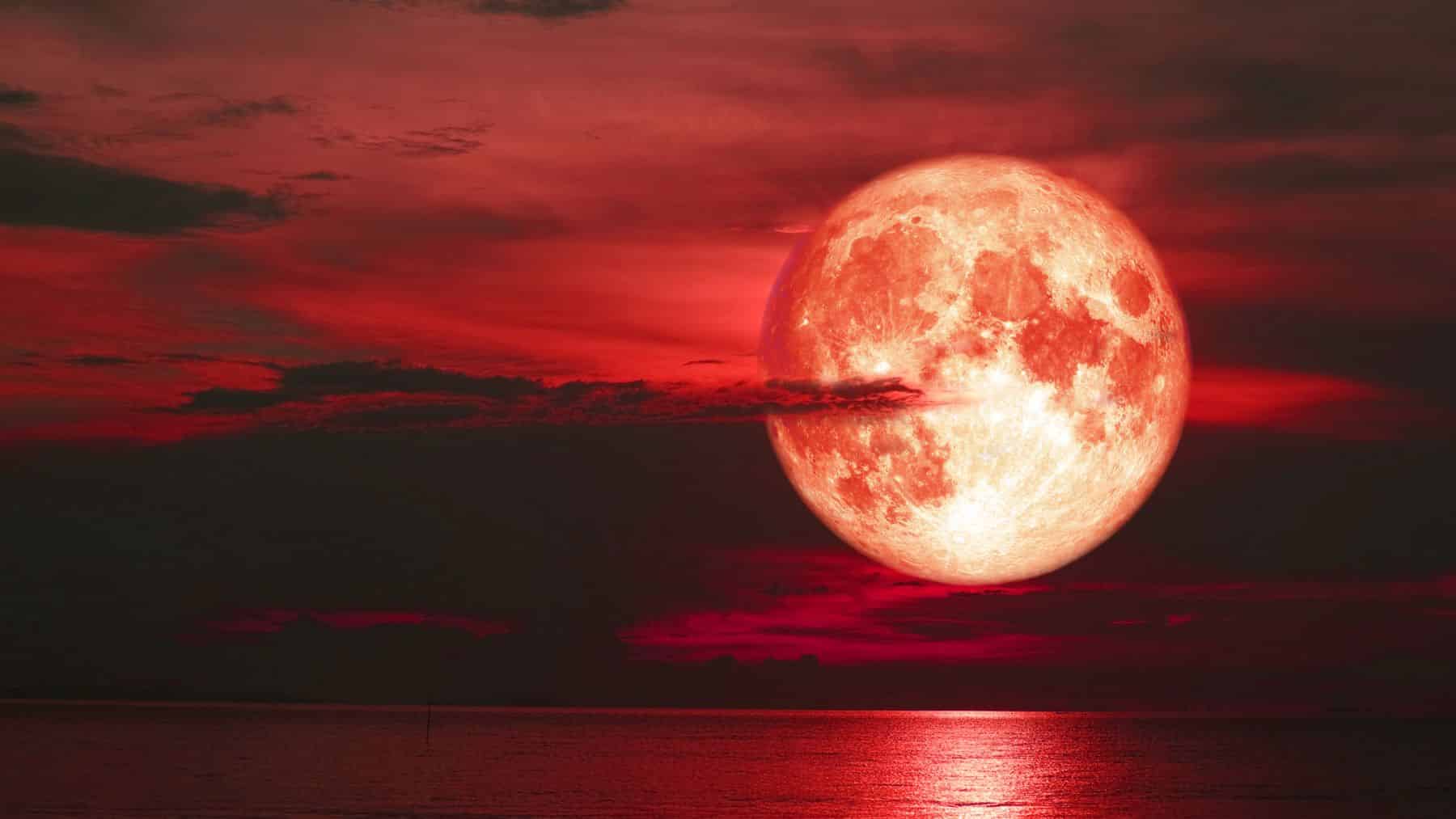
The U.S. population will be able to observe a “Blood Moon” total lunar eclipse between March 13 and 14, 2025. The Sun requires the Moon to align behind Earth during its movement to create the momentous Blood Moon effect. The spectacle is not beautiful since it demonstrates the orbital trends of solar system bodies.
Here’s why the Moon turns blood red during this rare event
Between Earth, the Sun, and the Moon lie during total lunar eclipses, preventing solar light from reaching the Moon. The atmospheric light passage concentrates sunlight strongly while scattering blue wavelengths and allowing red wavelengths to pass through. This is precisely why we observe sunrises and sunsets as being a shade of red. At a total lunar eclipse, this red light shines on the Moon in an ethereal, beautiful shade of a “Blood Moon.”
The Blood Moon can be viewed everywhere in a vast portion of North America, although best in Western and Middle America. The states best seeing this spectacle of Blood Moon are California, Nevada, Oregon, Washington, Idaho, Montana, Wyoming, Utah, Colorado, New Mexico, Arizona, and Texas. The states above see all of this spectacle of Blood Moon, in which all of it can be viewed. The other U.S. states see partial views, although states as above see it in all its best visibility.
Follow these expert tips to experience the Blood Moon at its best
The best experience of this astronomical display requires open sky visibility. Choose a site that provides unlimited sky observation positioned outside urban pollution areas. Countryside (related research) locations or the upper floors of buildings have perfect views. Checking the weather is also a requirement, as it is required for a clear view. While it is possible to see Blood Moon using an unassisted eye, a pair of binoculars or a telescope can enrich the experience of seeing more detail on the moon’s face.
Long exposure modes can be enabled on your camera for a more precise shade of red in case a click is desired. Prepare a mounted smartphone on a tripod or a mounted camera for stability and to prevent blurred imagery. With cold weather being a possibility in March, it is best dressed in warm clothing and has blankets and a pair of folding chairs for a cosy experience.
Why this rare celestial event has fascinated humans for centuries
A Blood Moon is a rare and lovely event that, all these years, amazed humankind. In all civilizations, it is an omen, a portent, a time of great portent. Modern society uses the phenomenon to remember the universe’s magnificent and abundant nature. When sunlight encounters Earth’s atmosphere during a total lunar eclipse, it scatters most colors, leaving only red hues to illuminate the moon. This is not an eye spectacle but rather a time of learning about the mechanisms of the solar system.
Throughout time, lunar eclipses have been a matter of myths, legends, and scientific study. In the past, it was a time when civilizations looked in a mix of fear and respect, seeing Blood Moon as a portent of gods, an omen of great events. In this modern time, despite explanations of this event, Blood Moon is a source of excitement and a source of motivation. The total lunar eclipse of 13-14 March 2025 is an event not to miss for anyone who is a science enthusiast, an astronomy enthusiast, or wants to see the spectacle of night.
If you are a stargazing enthusiast (here’s another research), a periodic observer, or wish for a night spectacle, Blood Moon is the experience of a lifetime. When Earth stands between the Moon and sunlight, the Moon turns into dark red or copper-colored fire. During this period, the atmosphere refracts sunlight, scattering blue wavelength light and creating a red-colored effect. The spectacle is visible globally in various regions, so find your best local time. Make a calendar entry, find a place, and stand in awe of this night spectacle.