The 2018 heat wave pushed surface water in the Baltic Sea to about 81 degrees Fahrenheit (27 °C) on August 1, from the Bornholm Sea to the waters around Sweden’s island of Gotland, according to satellite readings. On some July days that year, southern Scandinavia was hotter than parts of Spain.
The warmest Baltic year on satellite record
Herbert Siegel and Monika Gerth of the Leibniz Institute for Baltic Sea Research Warnemünde, in Germany, follow the sea’s skin temperature from orbit each year for HELCOM, the Baltic Marine Environment Protection Commission. Their record starts in 1990.
Their 2018 report found surface readings of up to 27 °C in the central Gotland Sea, the deep basin around the island, on August 1, with 22 to 25 °C in the Gulf of Bothnia.
By their measure, 2018 was the warmest year since 1990 in satellite-derived sea surface temperature, as it was in air temperature. Averaged across the whole Baltic, the sea came out 1.19 kelvin, or about 2.1 degrees Fahrenheit, above the 1990 to 2018 mean, a hair ahead of 2014. From May through August, monthly anomalies hit 7 to 9 degrees Fahrenheit (4 to 5 degrees Celsius).
A high-pressure block sat over the north
According to the World Meteorological Organization, a clear north-south divide opened in Europe’s weather in June and lasted well into July, with temperatures far above average in the north.
The Copernicus Climate Change Service traced it to a blocked weather pattern, with remarkably high surface pressure over the British Isles and the North Sea. Air sinking inside the high-pressure system warmed the lower atmosphere, set records in several places and kept clouds and rain away.
July was stranger still. Temperature anomalies in Scandinavia passed 6 °C above average, and “on some days, the actual temperatures in southern Scandinavia were higher than in parts of Spain,” Copernicus reported. Portugal and parts of Spain were left out of the above-normal heat.
Inside the Arctic Circle, temperatures topped 30 °C, the WMO said, and Bardufoss, in northern Norway, hit 92.3 degrees Fahrenheit (33.5 degrees Celsius) on July 17.
The European Centre for Medium-Range Weather Forecasts found the strongest anomalies around the Baltic from April through August, with close to normal temperatures around the Mediterranean on average. The south still got its heat, though. On August 4, temperatures reached 45 °C, or 113 degrees Fahrenheit, in Spain and Portugal.
Brown fields and fires in Sweden
The European Space Agency put two Sentinel-3 pictures of western Europe side by side. The first, from June 28, 2018, is mostly green with healthy vegetation. The second, from July 25, is mainly brown.
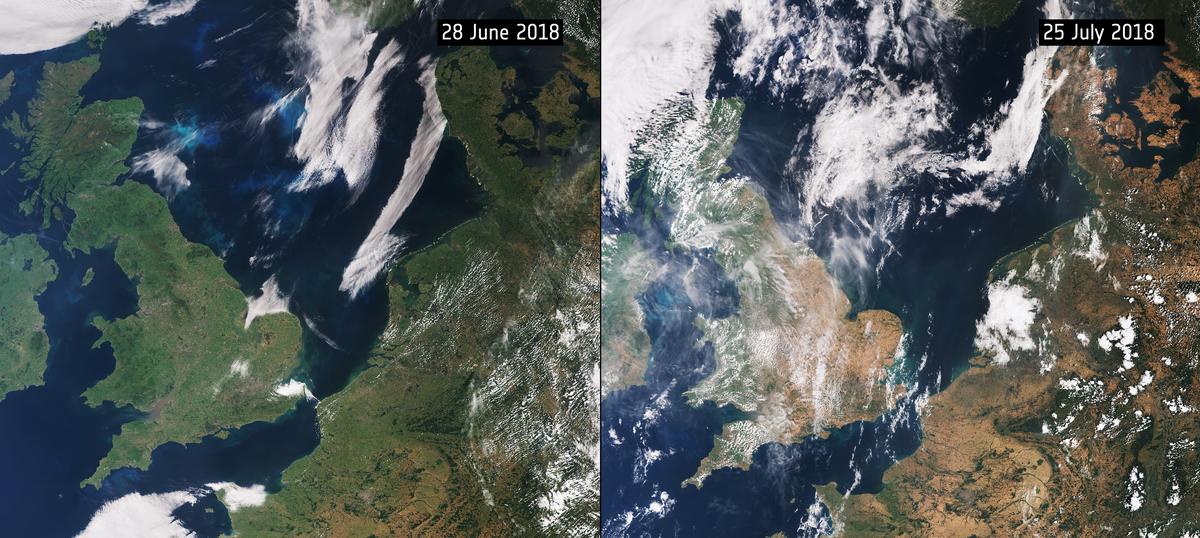
Large areas of Sweden, southern Finland and the Baltic countries got less than 80 percent of their usual rain in spring, summer and autumn, and Copernicus judged the drought in northern Europe as severe as 1976, the summer of a legendary British heat wave.
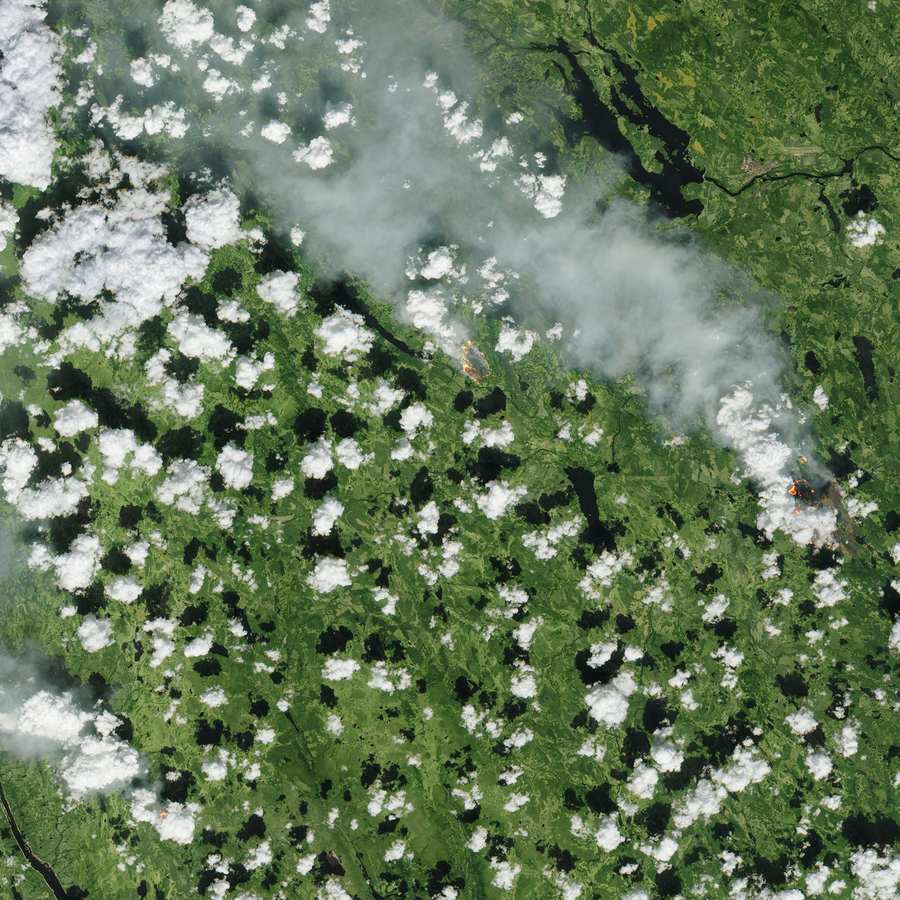
Sweden suffered “the worst outbreak of forest fires on modern record,” with about 50 forest fires burning in mid-July, the WMO said. ESA’s Sentinel-2 caught flames and smoke on July 17, with fires as far as the Arctic Circle, and Sweden called on other European Union countries for help.
Algae bloomed in the warm water
Petteri Taalas, then secretary-general of the World Meteorological Organization, said lake and sea waters had been 5 to 6 °C warmer than normal. That led to “the most severe algae blooming in the Baltic sea for decades,” he warned, leaving water poisonous for people and animals and causing difficulties for nuclear power plant cooling systems.
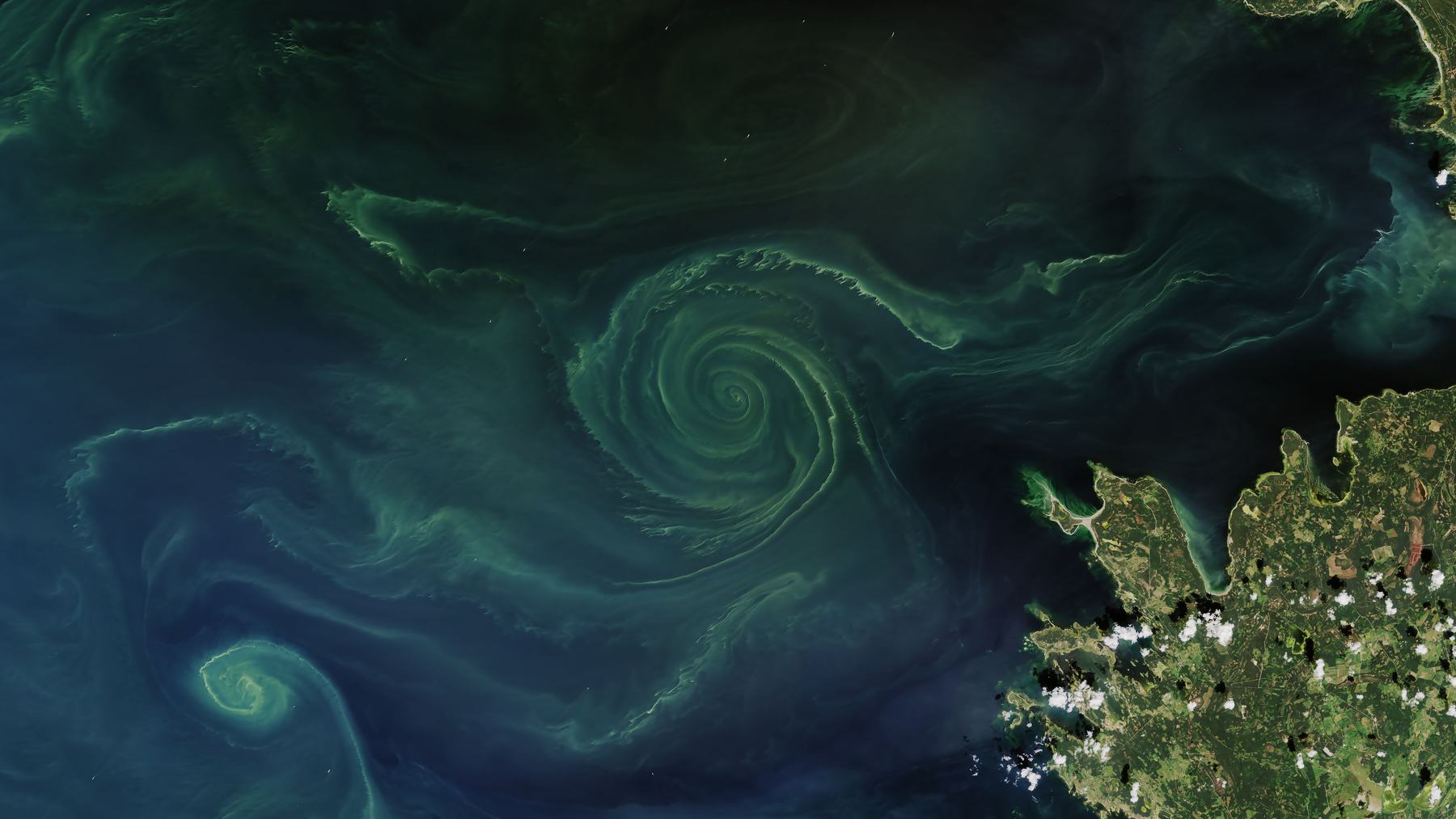
The HELCOM report traces the bloom to spring, when warm water brought temperatures of 18 to 20 °C to the central Gotland Sea in early June and set off an early development of cyanobacteria. Cyanobacteria, often called blue-green algae, are photosynthetic microbes, and some make toxins.
On July 18, Landsat 8 photographed a green spiral in the Gulf of Finland. NASA’s Earth Observatory said the phytoplankton traced the edges of a vortex, possibly an eddy pumping up nutrients from the depths, a job ocean eddies do along many coasts.
Heat that stayed below the surface
Baltic researchers define a marine heat wave as a period when the ocean’s surface temperature stays above the 90th percentile of the 30-year local mean for more than 5 days. The same yardstick has flagged warm water pushed far north off Japan.
Bronwyn Cahill, an oceanographer at the Leibniz Institute for Baltic Sea Research, led a 2024 study of the Arkona Sea, the western basin between Germany’s Rügen island and southern Sweden. The team found two separate marine heat waves there between May and August 2018. The first lasted 38 days, from May 13 to June 19, and the second 16 days, from July 25 to August 9.
“These heatwaves bookended an extended period of phytoplankton growth in the region,” the authors write. Phytoplankton are the drifting microscopic algae that feed almost everything else in the sea, and the May heat wave gave them optimal conditions, with enough light and nutrients.
Below the surface, temperature anomalies of up to 8 °C, about 14 degrees Fahrenheit, persisted at 49 to 66 feet (15 to 20 meters) for up to 15 days after the heat wave had vanished from the surface.
What the comparison leaves out
The HELCOM report covers the Baltic alone, so it says nothing about whether the whole sea was ever warmer than the whole Mediterranean. Even inside the Baltic, the record was patchy. Siegel and Gerth found 2014 warmest in the western and northern Baltic and 2018 in the large Gotland Sea.
The Arkona Sea results lean on a computer model, checked against the MARNET Arkona Buoy and NOAA satellite data, and cover one basin. Copernicus adds that attributing single weather events to climate change is never easy or even possible, though the WMO cited a rapid study that found such northern heat had become more than twice as likely.
From 1990 to 2018, Baltic surface water warmed about 1.1 degrees Fahrenheit (0.59 degrees Celsius) per decade, fastest in the Gulf of Bothnia and the Gulf of Finland. “This is not a future scenario. It is happening now,” WMO Deputy Secretary-General Elena Manaenkova said in July 2018.
The 2018 sea surface temperature assessment was published by HELCOM, and the Arkona Sea study appeared in Frontiers in Marine Science.
Image: NASA Earth Observatory / Joshua Stevens and Lauren Dauphin, Landsat data from USGS