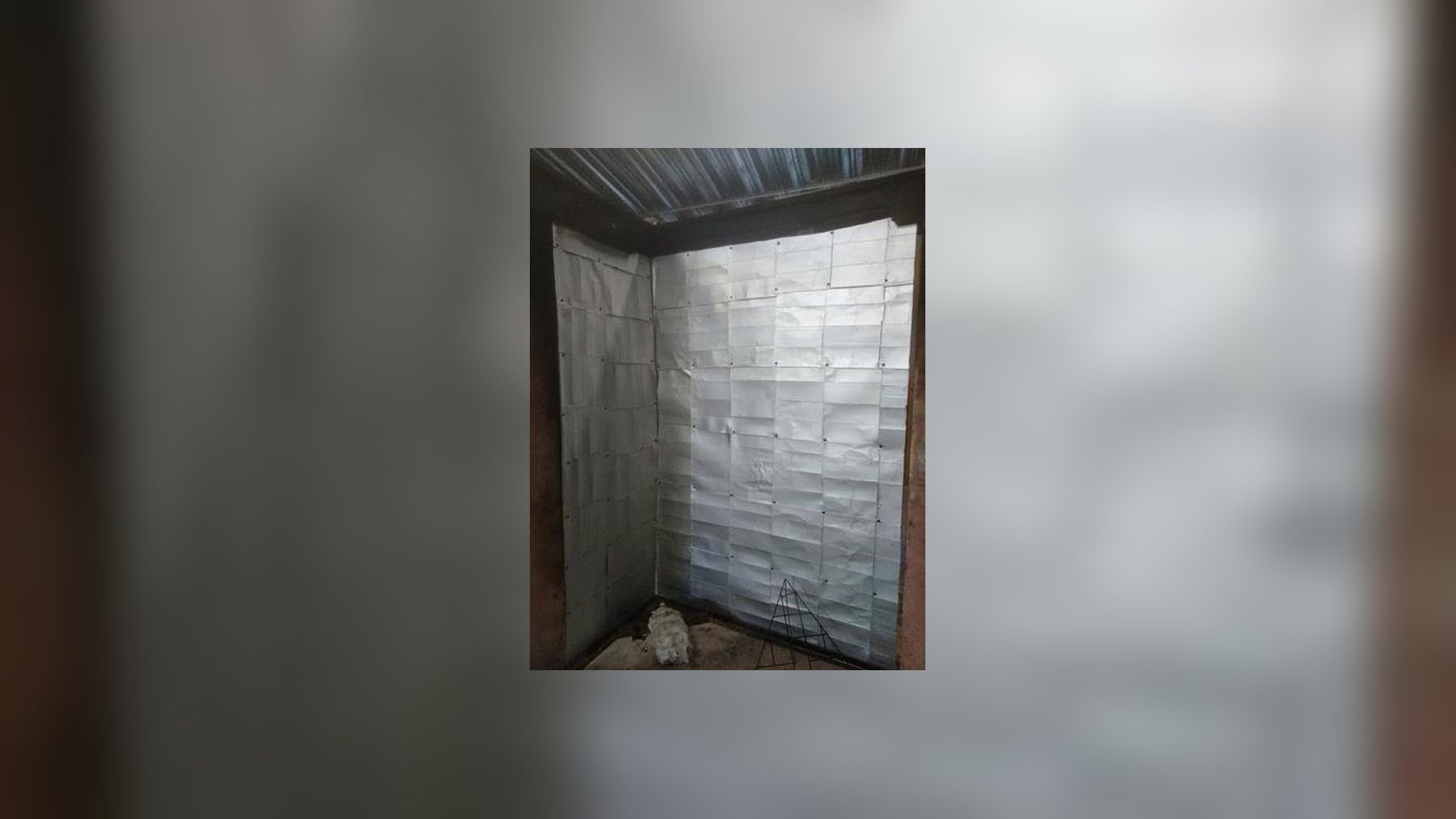
At a fire lab at Brazil’s Unisinos University, strips of Tetra Pak carton, the material promoted online as a cheap way to keep heat out of homes, carried flames nearly 6 inches in 14 seconds when lit from the cut edge. A 2017 Brazilian thesis had found that carton sheets cut the peak temperature on a test roof’s surface by up to 17.6°F (9.8°C), but the air inside improved less.
The fire researchers, led by first author Júlia dos Santos Beck Schultz, concluded that the packaging “should not be used as a lining for the internal surfaces of buildings.”
A fix born in Brazil’s poorest homes
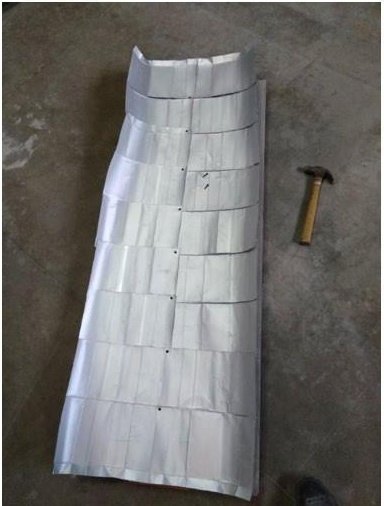
The fire study calls Tetra Pak sheets used in place of missing insulation a common sight in humbler neighborhoods. Volunteers with a project called Brasil sem Frestas staple or stitch the opened boxes together and screw the panels to inside walls and roofs.
Cheap fixes for hot roofs turn up all over the world, from Indian roofs built from cardboard and farm waste to a Brazilian mechanic’s water-filled bottle pushed through a roof tile.
The researchers warn that people without technical training end up choosing materials that may not suit buildings. A carton is built from layers of paperboard and aluminum, finished with polyethylene, a common plastic, and the manufacturer indicates it for food use only.
Two security booths in Curitiba
The best cooling numbers come from the abstract of a 2017 master’s thesis by Graziela Yumi Suetake at the Federal University of Technology – Paraná (UTFPR), who worked with two identical white fiberglass security booths in Curitiba.
Under the roofs she placed 2-inch (50-millimeter) polystyrene boards, a commercial double-sided foil, or carton sheets. With the aluminum face turned up toward the roof, the cartons cut the maximum surface temperature by 9.8°C (17.6°F).
Sheets made of two cartons glued back to back, with both shiny faces exposed, cut it by 9.3°C (16.7°F).
In 2018, Eduardo L. Krüger, Suetake and Adalberto Matoski of UTFPR published the work in Building and Environment. The carton sheets “showed a reduction in the roof’s inner surface temperature, comparable to commercial insulating sheets, though with lesser effect on indoor temperatures,” they write, and the booths’ poor design offset gains indoors.
A cooler ceiling is not a cooler room
The 17.6°F figure describes the hottest reading on a surface, while the air a person breathes also depends on walls, windows, floors and leaks. Viral posts have promised rooms up to 10.8°F (6°C) cooler, without naming the homes or measurements behind the claim.
Field studies in real Brazilian homes are less flattering. In Santa Maria, researchers who monitored carton-lined houses of socially vulnerable families on summer days measured high temperatures and humidity, the fire study notes.
In Passo Fundo, researchers studied a dwelling built from discarded materials and lined with cartons, and found that the cartons alone did not reduce discomfort, especially from the cold.
As early as 2008, researchers at the Federal University of Santa Catarina warned that many products look like radiant barriers but lack low emissivity, a measure of how readily a surface gives off heat as infrared radiation. The fire study cites 0.04 for the shiny side of a carton, which it says could help a building’s thermal performance if proven safe.
Shiny foil needs an air gap
A radiant barrier is a reflective layer that blocks heat traveling as infrared light, the warmth you feel from a hot stovetop without touching it. It does nothing for heat that creeps through solid materials.
“A radiant heat barrier must have an air space next to a reflective side to be effective,” explains a Virginia Cooperative Extension guide from Virginia Tech. Without that gap, the guide says, the barrier acts as a conductor and passes the heat along, and dust and dirt reduce its effectiveness.
You still need insulation, the guide adds, and a radiant barrier saves much less in an attic insulated to R-30 or above than in one at R-11 or less. Researchers keep testing new insulating materials, such as a wood foam developed in Maine.
The U.S. Department of Energy’s Building America Solution Center says a radiant barrier system can cut heat flow from the attic into the house by about 40 percent. That typically equates to 8 to 12 percent of annual cooling costs, the guide says, not the 40 percent cut in energy use many advertisers claim. Its checklist for choosing a product also includes a fire rating required by building codes.
Fourteen seconds at the edge
Schultz’s team ran the tests at Unisinos’ Technological Institute of Performance and Civil Construction. The first was a furnace at 750°C (1,382°F). The temperature inside rose by 114°C, the sample’s mass fell from 34.012 to 4.148 grams and flames lasted more than 2 minutes, so the material “failed all three normative criteria,” the paper reports.
Then a propane flame went against carton strips, on the face and on the cut edge. The standard requires flames to stay below the 150-millimeter (5.9-inch) mark for at least 1 minute, but at the edge the material failed from 14 seconds, with the back surface burning too.
Stapled panels are full of cut edges. Tested only on its face, the team notes, the material would have been rated Class V-A. With the edge, it fell to Class VI, and wall linings in homes need IV-A at most.
In the last test, carton panels were stapled to a wooden frame shaped like the corner of a room, with a 30.7-kilowatt gas burner at its base. Flames reached half the sample’s height right after ignition, and after 26 minutes the area hit by the fire was totally destroyed.
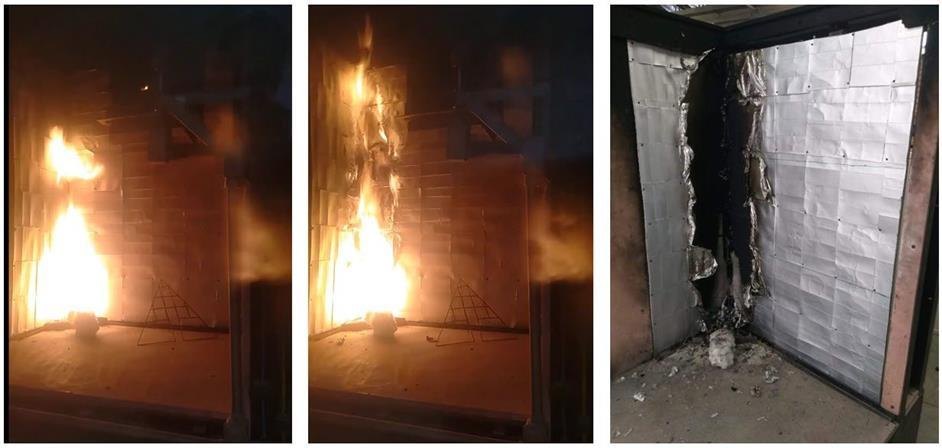
If a flame touched the edge of the boxes inside one of these houses, the authors write, it would spread very rapidly and be very hard to stop.
What these tests cannot tell a homeowner
The authors stop short of saying any given house will burn. A real fire is hard to predict, they write, but it is possible to define how much a product raises or lowers the odds of one developing.
The cooling evidence comes from two guard booths in Curitiba, where Suetake recorded surface temperatures. None of these studies put carton sheets in an American attic.
“Even with an appeal to sustainability, it is unacceptable for materials that do not meet safety requirements to be considered for their use in any built environment,” the authors write. The full study was published in Ambiente Construído.
Image: Schultz et al. / Ambiente Construído, CC BY 4.0