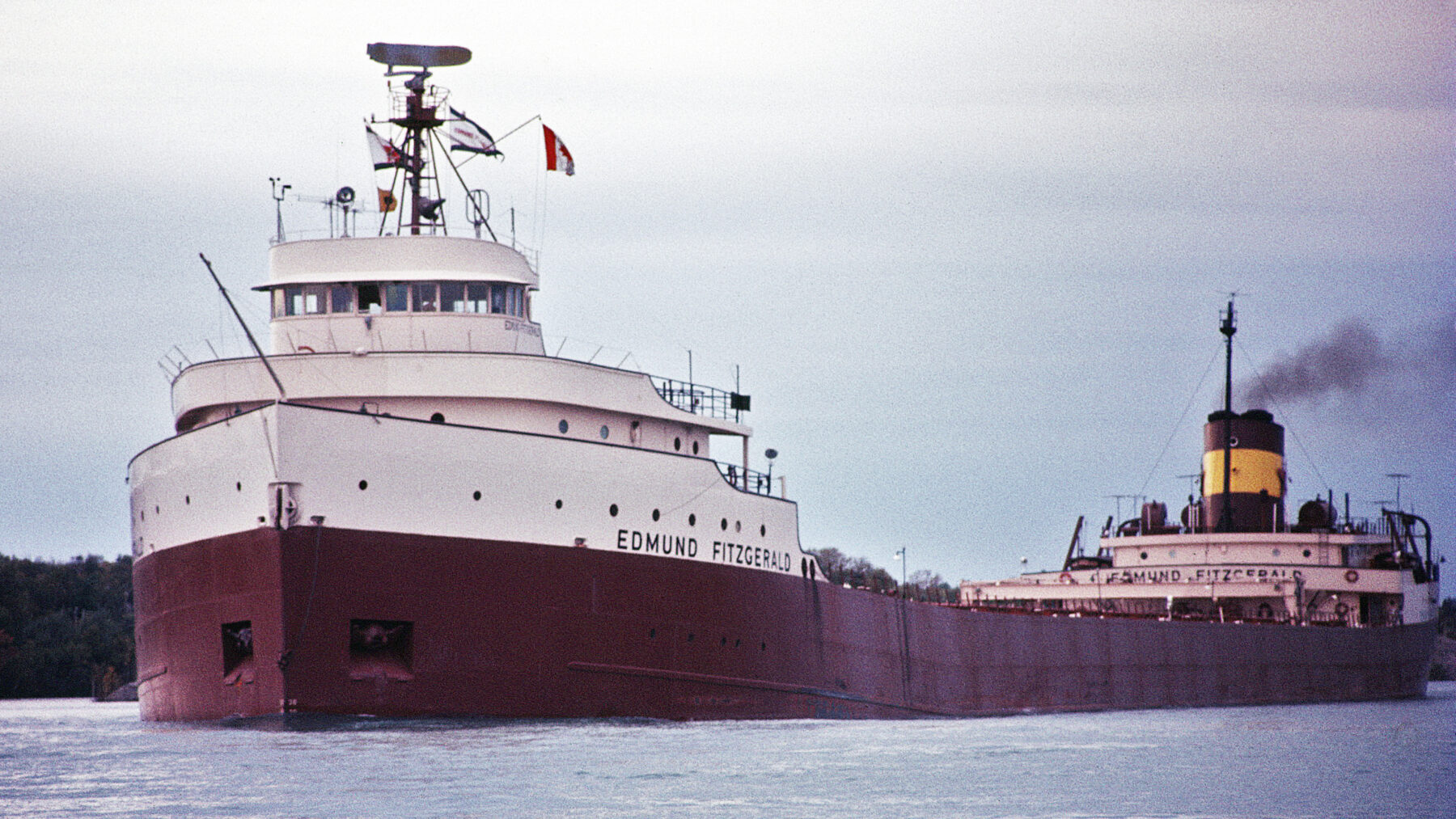
The Edmund Fitzgerald, the 729-foot ore boat that went down with 29 men on November 10, 1975, rests in 530 feet (161.5 meters) of Lake Superior water as “an upright bow section, an inverted stern section, and debris from a missing 200-foot midship portion,” in the words of the National Transportation Safety Board (NTSB). Its bow is buried in mud to the 28-foot draft mark.
She sank at about 7:15 p.m. “No distress call was heard by vessels or shore stations,” the board wrote, and no bodies were ever recovered.
Ten minutes before she slipped off radar, the freighter behind her asked about her problems. “We are holding our own,” the Fitzgerald answered. Nobody heard from her again.
“Don’t allow nobody on deck”
She’d left Superior, Wisconsin, around 2:30 p.m. on November 9 with 26,116 long tons of taconite, iron ore “heated and rolled into marble-size balls,” for Zug Island in Detroit, according to the Great Lakes Shipwreck Historical Society. Captain Ernest M. McSorley had commanded her since April 1972. From her 1958 launch at River Rouge, Michigan, until 1971 she’d been the biggest ship on the lakes, about two football fields long with the end zones.
The Arthur M. Anderson, under Bernie Cooper, trailed by 10 to 15 miles. Gale warnings went up at 7 p.m. that evening and became storm warnings before dawn.
By the afternoon of the 10th, southwest of Michipicoten Island, the Fitzgerald told Cooper she would “continue on” although she was “rolling some.” Around 3:30 p.m., northeast of Caribou Island, she called again: “I have a fence rail down, have lost a couple of vents, and have a list.” Both pumps were going, the crew said.
At 4:10 p.m. her radars were gone. Then the Coast Guard at Grand Marais, Michigan, told her the radio beacon at Whitefish Point wasn’t working. Sometime after 5 p.m., while McSorley talked to the pilot of the Swedish ship Avafors, his transmitter stayed keyed and the Avafors heard him tell someone, “Don’t allow nobody on deck.” He said he had a “bad list” and was in one of the worst seas he’d seen.
Cooper later put the waves south of Caribou Island at 18 to 25 feet (5.5 to 7.6 meters), with gusts of 70 or 75 knots. A National Weather Service meteorologist testified that “the average sustained wind speed was 45 knots from the northwest for a period of 6 to 7 hours.” At 8:32 p.m., the Anderson told the Coast Guard the Fitzgerald may have suffered a casualty.
Sixteen clamps and a shoal
Divers didn’t do the looking. In May 1976 the Navy’s unmanned CURV III made 12 dives, spent 56 hours and 5 minutes on the bottom and shot 43,255 feet of videotape. The stern lay upside down about 170 feet from the bow. Hatches 7 and 8 had lost their covers, and on hatch No. 5 only the first and eighth of 16 clamps were bent or broken; the other 14 were “undamaged and in the open position.”
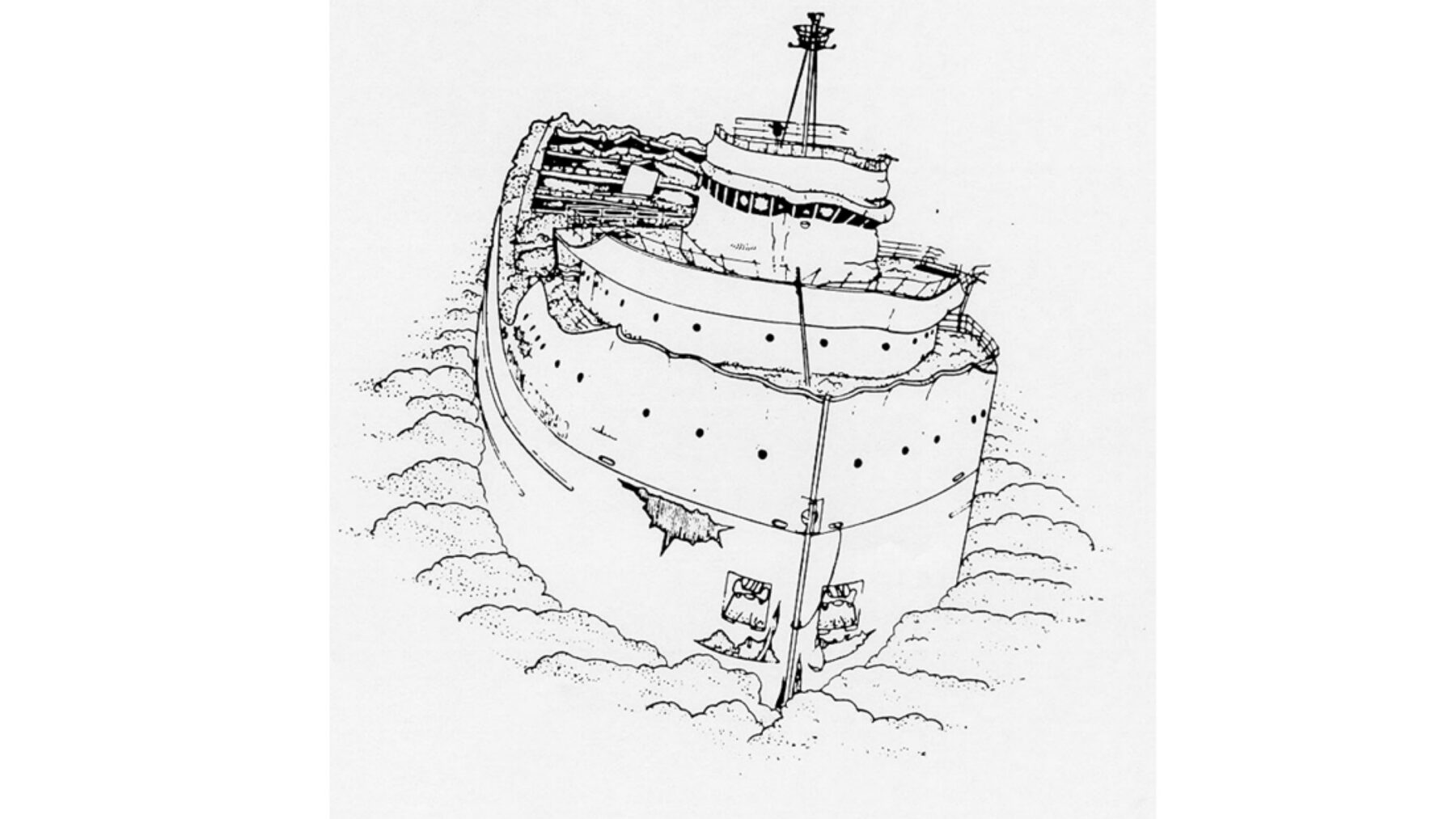
That’s the crux. The Coast Guard’s Marine Board of Investigation, reporting in July 1977, blamed flooding through hatch closures that didn’t keep water out, and said it couldn’t tell whether every clamp had been fastened. The NTSB, on May 4, 1978, settled on “the sudden massive flooding of the cargo hold due to the collapse of one or more hatch covers.”
Philip A. Hogue, one of the board’s members, dissented. The cause, he wrote, “was a shoaling which first generated a list, the loss of two air vents, and a fence wire,” followed by three to four hours of flooding nobody caught. He dismissed the hatch theories as blind to the list and the lost vents arriving “at approximately the precise time the FITZGERALD was reportedly in or over shoal waters.” Seas of “25 to 30 feet and winds gusting to 80 knots were variously observed,” he added.
Chairman James B. King wrote a reply, citing “the controversy it has engendered.” The “6-fathom spot” on Lake Survey Chart No. 9, he said, had been shown by survey not to exist. Getting there by 3:30 p.m. would have meant crossing “mountainous seas at a speed greater than her top speed,” which was 16.3 mph. And the majority report said grounding on the boulders north of Caribou Island “would probably have extended into the bottom plating of the stern section,” where the cameras found nothing.
Even so, the board told NOAA to fix that chart.
The bell at Whitefish Point
The historical society says the ship’s story “is surpassed in books, film and media only by that of the Titanic,” helped along by Gordon Lightfoot’s 1976 ballad. Its own expeditions reached the wreck in 1989, 1994 and 1995. On July 4, 1995, with the National Geographic Society, the Canadian Navy, Sony and the Sault Ste. Marie Tribe of Chippewa Indians, it raised the 200-pound (90.7-kilogram) bronze bell, which now hangs in the Great Lakes Shipwreck Museum at Whitefish Point.
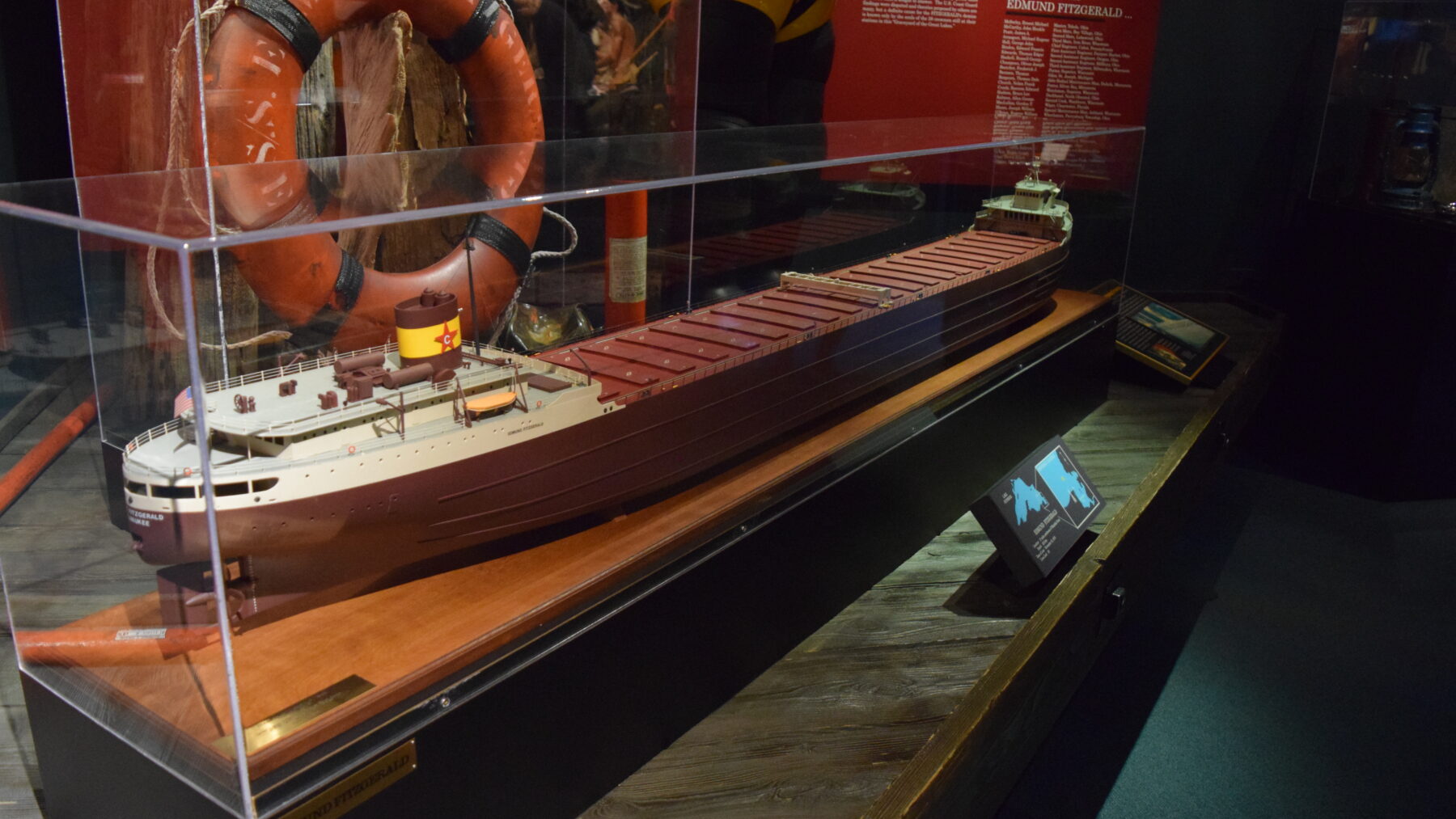
She isn’t alone down there. NOAA’s Thunder Bay National Marine Sanctuary in Lake Huron protects nearly 100 historic wrecks, including the 191-foot Ironton, upright with three masts still standing. Storms keep exposing old hulls elsewhere, too, like the one a nor’easter dug out on Nantucket.
The museum will hold a private memorial for Fitzgerald families at 7 p.m. on Tuesday, November 10, 2026, and stream it online. There won’t be a daytime event this year.