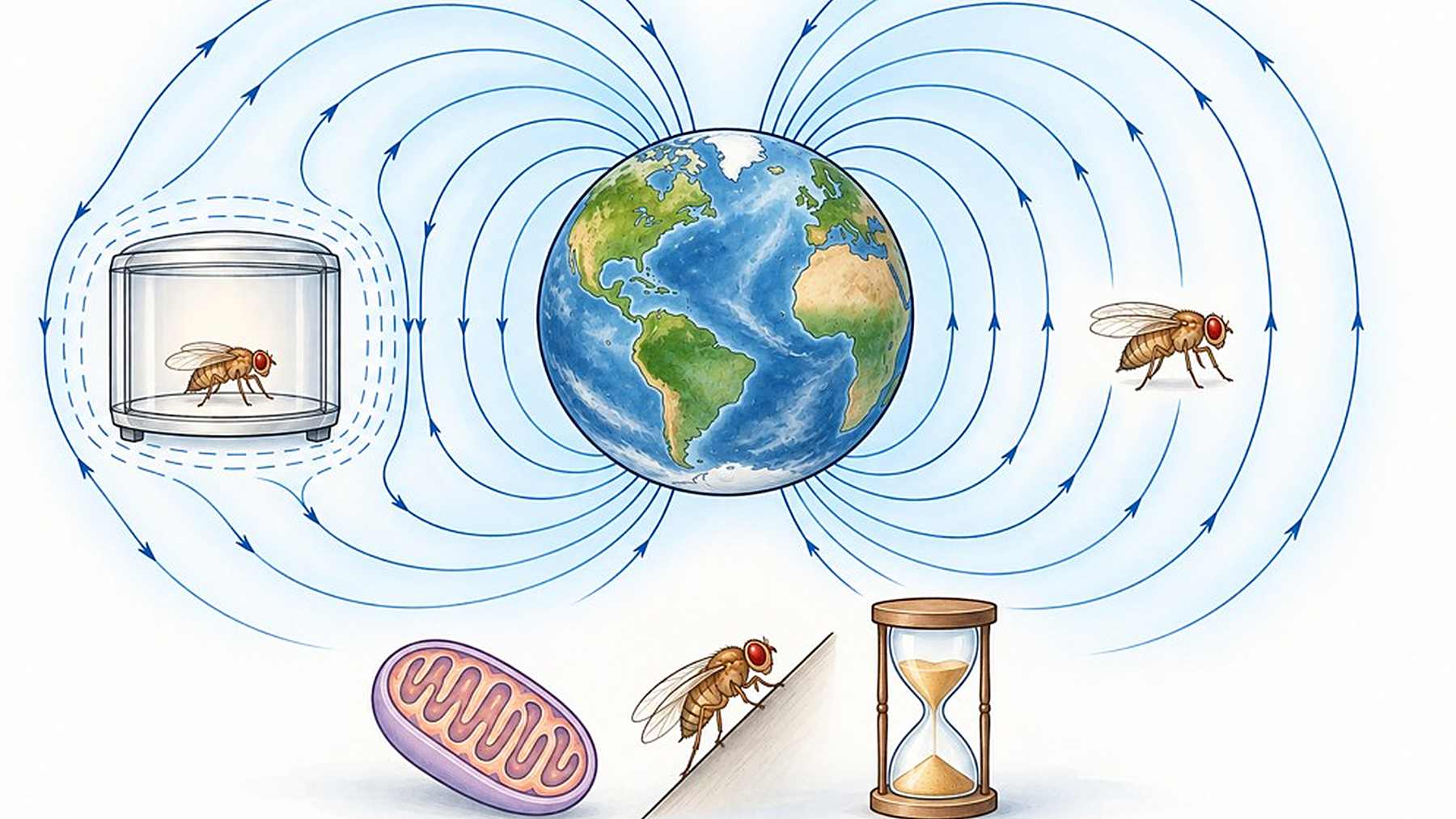
Fruit flies with a defect in a Parkinson’s-linked gene lived about 20 percent longer when shielded from Earth’s magnetic field, according to a University of Nottingham study. The longer life came with a cost. The same flies got worse at climbing the walls of a glass vial.
Professor Lisa Chakrabarti and doctoral candidate Jacob Reed, of the university’s School of Veterinary Medicine and Science, led the work. It appeared in the journal Aging on September 23, 2026. Healthy flies went the other way, with slightly lower survival and better climbing, which suggests the planet’s magnetic field matters differently depending on the state of an animal’s cells.
Inside a benchtop magnetic shield
The team kept the insects in a MuMetal benchtop shield made by Magnetic Shields Limited, a British company. Probe readings put the field inside at about 5.6 nanotesla. Earth’s own field ranges from 25 to 60 microtesla, which makes the shielded field thousands of times weaker.
Male flies went into the shield at 10 or 20 days old and stayed there. Comparison groups lived outside under the same light, noise and temperature. All stocks were kept in the dark at about 68°F (20°C).
“We live our entire lives within the Earth’s magnetic field,” Chakrabarti said in the university’s announcement. The field passes through every living thing, she added, “yet we know surprisingly little” about how it affects cells.
Why Pink1 flies are useful
The researchers compared normal flies with flies lacking a working Pink1 gene. In people, the matching PINK1 gene is tied to an inherited, early-onset form of Parkinson’s disease. Studies have also linked the illness to exposures such as the weed killer paraquat.
According to MedlinePlus, the PINK1 protein appears to help protect mitochondria. These tiny structures make most of a cell’s usable energy. Flies without the gene develop damaged mitochondria, movement problems, nerve-cell loss and shorter lives, so labs use them to model the disease.
Because the mutation sits on the X chromosome, only males were tested. Each lifespan group held 40 to 60 flies, 20 to a vial. The team checked them every two or three days for 70 days.
Half the risk after day 20
The clearest gain came in mutant flies moved into the shield at 20 days old. That is roughly 10 days before their symptoms usually begin. Their risk of dying at any given point fell by half compared with mutants left in the normal field.
Mutants shielded from day 10 also trended toward lower risk, but that result was not significant. The authors conclude that “the timepoint at which HMF is applied is important.” HMF is their shorthand for a hypomagnetic, or near-zero, field.
Healthy flies looked slightly worse off inside the shield, with hazard ratios, a measure of relative death risk, of 1.42 and 1.38. Neither number passed the statistical tests, so the study cannot show the shield shortens normal lives.
A tapped vial and a line
To test movement, the team tapped 20 flies to the bottom of an empty vial. Researchers then counted the flies above a line drawn on the glass. Healthy flies got 10 seconds, while slower Pink1 flies got 25 seconds.
Shielded healthy flies climbed better than unshielded ones at the 20, 30 and 40-day checks. Each test was repeated every five days until day 45, with at least four vials per group.
Pink1 mutants already lose climbing ability with age, the paper notes, and the shield made that deficit worse at checks from day 20 to day 40. The authors call it a paradoxical reduction, since these were the same flies that outlived their unshielded siblings.
Complex II and diamond sensors
Looking for a cause, the scientists homogenized whole flies and measured how fast their mitochondria used oxygen. Each sample pooled three flies, and an Oxygraph-2k instrument tracked the oxygen use behind cellular energy production. In healthy flies, a part of the energy chain called complex II became significantly more active after shielding.
Pink1 flies showed a similar rise, but it was not significant. The authors suggest extra complex II activity might offset a known weakness in complex I in these mutants. Their data do not prove that yet.
The team also used nanodiamonds with tiny defects called nitrogen-vacancy centers, which act as quantum sensors. They picked up more free radicals in shielded flies. These are highly reactive molecules, such as superoxide, and in mutants the rise appeared even at rest.
Free radicals are often blamed for cell damage and aging. The authors argue they also act as messengers, setting off chains of reactions tied to how cells clear out damaged parts. The paper suggests one stress response may hurt healthy flies and help the mutants, which could explain the opposite outcomes.
Male flies are not patients
The work used only male fruit flies with one genetic defect. Some groups were small, with four samples of three pooled flies for each energy test. The authors say sample size may explain why some trends missed significance.
Nothing in the study shows that blocking the magnetic field slows nerve-cell loss in people with Parkinson’s disease. Whether flies sense magnetic fields at all is also debated. A 2023 study in Nature reported no evidence of such effects on fly behavior.
Reed, a co-author, sees the result as a reason to keep asking basic questions. As he put it, “we still know very little about why all living organisms need or don’t need a magnetic field to function normally in the first place.”
The full study was published in Aging.
Image: University of Nottingham