Dirk Knaust has spent three decades looking at rock pulled up from under the North Sea. A specialist in the traces that invertebrates leave in sediment, he has examined several thousand meters of drill core from wells run by his employer, the Norwegian energy company Equinor, according to a release from Cambridge University Press. In some of those cores he kept finding tight clumps of broken shells that didn’t belong where they lay.
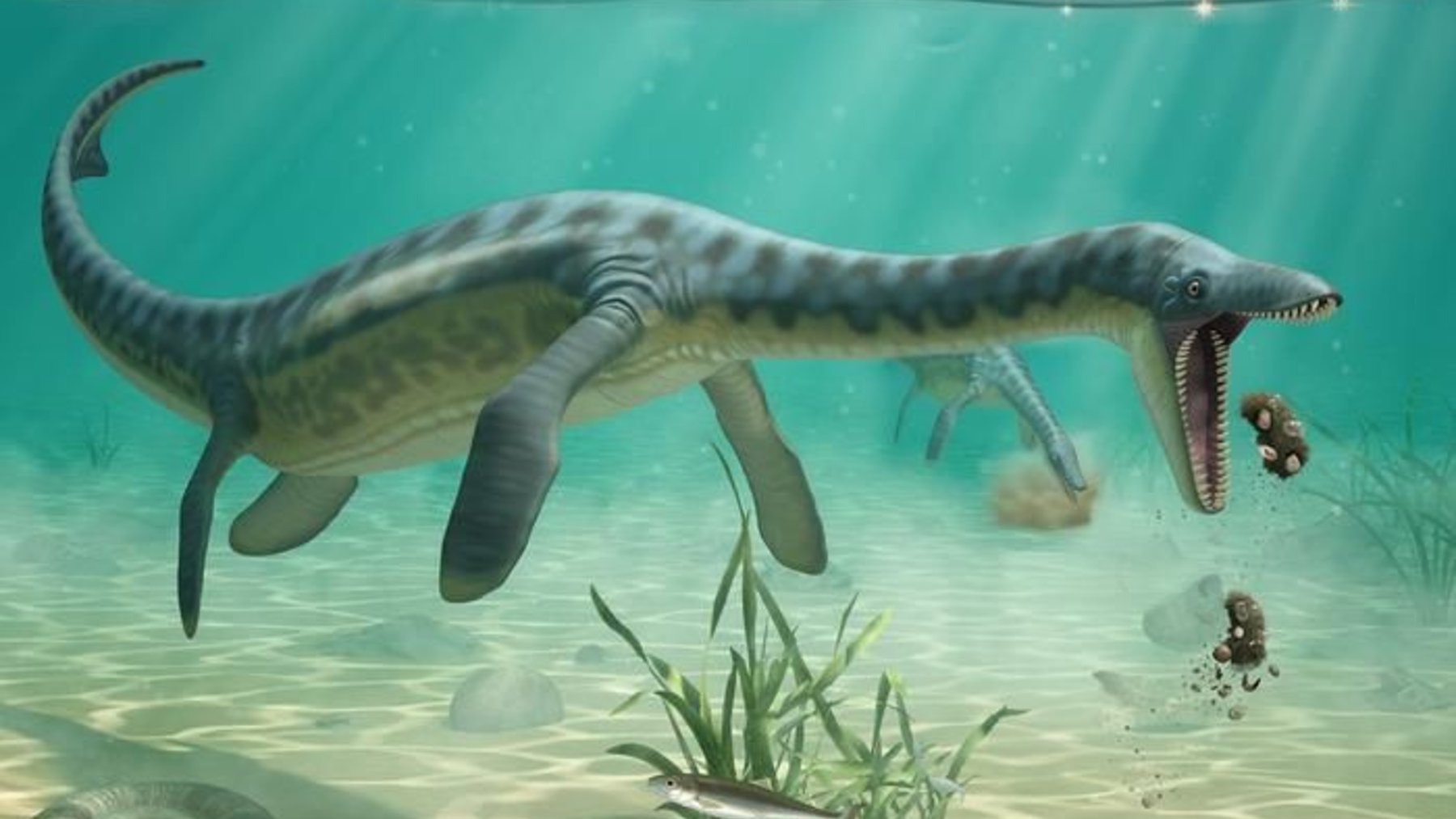
He now thinks they are vomit, brought up by long-necked plesiosaurs. “This is the first time that plesiosaur vomit, and the shellfish in it, have been identified, and these creatures tell us a great deal,” Knaust said in the release. His study came out Sept. 22 in Geological Magazine.
Ocean shells in a river delta
The cores come from the area of the Troll gas and oil field, about 50 kilometers (31 miles) off the Norwegian coast, from rock laid down in the Middle and Late Jurassic, when the spot was a set of shallow river deltas. Most of the vomit fossils came from cores drilled for a subsea carbon dioxide storage site near Troll, the release says.
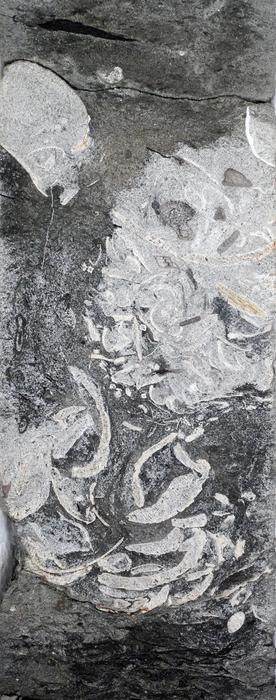
Inside the clumps were bivalve shells, the tubes of serpulid worms, pieces of crinoids, sea animals that anchored themselves to the seafloor on stalks, and belemnites, the hard parts of squid-like animals. Crinoids and serpulids need the steady salt levels of the open sea, the paper says, and the delta was brackish, washed through with river water. Knaust’s explanation is that something ate them in deeper water and swam in to throw up the hard parts.
The clumps range from about the size of a walnut to the size of a mango, according to the release. In the paper most are 1 to 10 centimeters across, up to about 4 inches, and some are wider than the 10-centimeter core itself. He looked at 20 to 30 of them. An exact count isn’t possible, he writes, because many have partly broken apart.
Vomit, not droppings
Knaust told vomit from fossil droppings by what was inside and what it was made of. The clumps hold far more undigested food than coprolites do, their shapes are scattered and irregular, and they are made of calcite rather than the phosphate typical of droppings, the paper says. He compared them with fossil vomit described over the past century in Europe and North America.
He also gave them a name, Vomitus, from the Latin for vomited matter, in three types: one mostly bivalve shells, one mostly worm tubes and one mostly crinoids. They are the first fossil vomit, or regurgitalites, described from drill cores, according to the paper. The type specimens are kept at the Natural History Museum of the University of Oslo.
The bone in the core
Centimeters from one clump, Knaust found a bone and some fossil droppings. “This was quite spectacular,” he said. “To begin with, I thought it was a dinosaur bone but when we looked at the CT scan we realised, no, it must be from an ichthyosaur.”
The ichthyosaur didn’t fit as the culprit. Ichthyosaurs mainly ate fish and soft-bodied prey such as squid-like cephalopods, the paper says, while the clumps point to an animal that picked hard-shelled prey off the seafloor. Fish vomit would be too small, and the area’s Jurassic sharks and crocodiles hunted fish, according to the release. Knaust found no fish bones in the clumps. He thinks one of the droppings near the bone came from a crocodile.
That left the plesiosaurs. “The plesiosaur most closely matches the size and feeding profile of the vomit producer,” Knaust said. His prime suspects are cryptoclidids, long-necked plesiosaurs that grew 4 to 8 meters (13 to 26 feet) long and lived from the Middle Jurassic to the Early Cretaceous, roughly 174 million to 100.5 million years ago. A long-necked plesiosaur from the Early Cretaceous of Australia was found with bivalve shell fragments, snail shells and crinoid pieces in its stomach, the paper notes.
The paper keeps hybodont sharks, an extinct group with crushing teeth, on the list of possible producers, and it says more than one kind of animal may have made the clumps.
A rest stop near shore
“Plesiosaurs may have come close to shore to relax or sleep after hunting, and that’s likely when they vomited,” Knaust said. “We see fur seals and marine crocodiles doing something similar today but while they go onto land, plesiosaurs probably remained submerged due to their weight and shape.” In the paper itself, the modern comparison he gives is fur seals and dolphins.
The paper describes the clumps as pellets from routine vomiting, compacted and probably stiffened by mucus, not as a sign that the animals were sick.
“This vomit survived partly because it was so compacted and covered in mucus,” Knaust said. “Even so, most pellets would have been completely broken up by the waves and tides. Some clusters were, however, quickly covered by sediment arriving from the rivers, and some ended up in burrows left by crustaceans on the seafloor, where they were partially preserved and fossilised.”
Footprints nearby
Dinosaurs walked the delta land nearby, and Knaust and his colleagues have found parts of their footprints in some of the cores, the release says. Knaust, who hunts for fossils on England’s Jurassic Coast, thinks plesiosaurs could have done the same thing around Britain, which in the Jurassic sat on the same narrow sea as the Norwegian wells.
“There’s so much more we can learn from picking through what extinct animals threw up after dinner,” he said.
Illustration: Cambridge University Press / EurekAlert