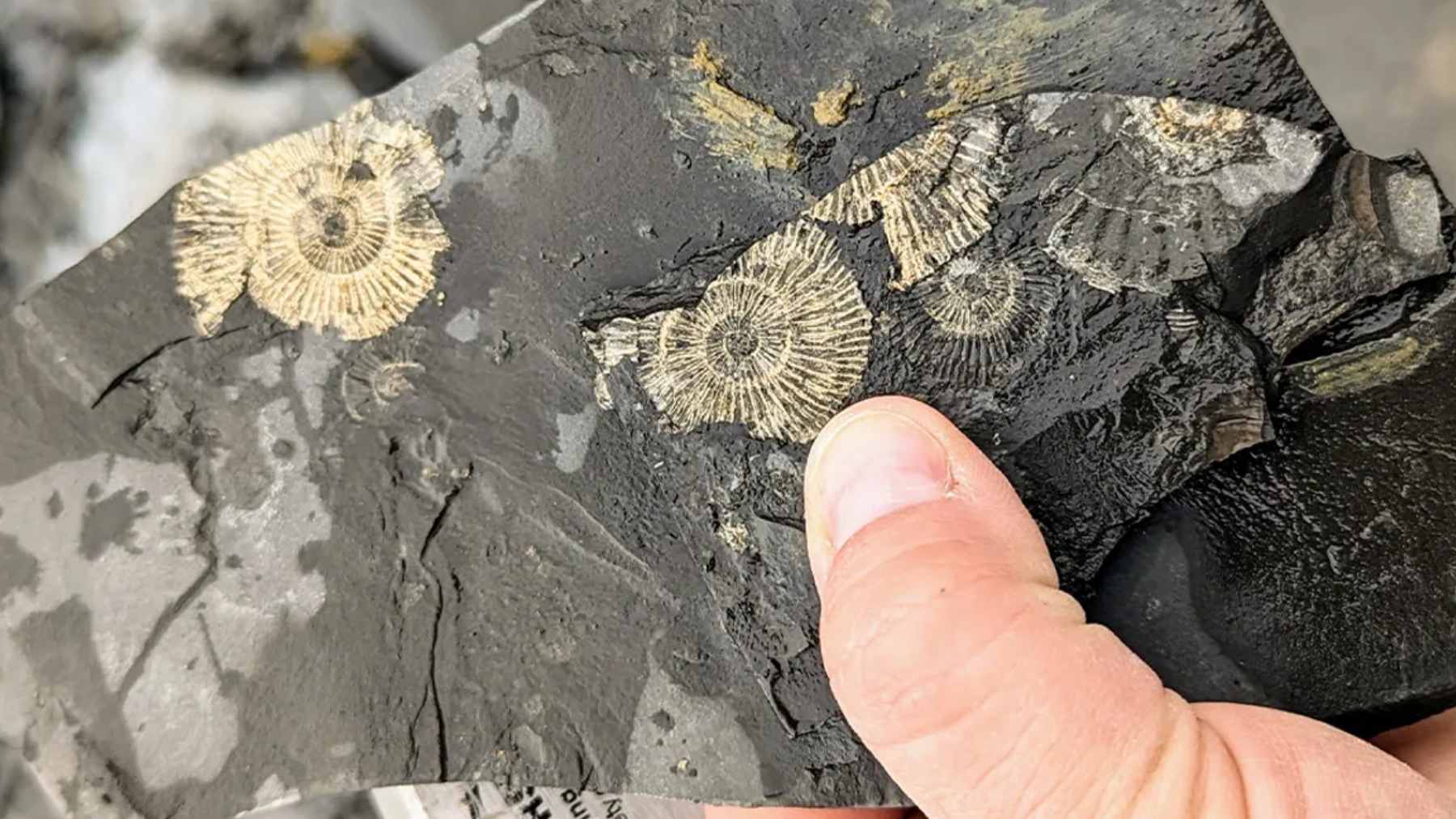
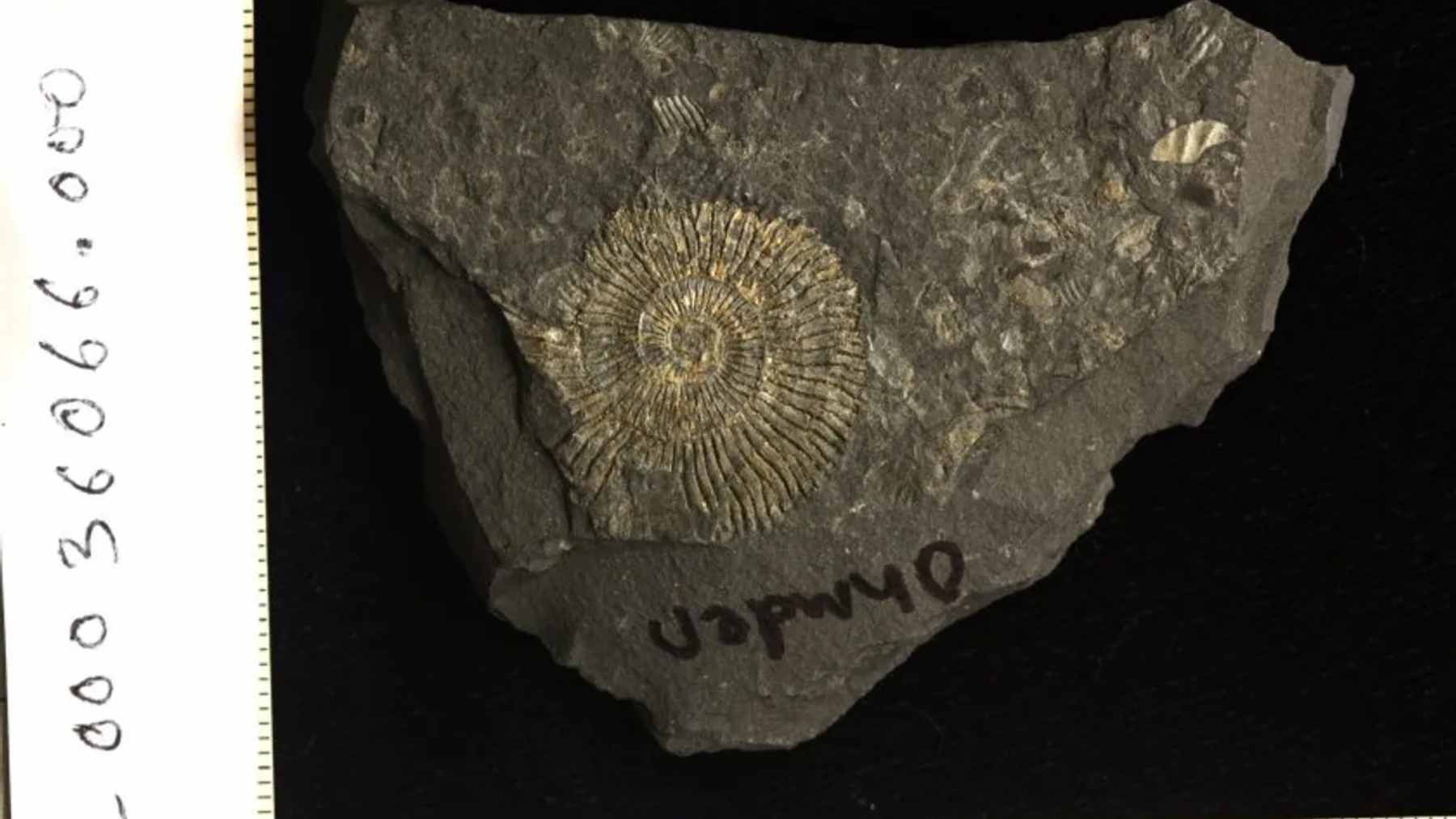
Crack open a slab of black shale in southwestern Germany and you might spot something that looks like metal. A fossil shell, 183 million years old, still catching the light like a freshly polished coin. It is the kind of shine that makes people assume one thing right away: “That must be pyrite, the mineral known as fool’s gold.”
But a detailed lab look flips that old assumption on its head. Researchers studying fossils from the famous Posidonia Shale found the glitter mostly comes from phosphate minerals in the fossil itself, while tiny pyrite clusters are concentrated in the surrounding rock.
In practical terms, the “gold” is more like a chemical illusion that preserves a surprisingly precise record of how oxygen behaved in an ancient sea.
A shine that fooled people for years
For a long time, many collectors and even some scientific interpretations treated these “golden ammonites” as classic pyritized fossils. It made sense on the surface, since pyrite can form in low-oxygen sediments and it looks convincingly metallic when it reflects light.
When a University of Texas at Austin team and collaborators took a closer look, though, they ran into a problem. They “struggled to find pyrite in the fossils,” even in specimens that looked the most golden at first glance. That mismatch is what pushed them to test the chemistry more carefully instead of trusting appearances.
The result is a reminder that fossils are not just bones and shells. They are also mineral stories, written by the chemistry of the mud, the microbes, and the water above the seafloor.
What the microscope actually showed
The team examined dozens of Posidonia Shale fossils under scanning electron microscopes and analyzed what the specimens were made of. Across the samples they studied, the fossils themselves were primarily preserved as phosphate minerals, not as pyrite.
This matters because phosphate preservation, often called phosphatization, is one of the key ways soft tissues and delicate structures can survive deep time.
The Earth-Science Reviews paper describes phosphatization across multiple kinds of fossils from the site, including ammonites and other marine life, as part of a broader explanation for the deposit’s exceptional preservation.
And yes, pyrite still plays a role here. It just tends to show up where you might not expect, mostly in the surrounding shale rather than replacing the fossil’s tissues or shell material directly.
Framboids and the golden “halo” effect
So where does the flash come from if not from a fossil packed with pyrite? A big clue is found in the matrix around the fossil, where the rock is dotted with microscopic pyrite clusters called framboids. These are tiny, raspberry-like groupings of crystals that can scatter and reflect light in a way that reads as “gold” to the human eye.
In one striking example, doctoral researcher Sinjini Sinha described counting “800 framboids on the matrix” while finding only “three or four on the fossils” themselves. That contrast strongly suggests the shine is largely an effect created by the fossil’s neighborhood, not just the fossil’s internal mineral makeup.
If you have ever seen a mineral “glitter” when you tilt it under a lamp, you already get the idea. Sometimes the sparkle is less about what the object is, and more about how a thin layer of crystals around it happens to catch the light.
Anoxia set the stage, but oxygen did the finishing work
The chemistry also points to something bigger than a labeling correction. The Posidonia Shale formed during the Toarcian Oceanic Anoxic Event, a time roughly 183 million years ago linked to widespread low oxygen conditions in parts of the oceans.
It is tempting to think anoxia alone explains the spectacular preservation, since low oxygen can slow decay and keep scavengers away. But the research argues that anoxia was only part of the setup, and that short-lived oxygenation pulses likely helped trigger key mineral reactions, including early phosphatization.
That idea feels almost counterintuitive. Oxygen is normally the enemy of preservation because it fuels decay, but in this case, a limited and temporary oxygen presence may have helped lock biological material into more stable minerals before it fell apart.
Why this Jurassic lesson matters for today’s oceans
At first, this might sound like a niche fossil debate. But it connects to a modern environmental concern that is getting harder to ignore — the ocean is losing oxygen in many regions as the climate warms and waters stratify.
The IPCC says deoxygenation has occurred in most open ocean regions since the mid-20th century, and scientists have linked the trend to warming and related changes in circulation and mixing.
Researchers have estimated that the global ocean’s oxygen inventory has declined by about 2% since around 1960, which may not sound dramatic until you remember how tightly marine life is squeezed by oxygen limits.
In real-world terms, low oxygen zones can compress habitats and force fish and other animals into narrower bands of water, changing ecosystems and sometimes intensifying die-offs in vulnerable areas.
No, the Jurassic is not a perfect mirror of today. Still, studies like this one help scientists understand how oxygen boundaries behave and how fast chemistry can flip under changing conditions, which is exactly the kind of knowledge we need as modern seas warm and oxygen patterns shift.
To sum it up, the “golden” look of these fossils is less a treasure story and more a chemistry clue, one that rewrites how this famous German deposit is preserved and what it says about oxygen in ancient oceans.
The study was published in Earth-Science Reviews.