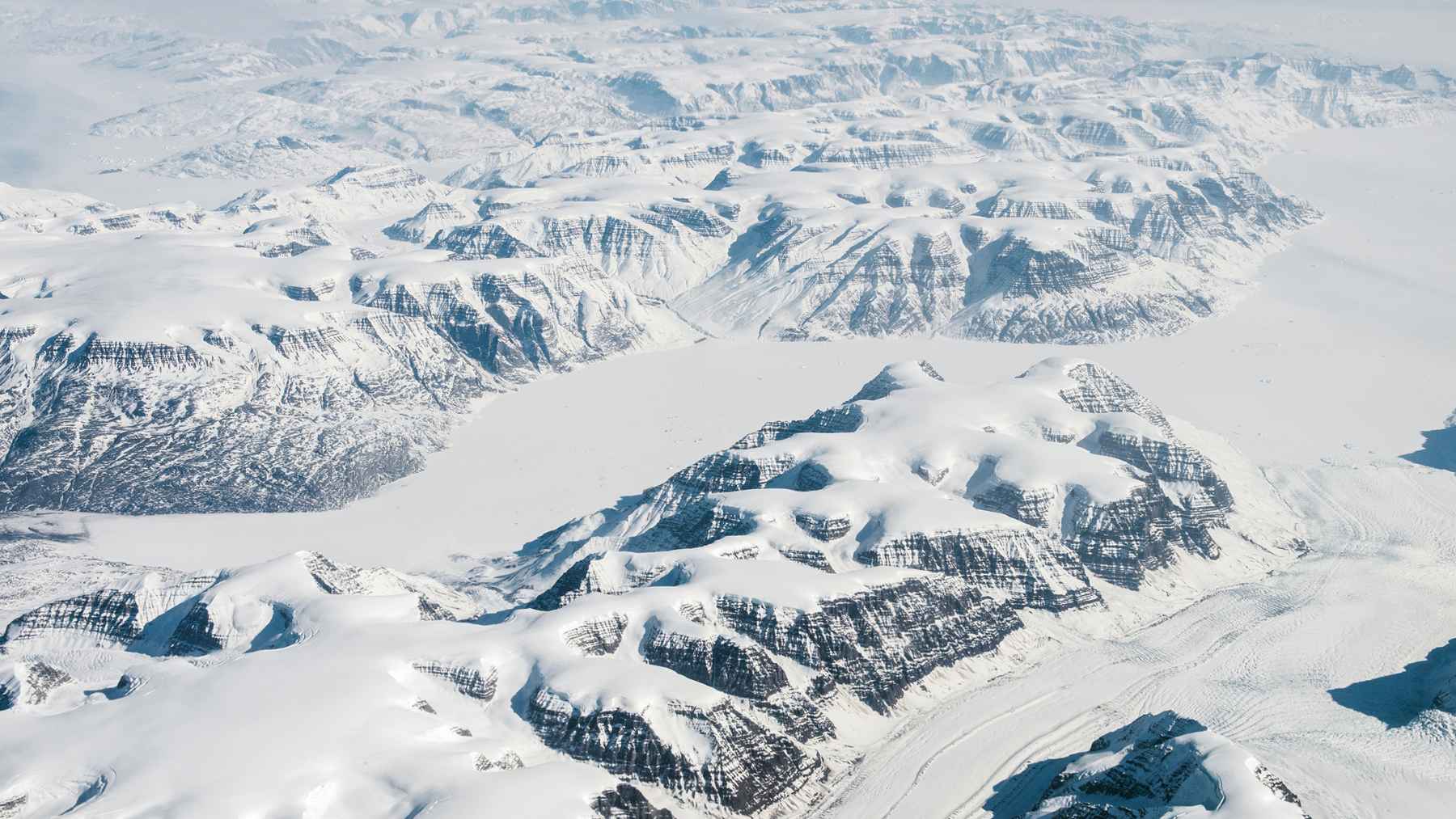
On an ordinary science flight over northern Greenland, researchers saw something that did not look natural at all. Straight lines and sharp angles showed up in radar data from an ice sheet that usually reads like a blank page.
The surprise was Camp Century, a long-abandoned U.S. military site nicknamed the “city under the ice.” The new radar view is more than a curiosity, because it also highlights a quieter concern that keeps coming up in climate science: when ice changes, old human leftovers can come back into play.
An unexpected find in April 2024
The discovery happened in April 2024, during a flight meant to test and fine-tune radar equipment over the Greenland Ice Sheet. About 150 miles east of Pituffik Space Base, the instrument picked up a buried complex that stood out from the surrounding layers of snow and ice.
Alex Gardner, a cryosphere scientist at the Jet Propulsion Laboratory, summed up the moment with a line that sounds like a plot twist. “We were looking for the bed of the ice and out pops Camp Century,” he said, adding that the team did not recognize it right away.
How radar can “see” through ice
Radar works by sending out radio waves and measuring how long it takes for the signal to bounce back. In practical terms, it can act a bit like a medical ultrasound, except the target is ice instead of human tissue.
The instrument used in the flight is called UAVSAR, short for Uninhabited Aerial Vehicle Synthetic Aperture Radar. It is designed to detect changes in the ground by flying over the same place again and again, which is why it is also used to study earthquakes, volcanoes, and shifting ice in the Arctic.
A Cold War “city under the ice”
Camp Century was built in 1959 by the U.S. Army Corps of Engineers, carved into the near-surface layers of the ice sheet. It was presented as a way to test how people could build and live in extreme Arctic conditions, but it also fed into a top-secret plan to explore whether nuclear missiles could be deployed from tunnels under the ice.
Researchers later described an even larger idea that never happened, a proposed tunnel network that could have stretched for roughly 2,500 miles under the ice. That broader missile plan was known as Project Iceworm, and it is part of why Camp Century still grabs attention decades after it closed.
A reactor built for the ice
Keeping an underground base running in the middle of Greenland took serious power. One key piece was the PM-2A reactor, an Army-built unit designed to provide electricity and heat in remote conditions, including at Camp Century. (usace.army.mil)
It is worth pausing on that for a second. A nuclear power system, placed in a place most people will never visit, ended up sealed under layers of snow that engineers at the time expected to keep growing forever.
Buried waste, and why scientists keep thinking about it
After Camp Century was abandoned in 1967, snow and ice continued to pile up above it. Solid structures linked to the site now sit at least 100 feet below the surface, far out of sight and out of mind for most people.
But out of sight does not always mean out of reach. A NASA Earth Observatory summary of a 2016 study in Geophysical Research Letters reported estimates of about 53,000 gallons of diesel fuel and about 6.34 million gallons of wastewater, including sewage, plus an unknown amount of low-level radioactive waste and PCBs, a group of toxic industrial chemicals once widely used in electrical equipment. (science.nasa.gov)
Warming could change the timeline
The big question is not whether the waste is dangerous today, because it is locked under thick ice. The question is whether Greenland’s ice will keep acting like a freezer, or whether warming will eventually flip the balance so that more ice disappears each year than arrives as new snowfall.
That flip is what scientists mean by net ablation, basically the ice sheet thinning over time. The same line of research has warned that a shift from net snowfall to net melt at the site is plausible within the next several decades under high greenhouse gas emissions, which would eventually make remobilization of buried material far more likely.
The ice moves, even when it looks still
Even if surface melting is slow, the ice sheet is not frozen in place like concrete. A 2023 Journal of Glaciology paper looking at measurements over decades described the ice flow near Camp Century as broadly stable over time, on the order of about a dozen feet per year.
That matters because moving ice can bend, squeeze, and shift buried structures. So the camp is not just getting deeper under snow, it is also being reshaped by the slow-motion mechanics of the ice sheet itself.
Why the new radar image matters now
Chad Greene, another project scientist, said the team’s main goal was to test how well UAVSAR can map internal ice layers and the boundary between ice and bedrock. Those measurements feed into a very current problem: estimating ice thickness well enough to improve future sea level projections.
The new image also gives scientists a sharper reference point for where the old base sits and how it lines up with historical layouts. For now, the researchers themselves describe the detailed radar view as a chance find, but it is the kind of chance find that can steer what questions get asked next.
The main official report has been published by Earth Observatory.