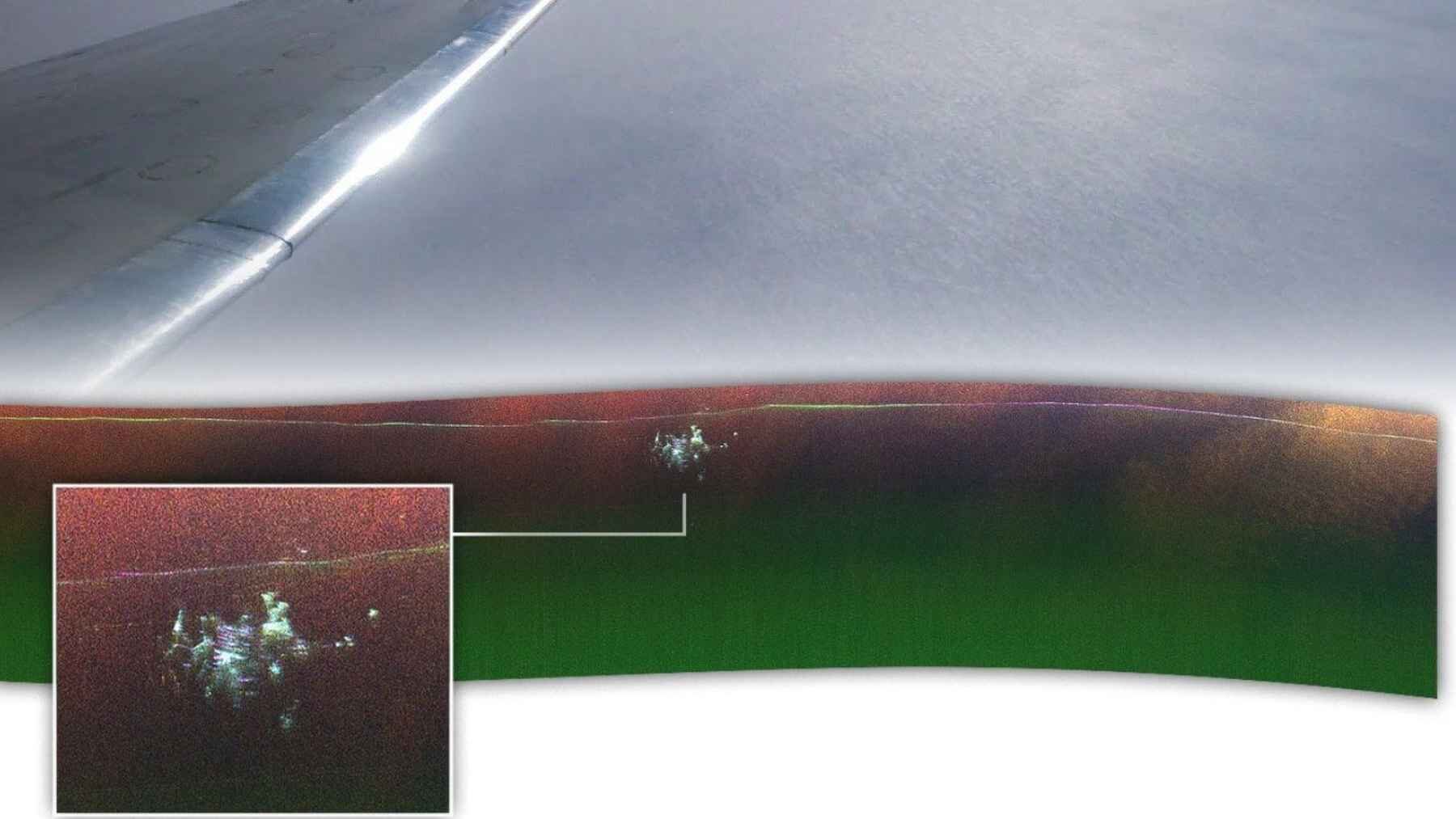
Then, in April 2024, radar operated by NASA unexpectedly produced the clearest modern view yet of Camp Century. The images revealed parallel structures that match the old tunnel layout, buried more than 100 feet under the ice. The base was never really “lost.” it had not been seen like this in decades.
And there’s a bigger issue. Camp Century still contains fuel, wastewater, discarded buildings, PCBs, and low-level radioactive material. A 2016 study warned that warming could eventually mobilize some of that waste. More recent research, however, suggests that surface meltwater is extremely unlikely to reach it before 2100.
The radar discovery was accidental
NASA scientist Chad Greene was flying aboard a Gulfstream III when the radar picked up the buried structures. The mission wasn’t even looking for Camp Century.
“We were looking for the bed of the ice and out pops Camp Century,” said Alex Gardner, a cryosphere scientist at NASA’s Jet Propulsion Laboratory. Quite a surprise.
The radar works a little like an ultrasound. It sends out waves and measures the echoes that bounce back. In this case, the newer system produced a much clearer view of the abandoned base than earlier surveys had managed.
A city built inside moving snow
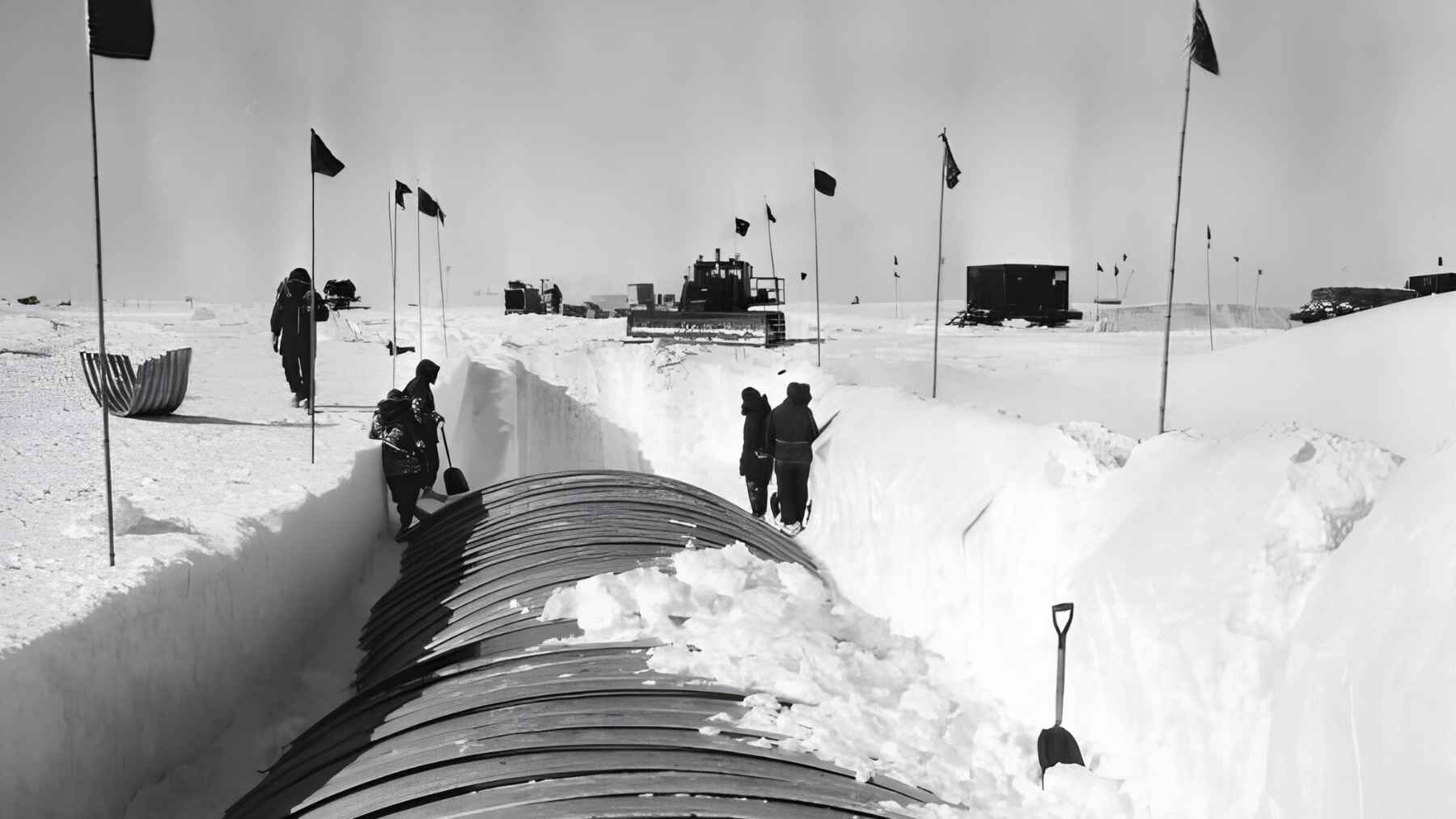
The U.S. Army Corps of Engineers began building Camp Century in 1959. It used 21 cut-and-cover trenches, curved roofs, and prefabricated rooms buried beneath the snow.
It was basically a small town under the ice. Soldiers lived and worked there alongside laboratories, sleeping quarters, medical facilities, and even a portable nuclear reactor.
There was one big problem. The ice wouldn’t stay still.
The base was built in firn, the compacted old snow that sits between fresh snow and solid glacial ice. It slowly moves and deforms. Think of very cold dough being squeezed over years. Eventually, that movement began crushing the tunnels.
Project Iceworm stayed on paper
Officially, Camp Century was used for Arctic construction experiments and scientific research. Some of that research was genuinely important, including early ice-core work.
But there was another plan in the background. Project Iceworm.
The proposal envisioned a vast underground network that could potentially support hundreds of ballistic missiles aimed toward the Soviet Union. Camp Century was partly used to test whether such a system could actually work beneath Greenland’s ice.
It never happened. The missile network stayed on paper, no nuclear weapons were deployed there, and Camp Century was eventually abandoned in the 1960s.
Millions of gallons remain below
What was left behind? Quite a lot.
The 2016 study estimated roughly 10,000 U.S. tons of buildings, rail equipment, and other material beneath the ice. Researchers also calculated about 53,000 gallons of diesel and more than 6 million gallons of wastewater and sewage.
Then there are the PCBs. These industrial chemicals were once widely used in paints, electrical equipment, and other materials. They break down very slowly, which is exactly why scientists worry about them.
The radioactive waste is a different issue. It came from operating the reactor, not from nuclear weapons. According to a 2024 U.S. Government Accountability Office review, radioactive liquid was buried in the ice during Camp Century’s operation.
Why 2090 became the headline
So when could all of this become a problem?
A 2016 study led by William Colgan looked at how climate change might affect the site over the rest of the century. Under one high-emissions scenario, the researchers projected that the area could eventually shift from gaining more snow than it loses to losing more ice overall.
That possible tipping point was placed around 2090.
But that doesn’t mean the tunnels suddenly pop out of the ice in 2090. Far from it. The debris would still be buried deeply, and exposing it directly could take much longer.
Meltwater is the bigger question. Could water from the surface work its way down and carry pollutants with it?
That possibility helped drive later research.
New measurements changed the outlook
A 2021 study offered a much less alarming picture for this century.
Researchers modeled how the snow and firn around Camp Century could evolve through 2100. Their conclusion was pretty clear. They found it “extremely unlikely” that surface meltwater would reach the buried debris before 2100 under any of the climate scenarios they tested.
Why? Snow is still expected to pile up faster than summer melting removes it at the site.
Camp Century may actually become more deeply buried relative to the surface during the coming decades.
That matters. A lot.
It means the waste is not currently on track to burst out of the ice by the end of this century, despite some of the more dramatic interpretations of the earlier research.
Monitoring a Cold War time capsule
Still, nobody is simply forgetting about Camp Century.
Denmark and Greenland established long-term monitoring of the site after concerns about its buried waste grew. Scientists have used weather measurements, snow observations, and radar surveys to understand what is happening above and around the debris.
The U.S. Government Accountability Office also reviewed Camp Century in 2024. It found that changing environmental conditions could affect how Cold War contamination is managed in the future.
For now, there is no immediate cleanup operation.
And digging everything out would hardly be simple. The remains sit beneath a huge amount of moving snow and ice. Reaching them would mean a major engineering project in one of the harshest environments on Earth.
Who would actually clean it up?
Then comes the awkward question.
Who pays?
Camp Century was established under agreements between Denmark and the United States during the Cold War. But those agreements were written in a very different era, when few people imagined that climate change might one day expose or mobilize material buried deep inside the Greenland Ice Sheet.
The 2016 researchers warned of “substantial ambiguity” over political and legal responsibility if pollutants eventually begin moving into the surrounding environment.
So the ice isn’t the only thing keeping the problem frozen.
The politics are, too.
What the new image really shows
NASA’s 2024 radar image does not mean Camp Century is suddenly emerging.
Quite the opposite.
It shows how modern radar can reveal a site that has remained buried for decades and help scientists track what happens to it over time.
For now, the base remains safely under the ice according to the latest modeling. But it’s still there. So is the waste.
A Cold War experiment, frozen in place.
For how long? That’s the question.
The official account of the 2024 radar discovery was published by NASA Earth Observatory.