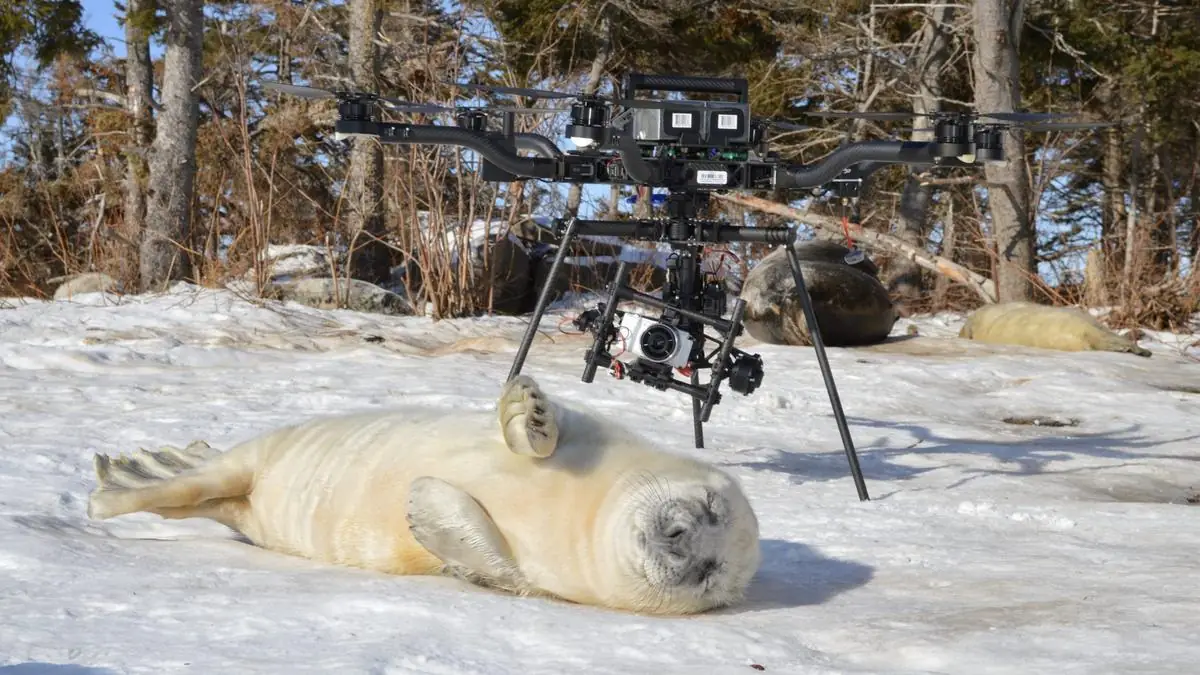
Drones can photograph a seal or a whale without touching it, but a new review in Science says the picture alone can't reliably show what body changes mean for the animal's health
A Science review from WHOI, Oregon State and UMCES says drone photos need physiological data to show whether an animal is gaining fat or muscle.

· 4 min read
Key points
- Drone photos can measure an animal's length, width and body volume, but they cannot reliably tell fat from lean tissue, according to WHOI.
- The Science review by WHOI, Oregon State and UMCES draws on more than a decade of Weddell seal research and calls for pairing drones with physiological measurements.
- Aerial imagery of North Atlantic right whales has documented long-term changes in body size, giving insight into pressures such as fishing-gear entanglements, according to WHOI.
Drones are changing how scientists study wild animals. They can photograph and measure animals in their natural environments, according to the Woods Hole Oceanographic Institution. They can also watch larger populations with less disturbance.
A photograph can reveal changes in an animal's size and shape. It cannot confidently tell researchers what those changes mean for its health, WHOI said in a news release on November 26.
That is the focus of a new scientific review published in Science. Its authors work at WHOI, Oregon State University, the University of Maryland Center for Environmental Science and collaborating institutions. As a review, it examines how drone imagery and other emerging tools can be combined with established physiological measurements, according to WHOI.
One example the release gives is the North Atlantic right whale. Research on these whales has used aerial imagery and repeated observations to document long-term changes in body size, the release says. Those findings provide insight into how fishing-gear entanglements, changes in prey availability and vessel collisions can affect the energy the whales have available for growth and reproduction, according to WHOI.
Fat or muscle?
One important distinction is whether an animal is gaining or losing fat, muscle or both. These tissues serve different biological purposes and store different amounts of energy, the release explains.
An animal that appears to be gaining weight may be building muscle rather than storing fat. Without knowing the difference, researchers could misread an animal's nutritional health, according to WHOI. They could also misjudge its ability to withstand environmental stress.

"Integrating traditional methods - weighing and handling animals on the ground - with emerging, non-invasive toolsets such as drone imagery means that we can now really tailor the scope of how we look at wildlife health," said Michelle Shero, an associate scientist in WHOI's Biology Department and lead author of the study.
What each method can do
Traditionally, researchers have temporarily captured and weighed animals, measured their bodies and collected biological samples. They have also used tools such as ultrasound to measure fat stores, the release says.
Those methods give detailed information about physiology, but they are labor-intensive and can be stressful for animals. They are also not always practical for monitoring large numbers of individuals, according to WHOI.
Drone imagery offers another approach, without handling the animal. Researchers can use aerial photos to measure its length, width and body volume and track changes over time. Because it is quick, more individuals can be monitored than through direct handling.
External measurements alone, however, cannot reliably separate fat from lean tissue. That distinction can be particularly important during demanding periods such as reproduction, migration or nursing, the institution notes.
Lessons from Weddell seals
The review draws on more than a decade of research measuring body composition and energy reserves in Weddell seals. Females of the species lose substantial amounts of both fat and lean tissue while nursing their pups, according to WHOI.
Losing lean tissue can have more dire impacts, because it comes from the breakdown of muscle and working organs. Once pups are weaned, females regain their lean tissue first, the release says. A photograph showing a change in body size cannot, on its own, reveal how much of that change is fat and how much is lean tissue.
Jennifer Burns, a professor at UMCES and a co-author, gave another example involving seal pups. "Based on external appearance alone, seal pups don't seem to grow much between the time they are weaned and their first birthday," she said.
"However, physiological measurements reveal many internal changes: yearlings are much leaner than weaned pups, and their muscles have developed to support effective underwater foraging," Burns added.
Whales under pressure
Pairing drone images with targeted biological sampling lets researchers check photographic measurements. That way, they can see what is happening beneath an animal's external appearance, according to WHOI.
Other tools can help too. Hormone measurements, genetic analysis, tracking devices and additional biological indicators can provide clues about how food availability, disease, environmental stress and behavior influence an animal's condition, the release says.
"For example, a baleen whale might be in average body condition, but may have high stress levels due to anthropogenic or environmental stressors that may be preventing them from further increasing their mass," said KC Bierlich, a co-author at Oregon State University's Marine Mammal Institute, speaking about baleen whales in general.
A framework for conservation
Wildlife faces mounting pressures from a changing climate, habitat degradation, shifting food supplies, disease and human activities, the institution says. Understanding how animals respond is increasingly important.
The review gives researchers a framework for choosing and combining monitoring tools. The choice depends on the species, the research question and the level of detail needed, according to WHOI.
Knowing what remote observations can and cannot reveal helps scientists identify potential warning signs of nutritional stress and track changes in populations. It also helps them provide more reliable information to guide conservation decisions, the release says.
Michelle Shero, © Woods Hole Oceanographic Institution
Jordi Company
Writer at ECOnewsJordi Company is a well-known figure in Catalan publishing and a pioneer of the free press model, with 40 years of experience in television, radio and print. He has founded and led several media groups and today heads ECOticias.com, an environmental news outlet read in Spanish and English around the world and an audience leader since 2004. He is a member of the International Network of Writers for the Earth (RIET), among other organisations.
More from Jordi CompanyComments · 0
Rules ›No comments yet. Be the first to share your view.