UGA agricultural engineer Luan Oliveira on an AI weed sprayer: "The nozzle opens and sprays herbicide only on the weed"
An AI spot sprayer with 156 independent nozzles cut herbicide use 60% in a UGA onion test; a LiDAR tool for pecans saved about 60% on fungicide.

· 3 min read
Key points
- The sprayer has 156 nozzles spaced a half-inch apart that open independently, against one nozzle every 20 to 30 inches on a conventional machine.
- In an onion test, herbicide use fell 60% compared with standard broadcast sprayers, with a significant reduction in plant injury, UGA reports.
- With a LiDAR tool that sprays only pecan canopies, "the savings on fungicide chemicals were around 60%," Oliveira said.
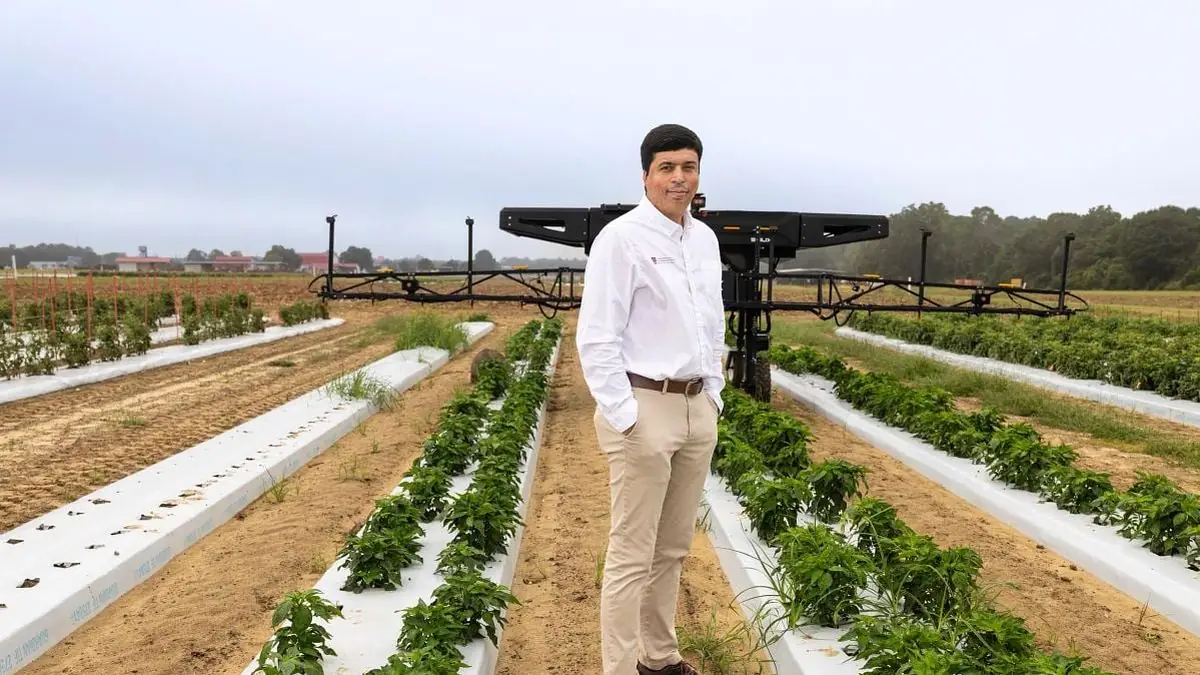
A weed sprayer tested at the University of Georgia does not douse the whole field. Its AI-driven machine vision detects weeds as it moves, and a nozzle opens to spray only the weed. In a test with onions, it used 60% less herbicide than standard broadcast sprayers, according to the university.
"When the sprayer's AI-driven machine vision detects a weed as it moves across a field, the nozzle opens and sprays herbicide only on the weed, thereby saving money and avoiding chemical damage to the crop," said Luan Oliveira.
Oliveira is an agricultural engineer and assistant professor who leads the Precision Horticulture Team on the UGA Tifton campus. He spoke in a story published on November 25, 2026, by the university's College of Agricultural and Environmental Sciences (CAES).
156 nozzles instead of one
His team field-tests machinery for planting, spraying and harvesting vegetables and specialty crops. The weed sprayer he described has 156 nozzles spaced a half-inch apart. A conventional machine uses one nozzle every 20 to 30 inches, the story says.
"Each of the 156 nozzles opens and closes independently," Oliveira said. Spraying only the weed saves money and avoids chemical damage to the crop, he said.
In the onion test case, the team found a significant reduction in plant injury with the spot sprayer. Herbicide use fell by 60% compared with standard broadcast sprayers, the university reports.
Lasers over pecan trees
The team has also field-tested a tool called Smart Apply in orchards. It uses LiDAR, a remote sensing technology that sends out laser pulses to build highly accurate 3D digital maps.
AI software processes the sensor data in real time. The nozzles then open to spray only the pecan tree canopies, not the rows or gaps between them.
Oliveira put a figure on it. "We finished a trial last year using that tool, and the savings on fungicide chemicals were around 60%," he said.
The Precision Horticulture Lab has also developed the Drone Dock, a mobile refueling and reloading station for a drone. It holds a water tank, chemical reservoirs, a mixer and a generator, all controlled by a cell phone, according to the university.
Teaching software to see plants
At UGA, precision agriculture technologies such as GPS, drones, machine vision, sensors and robots are increasingly complemented by artificial intelligence, the story says.
George Vellidis directs the university's Institute for Integrative Precision Agriculture and is a professor in the Department of Crop and Soil Sciences. He said AI can help Georgia farmers improve resource management and profitability, through generative AI chatbots and specialized software for agriculture.
The story gives the example of a peanut breeder managing 10,000 plots for disease resistance or high yield. Producers like that can use specialized AI software trained to process drone images of fields.
Images of plants are cataloged by hand, by species and disease symptoms, to build a database that may contain millions of pictures. New images are then compared against it to judge the health of each plant and recommend remediation steps.
It is an expensive task requiring thousands of hours of painstaking work, the university notes. It is necessary because the quality of AI output depends on the quantity and detail of the training data.
"We fly drones over a field and photograph plants at the centimeter scale. Each leaf image may consist of dozens of pixels," Vellidis said.
A farm for testing
UGA also has a new test site for this kind of equipment, the UGA Grand Farm near Perry, Georgia. Field trials began last year, shortly after ground was broken on the 250-acre site.
Its groundbreaking showcased solar-powered autonomous robotic weeders and tractor retrofit kits that enable driverless operations for row crops. It also featured autonomous, solar-powered robots that spot-apply herbicides and scout fields for plant health data.
The site is a partnership with the original Grand Farm in Fargo, North Dakota, a network of growers, companies, researchers and agencies. It lets agricultural technology companies test their products under Georgia's growing conditions, and it hosts field days and workshops for growers and students.
Kaytlyn Cobb, its regional assistant director, said one goal is to work with groups using AI to analyze field data in real time. Another goal, she said, is to explore autonomous equipment and predictive analytics that boost productivity and sustainability.
Oliveira's comments appear in the CAES Field Report story "Artificial intelligence helps UGA researchers transform agriculture in Georgia," written by Gary Goettling. The university lists him as an assistant professor and precision ag extension specialist.
University of Georgia CAES
Glossary for this story
- LiDAR
- A remote sensing technology that fires laser pulses and times their return to build detailed 3D maps. It is used to measure terrain, forests and individual trees.
ECOnews Newsroom
Writer at ECOnewsA team of journalists specializing in socio-environmental news, sustainability, climate change, the environment, responsible consumption, and innovation. At EcoNews, we provide clear, reliable, and relevant coverage of the environmental and social challenges shaping our era.
More from ECOnews NewsroomComments · 0
Rules ›No comments yet. Be the first to share your view.