Larry Madin, Woods Hole deputy director emeritus, on a new deep-sea salp: "We're reminded of how little we know about the largest living space on the planet"
Vitreosalpa gemini lives 280 to 2,200 meters down, carries twin embryos and feeds on detritus, MBARI says; 50 salp species are known.

· 3 min read
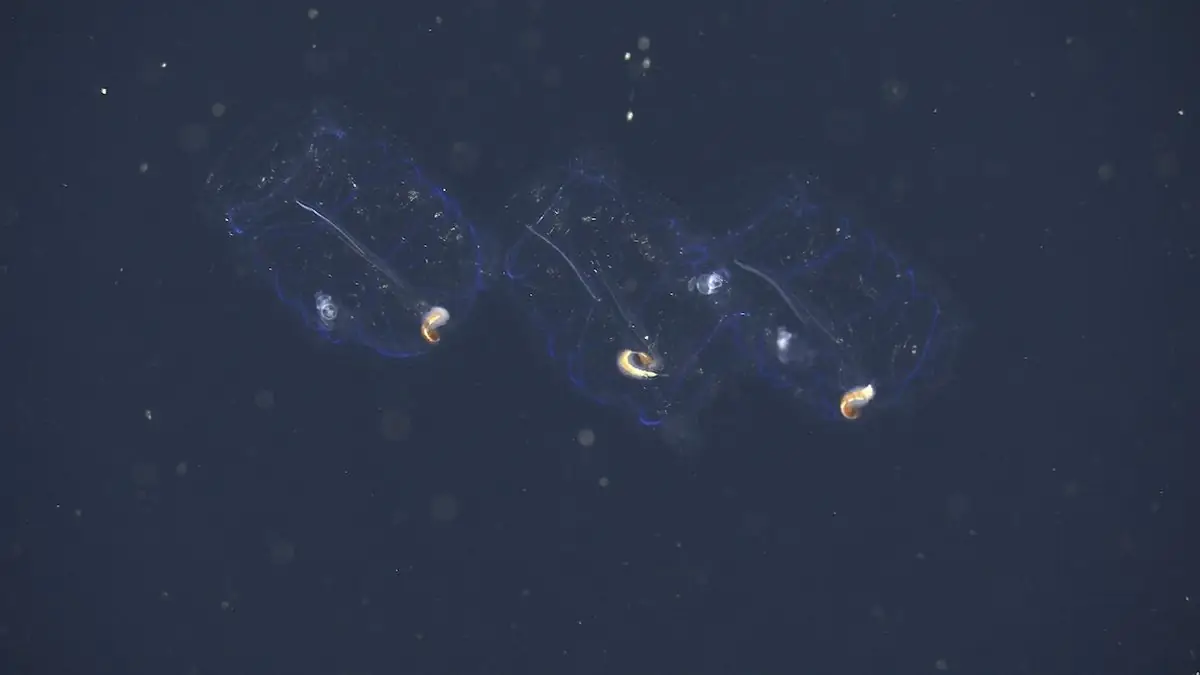
A see-through animal first spotted in Monterey Bay more than twenty years ago finally has a name. Larry Madin, of the Woods Hole Oceanographic Institution, has described the glass salp, Vitreosalpa gemini. It is the first salp known to live only in the deep sea, at depths of 280 to 2,200 meters. Scientists recognize 50 salp species, and until now all lived mainly in the sunlit upper ocean. The glass salp is a slow swimmer with a delicate, watery body, and it feeds on detritus and tiny single-celled organisms instead of living algae. Its name refers to its glassy body and to the twin embryos it produces, a rare trait that may double reproduction in sparsely populated depths. The Monterey Bay Aquarium Research Institute used remotely operated vehicles to log thousands of sightings. Madin says each trip into the deep reminds us how little we know about the largest living space on the planet.
Key points
- The glass salp, Vitreosalpa gemini, is the first salp known to live only in the deep sea, between 280 and 2,200 meters down.
- In its chain stage it produces twin embryos, a rare trait among salps that MBARI says may double reproduction where animals are scarce.
- Below the reach of sunlight it cannot eat living phytoplankton and lives on detritus and single-celled protozoans instead.
A see-through deep-sea salp first spotted in the waters of Monterey Bay more than 20 years ago finally has a name. Larry Madin, deputy director emeritus at the Woods Hole Oceanographic Institution and an adjunct at MBARI, has described the glass salp, Vitreosalpa gemini.
It is "the first salp species known to live exclusively in the deep sea," according to a news release from the Monterey Bay Aquarium Research Institute (MBARI) dated November 24, 2026. The animal lives at depths of 280 to 2,200 meters, or 920 to 7,200 feet.
"Every time we can venture into the deep ocean, we're reminded of how little we know about the largest living space on the planet and the creatures that have lived there for millions of years," Madin said in the release.
A salp that stays deep
Salps are barrel-shaped, gelatinous animals that drift in the open ocean. They belong to the tunicates, which MBARI describes as some of our closest invertebrate relatives. Most tunicates live attached to the seafloor, but some have adapted to life in open water.
MBARI says scientists currently recognize 50 salp species, most of them offshore and typically close to the surface. According to the paper, all species known to date live principally in the sunlit upper layer of the ocean. Some undertake daily migrations to 800 meters or more.
The glass salp breaks that pattern. MBARI says it is the first salp found exclusively in the ocean's twilight and midnight zones, deep layers where little or no sunlight reaches. Madin's paper describes it as a new genus as well as a new species.
Named for glass and twins
The name Vitreosalpa gemini refers to the glass-like transparency of its body and the presence of twin embryos, the paper explains.
Like other deep-water tunicates, the glass salp has a delicate body with very watery tissues. It is a slow swimmer. Its feeding and metabolic rates are much lower than those of its relatives near the surface, MBARI reports.
Salps alternate between a solitary form and an aggregate form that lives in chains. The solitary form produces those chains of reproductive clones, and the clones spawn eggs and sperm to create the next generation. MBARI researchers have observed glass salp chains of up to 20 animals.
Solitary glass salps appear to produce chains continuously and keep them attached, towing them behind the parent. In the aggregate stage, when the animals live in chains, the glass salp produces twin embryos. MBARI calls this a rare trait among salps, "perhaps an adaptation to double reproductive output in sparsely populated depths."
Each clone is also a sequential hermaphrodite, as in other salps. It starts as a female and produces eggs, then becomes male and produces sperm.
Living on what sinks
Salps feed by pumping water across a mucous net inside their bodies. Salps in general are important grazers of phytoplankton, the microscopic algae that drift in the sea, according to the paper.
The glass salp lives below the reach of sunlight, so it does not eat living phytoplankton. Instead, according to MBARI, it must subsist on detritus and single-celled protozoans.
That diet links it to a process the institute highlights. Salps consume phytoplankton and tiny particles of organic material known as marine snow. That makes them an important link in the ocean carbon cycle, MBARI says.
Capable of both sexual reproduction and cloning, salps can also quickly dominate an ecosystem. The boom-and-bust nature of these blooms can rapidly transport carbon to the abyssal seafloor, the institute adds.
Robots did the watching
Salps are hard to study because of their fragile bodies and remote habitat. MBARI relies on remotely operated vehicles that can document them undisturbed in their natural environment.
The institute has logged thousands of observations of the glass salp in Monterey Canyon, the Pacific Northwest and the Gulf of California. Researchers also collected specimens for morphological and molecular analyses.
According to MBARI, its technology has revealed more than 300 previously unknown species. The institute says this cataloging work will be instrumental in assessing the impact of threats like climate change and mining on deep-sea ecosystems.
It says its technology provides an independent baseline of deep-sea biodiversity, "needed to guide decision-making about ocean ecosystems."
Madin's study, titled "Vitreosalpa gemini, gen. nov., sp. nov., a new deep-sea salp (Tunicata, Thaliacea) from Monterey Canyon: description, distribution, and biology," appears in volume 56 of Marine Biodiversity. MBARI announced it on November 24, and says the research was supported by the David and Lucile Packard Foundation.
© 2022 MBARI
Glossary for this story
- Ecosystem
- A community of living things and the environment they live in, together with the relationships between them.
- Climate change
- A long-lasting shift in the planet’s climate: temperatures, rainfall and extreme events. Today’s change is caused mainly by burning fossil fuels.
- Biodiversity
- The variety of life in a place or on the planet: species, genes and ecosystems.
Javier Niño
Writer at ECOnewsJavier Niño has been a Spanish National Police officer since 2017 and a journalist specialising in employment, labour law and Social Security, with more than seven years of writing experience. At ECOnews he covers environment, energy and sustainability news, focusing on how new regulations and court rulings affect people in their everyday lives.
More from Javier NiñoComments · 0
Rules ›No comments yet. Be the first to share your view.