The US used 34 quads of primary energy in 2025 to deliver 14 quads of electricity, and the EIA says nearly 60% was lost, mostly as heat escaping from coal and gas plants
Coal needs about a third more energy per kWh than gas, grid losses are much smaller than conversion losses, and for wind and solar EIA counts only output.

· 4 min read
Key points
- About 95% of the losses came from converting fuels into electricity; the rest was lost on the grid.
- Coal used by U.S. power plants averages about 10,077 Btu per kilowatthour, against the 3,412 Btu a kilowatthour contains.
- The EIA does not calculate conversion losses for wind, solar, hydropower and geothermal.
Most of the energy that goes into making America's electricity never reaches a light switch. In 2025, the United States consumed 34 quadrillion British thermal units, or quads, of primary energy to deliver 14 quads of electricity sales to end users.
Nearly 60% was lost along the way, the federal Energy Information Administration (EIA) said on November 25. About 95% of those losses came from converting fuels into electricity, mostly heat lost from burning coal and natural gas. The remaining 5% was lost delivering power across the grid to homes and businesses.
Wind and solar are counted differently
An important accounting detail sits behind the nearly 60% figure. For coal, natural gas and petroleum plants, the EIA surveys both the energy the plants consume and the electricity they produce. The difference between the two is the conversion loss.
For wind, solar, hydropower and geothermal energy, which are not burned, the agency accounts for only the output electricity.
The losses in the nearly 60% figure leave out these four sources, because the EIA does not calculate conversion losses for them. It still measures their energy: in a companion article on November 24, the agency described a captured energy approach.
Captured energy is "the energy available for consumption after converting a renewable resource into electricity, net of conversion losses," the EIA wrote. It is measured with the constant heat content of electricity, 3,412 Btu per kilowatthour.

Where the energy goes
Electricity is what the EIA calls a secondary energy source. It is made by converting primary sources such as natural gas, nuclear power and wind. Some of the input energy is lost in that step.
For natural gas, coal, petroleum and biomass, the conversion usually means burning fuel to make heat and spin steam turbines. Nuclear, solar thermal and geothermal plants use direct heat to spin turbines. Wind, solar photovoltaic and hydropower convert forces of nature directly into electricity.
Most of the lost energy escapes as heat from combustion into the surrounding environment, the EIA says. Other losses include fuel that does not fully burn and the efficiency limits of the systems themselves.
Coal takes more than gas
The agency uses coal as its example of how large conversion losses can be. The average potential energy in coal used by U.S. power plants is about 10,077 Btu per kilowatthour. That is "more than twice the energy contained in electricity output, which is the constant 3,412 Btu/kWh," the EIA writes.
Coal plants in the United States are often older and less efficient than many natural gas plants. On average, generating a kilowatthour from coal takes about one-third more Btu than producing one from natural gas, according to the EIA.
The agency measures this with the heat rate, the energy a plant uses to generate one kilowatthour. An EIA heat-rate explainer turns that into a percentage by dividing 3,412 Btu by the heat rate. A heat rate of 10,500 Btu means 33% efficiency, and 7,500 Btu means 45%.
The heat rate is based on net generation, the electricity a plant actually supplies to the transmission line. It already subtracts the power the plant uses to run its own equipment, the EIA explains. That includes fuel feeding systems, boiler water pumps, cooling equipment and pollution control devices.
Losses have been falling
In recent decades, U.S. electricity has moved away from mostly coal, the EIA says. The fuel mix now includes more natural gas and renewable energy.
In particular, newer and more efficient natural gas plants in combined-cycle configurations have raised the average efficiency of fossil fuel plants. That has reduced conversion losses.
The grid's share
Moving power from plants to customers also costs energy, through transmission and distribution losses as electricity is transformed and delivered. The EIA calls them "much smaller than conversion losses but still significant."
High-voltage transmission lines carry electricity over long distances, because higher voltage makes long-distance transmission more efficient and less expensive, according to the EIA. Transformers at substations then step the voltage down for the distribution lines that reach homes and businesses.
In 2025, those grid losses accounted for less than 1 quad, compared with 18 quads lost to conversion. As the grid has grown more efficient, its losses have fallen as a share of retail electricity sales.
The EIA also has a separate estimate for grid losses. Annual transmission and distribution losses averaged about 5% of the electricity transmitted and distributed in the United States from 2018 through 2022.
The figures come from the EIA's Monthly Energy Review and Electric Power Monthly. Allen McFarland is listed as the article's principal contributor.
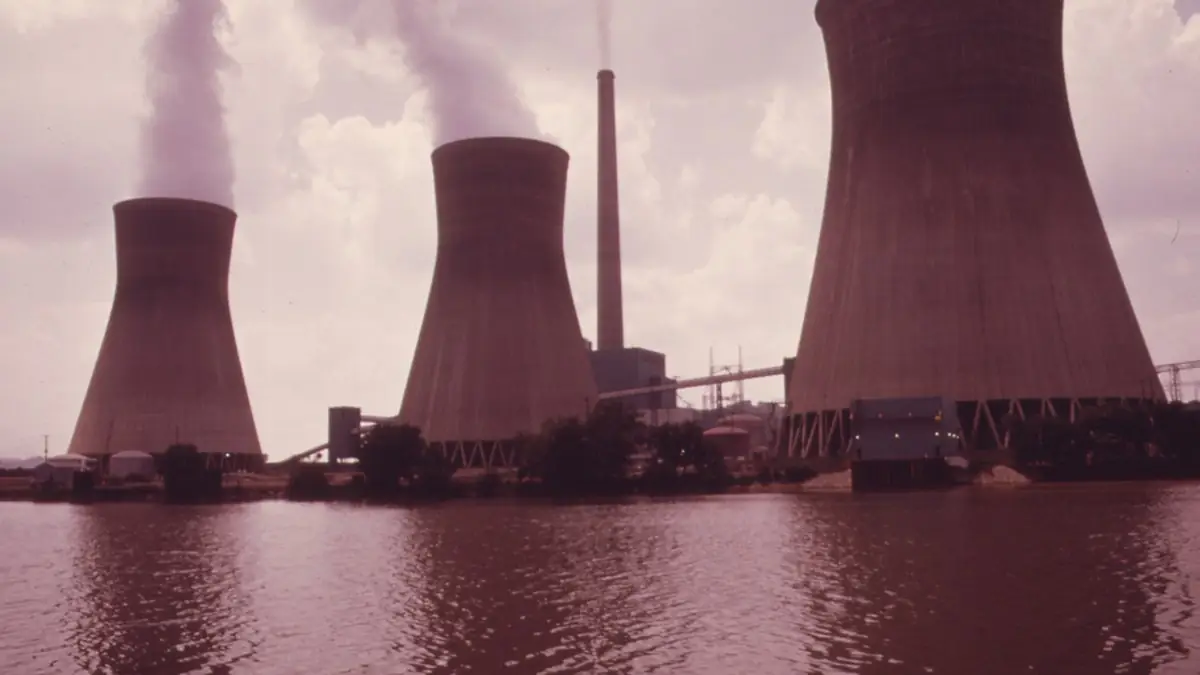
Harry Schaefer, EPA Documerica / National Archives
Glossary for this story
- Geothermal energy
- Heat from inside the Earth used to make electricity or to heat and cool buildings.
- Hydropower
- Electricity made by falling or flowing water spinning the turbines of a dam or power plant.
- Solar power
- Electricity made from sunlight, usually with panels whose cells turn light directly into current.
- Biomass
- Organic matter, such as forest, crop or animal waste, used to produce energy, heat or fuels.
- Kilowatt-hour
- The unit of energy on electric bills: what a 1,000-watt appliance uses in one hour.
- Renewable energy
- Energy from sources that are naturally replenished, such as sunlight, wind, water and biomass.
- Fossil fuels
- Coal, oil and natural gas. They formed over millions of years from the remains of living things and release CO₂ when burned.
- EPA
- The Environmental Protection Agency: the U.S. federal agency in charge of protecting air, water and land and enforcing environmental laws.
Adrián Villellas
Writer at ECOnewsAdrián Villellas is a computer engineer and entrepreneur in the fields of digital marketing and advertising technology. He has led projects in data analysis, sustainable advertising, and solutions for new audiences. He also contributes to scientific initiatives related to astronomy and space observation. He writes for science, technology, and environmental media outlets, where he makes complex topics and innovative advances accessible to a broad audience.
More from Adrián VillellasComments · 0
Rules ›No comments yet. Be the first to share your view.