Just when we think we know everything about our planet, that we have mapped oceans, islands, and continents, a bombshell comes along to change everything we know. The historic news this time is that a sixth ocean is being formed. Of course, at first, we are frightened by this news and think: how is this possible? However, even though it is not something we see every day (far from it), this new ocean is the result of several geological transformations that are still happening.
What does plate tectonics have to do with new oceans?
Before we talk about this new sixth ocean itself, and what phenomenon this continent is going through, we need to go back almost to school, when we studied how oceans are formed, and that’s when we come to the topic of tectonic plates. For an ocean to be born, tectonic plates need to be in motion because when they’re moving, they constantly collide, overlap, or move apart. And when two plates separate, magma from the Earth’s interior rises, pushing the crust upwards and opening cracks that, one day, may be filled with seawater.
It was precisely through this process that many seas were formed, such as the Red Sea and the Gulf of Aden. And apparently, the same thing is happening now on dry land, giving scientists a unique opportunity to observe the birth of an ocean from the beginning (yes, it seems they found their golden goose). And, more than that, we’re observing the initial stage of continental separation, which, by the way, is quite fascinating.
The sixth ocean is in Africa
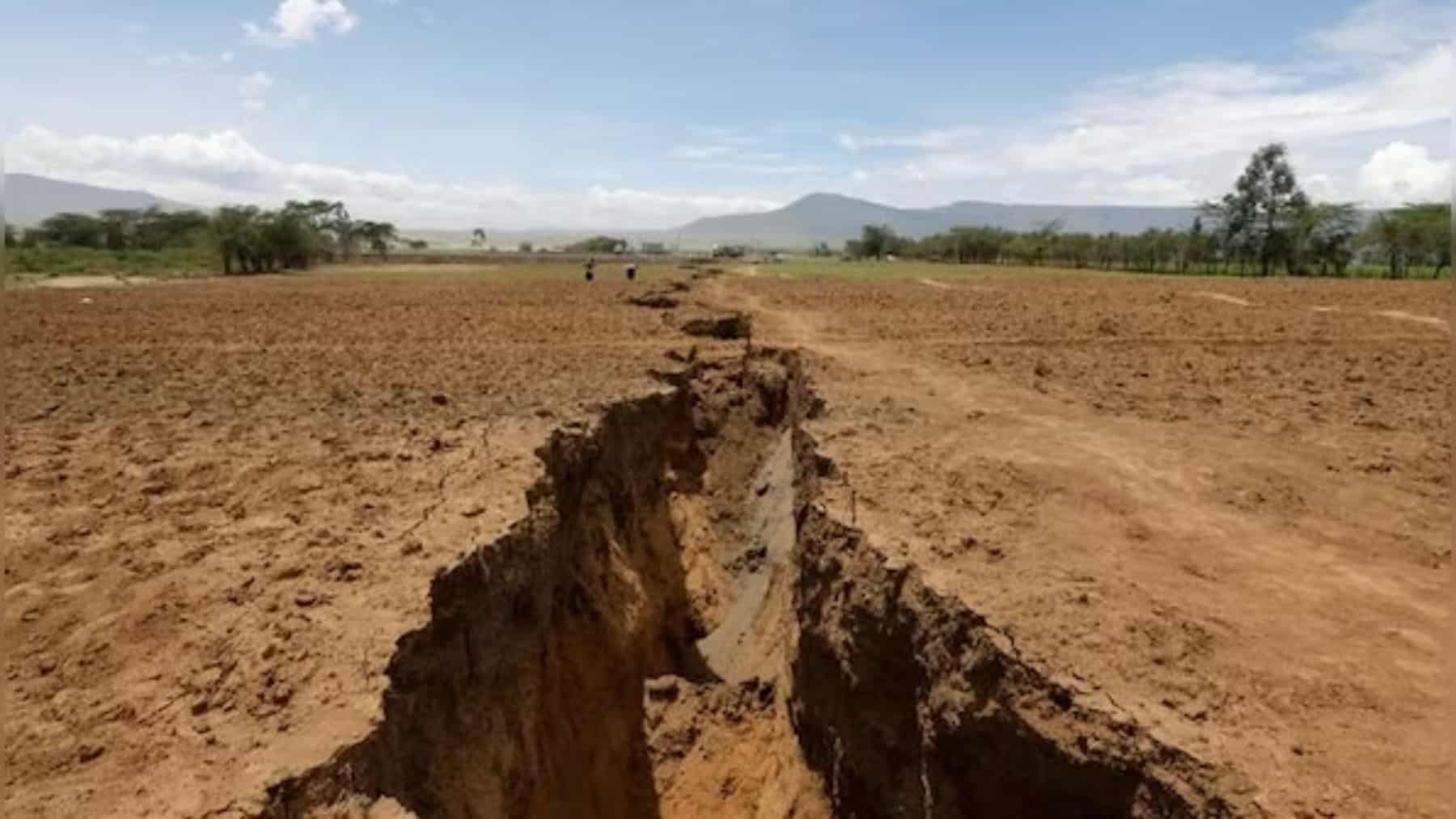
Okay, but where is this sixth ocean? We know it may seem like a lie, after all, it is an almost unimaginable place for this phenomenon to occur, but the location of this historic event is a remote and scorching desert located in the Horn of Africa (this phenomenon can even be seen from space). To give you an idea, this region is known as the Afar Depression, as it is located at the meeting point of three tectonic plates (the African, Somali, and Arabian). And when did this happen? Because, of course, it didn’t happen overnight…
We need to go back to 2005, when an eruption of the Dabbahu volcano caused the opening of a gigantic fissure of over 60 km in just 10 days. From then on, the separation of the plates began to be monitored very closely, after all, the ground is literally splitting, and the result of this will be: the Indian Ocean invading the fissure, isolating the eastern end of the continent,t and creating the sixth ocean on Earth. Basically, East Africa could become an island. Ken Macdonald, a marine geophysicist, says:
“The Gulf of Aden and the Red Sea will flood the Afar region and the East African Rift Valley and become a new ocean, and that part of East Africa will become its own separate little continent”
Was this the first time we saw a new ocean forming?
Actually, no, in 2021, the National Geographic Society officially recognized the Southern Ocean as Earth’s fifth ocean. Now we have it alongside the Atlantic, Pacific, Indian, and Arctic Oceans. Even though scientists have considered it a distinct ocean for decades, it was only recently that it was recognized by the general public.
And as if we didn’t already have enough oceans to talk about (especially with this sixth ocean slowly coming) here on Earth, Chinese scientists recently discovered a historic first: they found an ocean on the far side of the Moon, but, contrary to what everyone thought, it is not water – in fact, it’s the opposite of that.