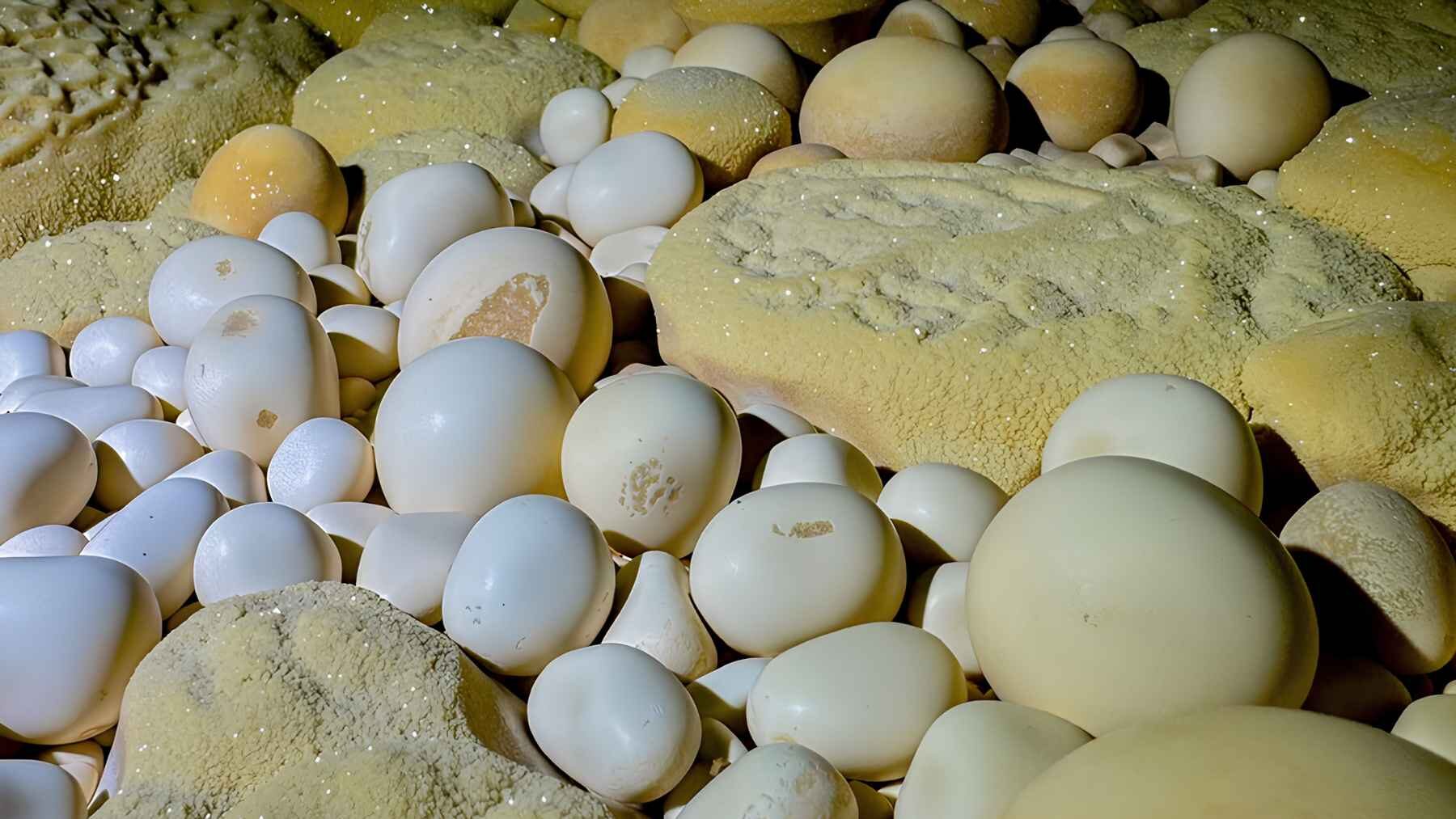
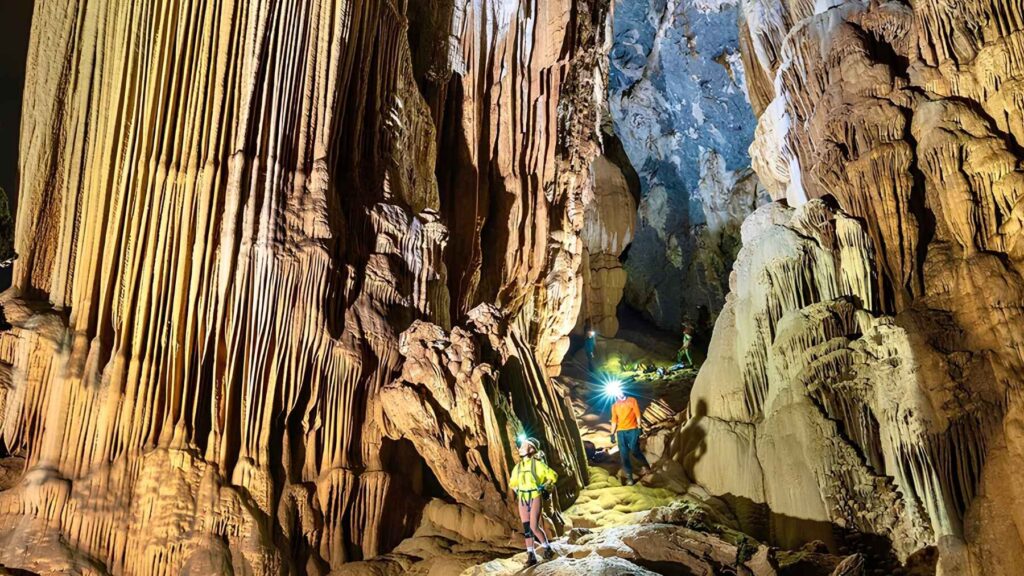
Deep beneath the limestone mountains of central Vietnam, explorers have mapped a newly documented cavern stretching about 1.9 miles through Phong Nha-Ke Bang National Park. Known as Thang Cave or Victory Cave, it contains towering mineral formations and an unusually dense concentration of smooth, bright white cave pearls gathered in natural rock basins.
The headline discovery is spectacular, but the bigger story is what happens next. The cave lies in a strictly protected area, and while officials have supported further consideration of a guided ecotourism route, it is not yet a public attraction. For the most part, this is a geological archive that still needs careful mapping, research, and conservation planning.
A small opening hides a vast cave
The survey began on June 3, 2026, after a local resident reported an entrance in Ma Da Valley. Jungle Boss explorers then worked with the Phong Nha-Ke Bang National Park management board during a six-day expedition, naming the site Thang Cave after the person who identified its location.
The entrance is surprisingly modest, covering only about 54 sq. ft. near the top of a limestone mountain. Reaching the floor required a rope descent of roughly 66 ft. “When I shouted down, the sound came back loudly and stayed for a long time,” said Nguyen Van Uy, Jungle Boss deputy general director and safety director.
That echo hinted at the scale below. Preliminary measurements put the cave at about 230 ft. wide on average, with some sections opening beyond 328 ft., while stalactite columns rise as high as 164 ft. Explorers also recorded giant stalagmites, flowstone, stone curtains, and chambers described as a “stalactite palace.”
The white spheres are not ordinary stones
The cave pearls quickly became the standout feature. Survey teams found many clusters resting in natural hollows, and Jungle Boss representatives said even experienced cave specialists had rarely seen such a high concentration. Their polished appearance makes them look almost manufactured, but they are slow products of water, rock, and chemistry.
A cave pearl begins around a tiny nucleus such as a grain of sand, a bone fragment, or a piece of another cave formation. When mineral-rich water loses carbon dioxide, calcite can precipitate around that core in repeated layers. The pearl becomes rounded mainly through relatively uniform mineral growth, not because it must constantly roll or spin.
What does a large concentration tell researchers? At minimum, it shows that parts of the cave repeatedly provided the shallow pools, mineral supply, and water movement needed for pearl growth. The official announcement does not include laboratory ages, chemical analyses, or measured growth rates for these particular pearls, so their exact history remains open for study.
Why the cave matters to science
Thang Cave sits inside a much older geological system. UNESCO says the wider Phong Nha-Ke Bang and Hin Nam No karst landscape began developing around 400 million years ago and now contains more than 137 miles of documented caves and underground waterways. Even inside one of the world’s most exceptional karst landscapes, large spaces can remain hidden.
The first survey may also offer clues about underground water movement. Jungle Boss reported three large rimstone pools and raised the possibility of a connection with nearby Ma Da Lake, although that link has not been confirmed. That is exactly why follow-up hydrological work matters.
Cave deposits can also preserve information about past surface conditions. Scientists use layers in speleothems to investigate changes in water supply, rainfall, vegetation, and climate, but those records require careful dating and geochemical analysis. In practical terms, Thang Cave has scientific potential, not yet a completed climate story.
Tourism is possible but not approved
After the survey, Jungle Boss proposed adding Thang Cave to an existing two-day, one-night eco-adventure route through Ha Ma Da Valley and Tra Ang Cave. The park management board agreed to the idea in principle, though that is not the same as opening the cave. Travelers cannot currently book a standard visit.
Access is restricted for good reason. The cave is inside a strictly protected zone, independent entry is not allowed, and reaching the interior requires technical rope equipment. There are also formations on the floor that could be damaged by one misplaced boot.
Jungle Boss says any future route would need detailed mapping, safety review, geological assessment, and conservation planning. Visitor numbers, group frequency, fixed paths, observation points, and guide rules would all need approval. The operator warns that touching growing formations, stepping into mineral pools, or altering the cave’s microclimate could disrupt processes that took immense spans of time.
The discovery now becomes a conservation test
Victory Cave proves that even familiar valleys can still hold major underground surprises. Dense forest, razor-edged limestone, and protected boundaries make exploration slow and difficult, which may be one reason this system remained undocumented for so long.
The find is exciting. The harder work starts now. Its pearls formed in darkness, but their future will be shaped by decisions made in daylight.
The better result would be completing geological and biological studies, then allowing only the level of access the site can withstand. For now, Victory Cave is a newly surveyed scientific and conservation site, not a finished tourist product.
The official announcement was published on Phong Nha-Ke Bang National Park’s website.