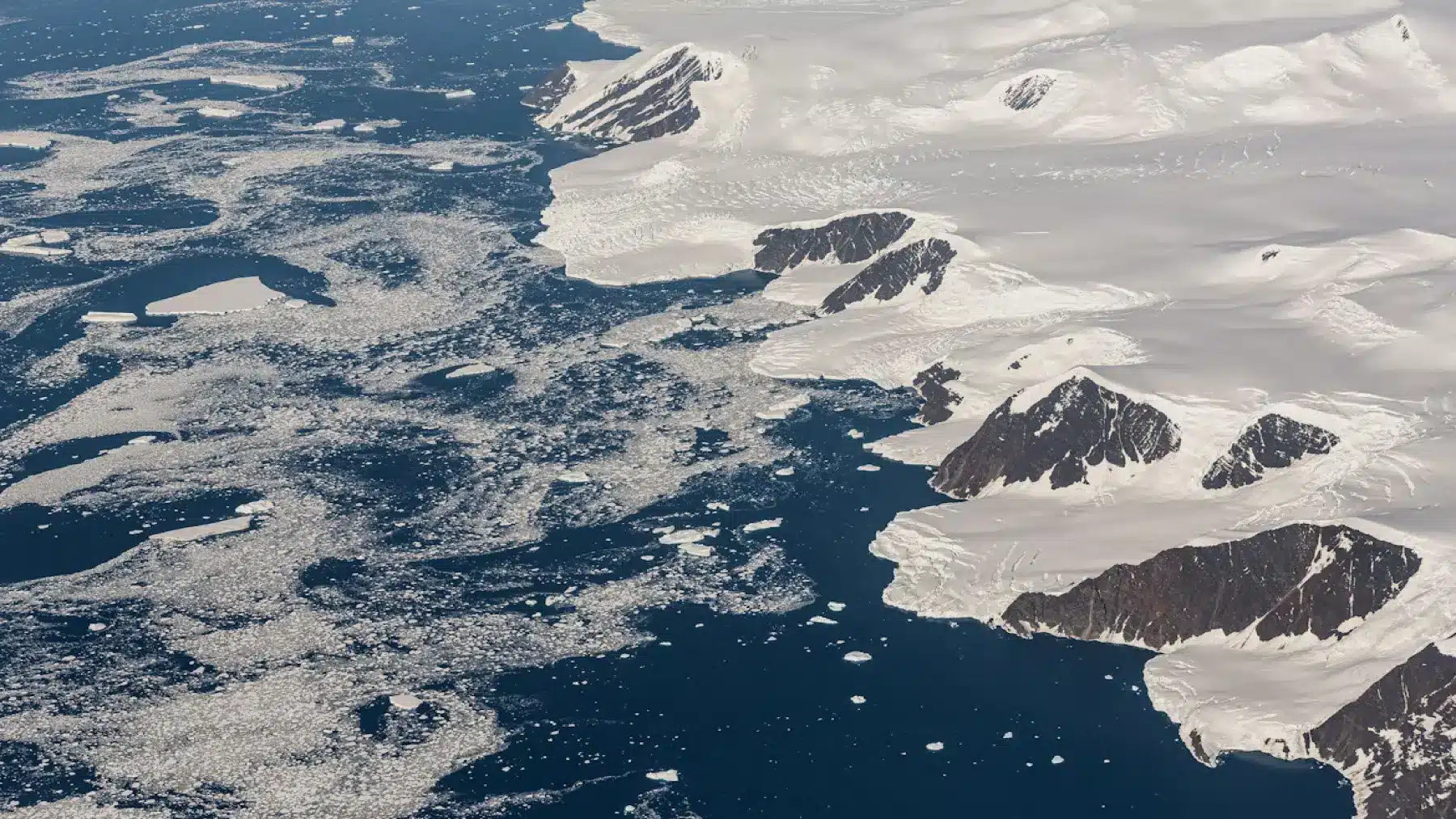
The icy waters of Antarctica feature 332 giant submarine canyons that were previously unknown to researchers and scientists, and some of them are over 4,000 meters deep. These massive ocean trenches were revealed through high-resolution seabed mapping, and five times as many canyons as expected were discovered in the Antarctic waters.
Revolutionary mapping reveals Antarctica’s underwater landscape secrets
New research by the University of Barcelona and University College Cork reveals the alarming differences between the Eastern and Western Antarctic systems of canyons, and new facts have emerged concerning the ancient history of the ice on the continent.
A complete investigation was made on the basis of the international bathymetric chart of the Southern Ocean, Version 2, the most detailed map of the seabed of Antarctica to date. This fine-scale map of the bathymetric information with a 500-meter pixel rate, as opposed to the standard 1-2 kilometers maps, in which the automated techniques are not used, enabled the researchers to employ semi-automated techniques in identifying and analyzing the canyon features in the continent.
David Amblas of the University of Barcelona characterized the canyons in the Antarctic seabed as comparable but bigger and even deeper than the others found in other parts of the ocean because of the activity of polar ice over time and the large quantities of sediment washed to the ocean by flowing glaciers. The research team has also developed GIS software scripts, which enabled them to compute 15 morphometric parameters that can reveal the intricate geological structures of the canyons.
East Antarctica showcases the most spectacular canyon systems
Most of the more notable canyons occur in East Antarctica in the form of complex or branching systems, which must have had multiple heads of canyons in the continental shelf edge. These channels are united in one major single main channel draining deep ocean water, which cuts across sharp slope gradients and bears typical U-shaped cross-sections revealing extensive glacial shaping.
Unique characteristics have captured researchers’ attention
The East Antarctic canyons are more detailed and branched systems that create relatively large canyon-channel systems as a result of a prolonged history of glacial activity, erosion, and the deposition processes of sedimentary material. The canyons of the West Antarctic, conversely, are shorter and steeper, and have cross-sections of a V-shape.
This is a morphological difference favouring theories about the East Antarctic Ice Sheet and seemingly indicating that these canyons have existed for much longer than those in West Antarctica. The research proves this hypothesis on a large scale, where it was earlier suggested based on sedimentary records alone.
Climate implications would display critical areas of ocean circulation
These canyons in the oceans contribute to essential interactions of water in the frontiers of the deep ocean and the continental shelves, as the cold and thick water that is produced in the ice shelves travels into the deep ocean, creating the Antarctic Bottom Water. The process plays a fundamental role in ocean circulation and global climate regulation.
The other contribution made by the canyon systems is that they guide warmer Circumpolar Deep water in open oceans to the coastlines, which results in basal melting and thinning of floating ice shelves. When these defensive shelves collapse or become weak, the ice of the continent flows quickly to the seas, and it is itself a direct contribution to the rise of the sea over the world.
The discovery of 332 giant canyons on the bottom of Antarctica can be considered to be an innovation in respect of estimating the hidden underwater topography of the continent and the enormous impact it makes on worldwide weather patterns. A few of these massive geological formations are over 4,000 meters deep, and they play a role in the oceanic circulation, stability of ice shelves, and changes in the sea level.