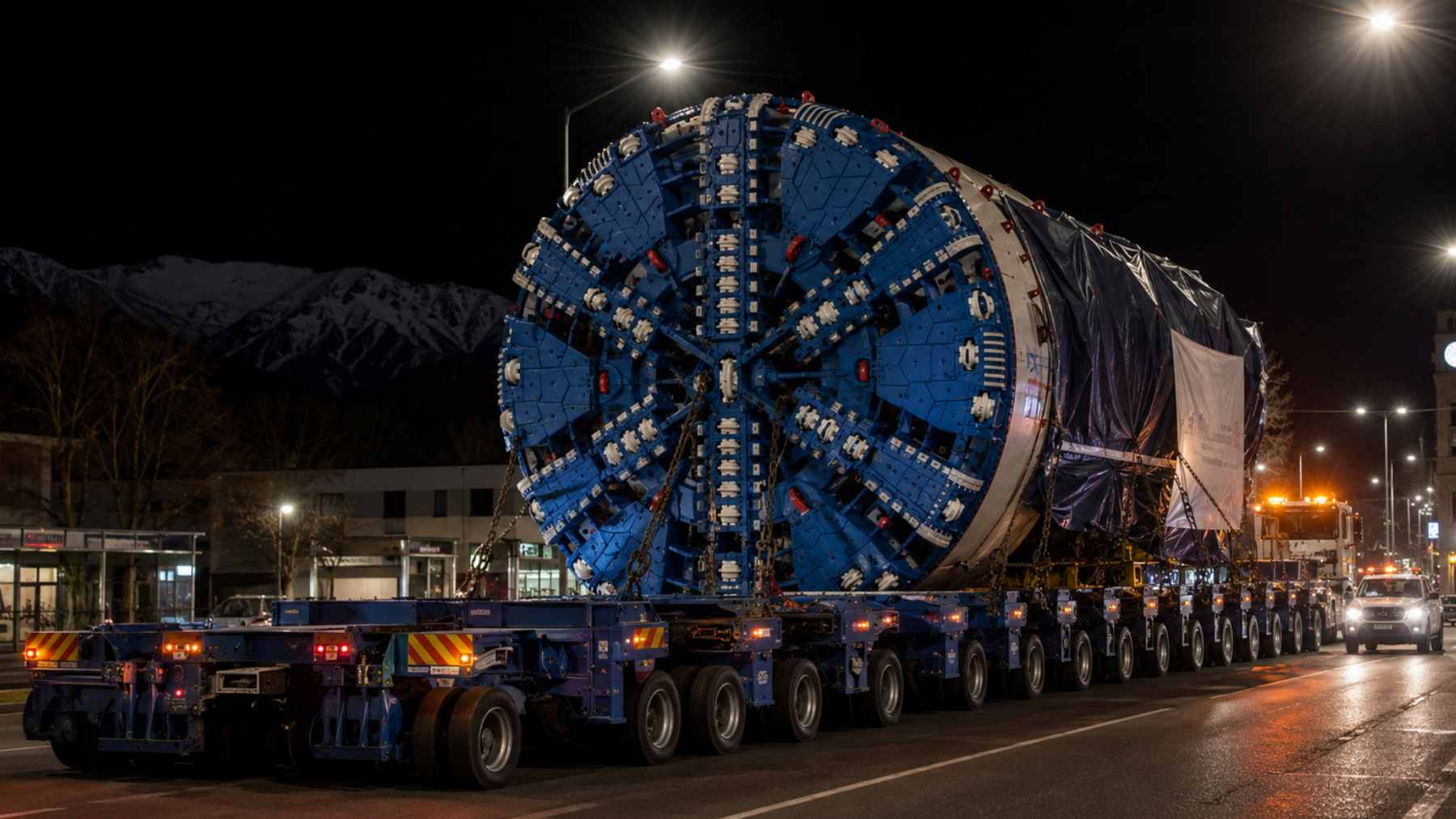
Before Snowy 2.0 can store clean power for millions of homes, some of its biggest parts have to make a much more visible journey. In late 2025, one of those parts rolled through Cooma, New South Wales, on a 152-wheel transport setup that looked more like a moving construction site than a truck.
The cargo was the center section of tunnel boring machine (TBM) Monica’s cutterhead, weighing more than 151 U.S. tons and measuring about 23 feet wide.
The move was not just a big-haul stunt. It was a key step in getting Monica to the Marica worksite, north of Kiandra, where the giant tunnel boring machine would be assembled for the Snowy 2.0 pumped hydro project.
What does a future energy storage project look like before it disappears underground? Sometimes, it looks like a huge piece of steel crawling through town at night.
A night move through Cooma
Snowy Hydro said the center cutterhead piece traveled through Cooma on a Wednesday night in early October 2025. The transport moved along Sharp Street before heading toward the final leg on the Snowy Mountains Highway, with the overall transfer measuring about 240 feet long.
For people nearby, it was the kind of thing that makes you stop on the sidewalk and stare. Big infrastructure usually happens behind fences or deep underground, but this moment briefly put Snowy 2.0 right in front of everyday traffic, shopfronts, and local streets.
What the cutterhead does
A tunnel boring machine, often called a TBM, is basically a moving underground factory. Its cutterhead is the rotating front face that breaks into rock and soil, a bit like a massive circular drill bit, while the rest of the machine supports the tunnel behind it.
That is why this part mattered. Without the cutterhead, Monica could not begin carving through the Snowy Mountains section assigned to it, and without careful transport, the machine could not even reach the remote site where it was needed. Simple as that.
Why it had to be split
The cutterhead was too large to move in one piece, so it had to be separated into five parts. The center piece was only one part of the larger assembly, but even that section required months of planning before it could be moved safely.
Dave Evans, Chief Delivery Officer for Snowy 2.0, said the transfer was the result of months of work and planning. He called it “an amazing sight” and credited the traffic and transport team for completing the “complex operation safely.”
More than 140 heavy loads
The cutterhead trip was part of a much bigger delivery campaign. More than 140 large loads had been brought to the Marica site from Port Kembla in the weeks around the move, all feeding into the assembly of Monica.
That detail matters because tunnel boring machines are not dropped into place fully built. They arrive in sections, then teams fit together the cutterhead, drive systems, shields, gantries, and support equipment until the machine is ready to work. It is slow, practical engineering, not movie magic.
Snowy 2.0 works like a giant battery
Snowy 2.0 is designed to link the Tantangara and Talbingo reservoirs through about 17 miles of tunnels and an underground power station. In practical terms, that means water can be used to generate electricity when demand is high, then pumped back uphill when there is extra wind and solar power available.
The company says the project will have 2,200 megawatts of capacity and enough stored energy to supply 3 million homes for a week. For households, the point is easy to understand. When sticky summer heat pushes air conditioners hard and the electric bill starts to bite, grid storage can help keep supply steady.
Monica’s job underground
Monica was built for a tough section of the headrace tunnel, the waterway that will help connect the reservoirs to the underground power station. In February 2026, Snowy Hydro said the machine had been commissioned and would excavate the portion passing through the Long Plain Fault Zone, an area described as geologically challenging.
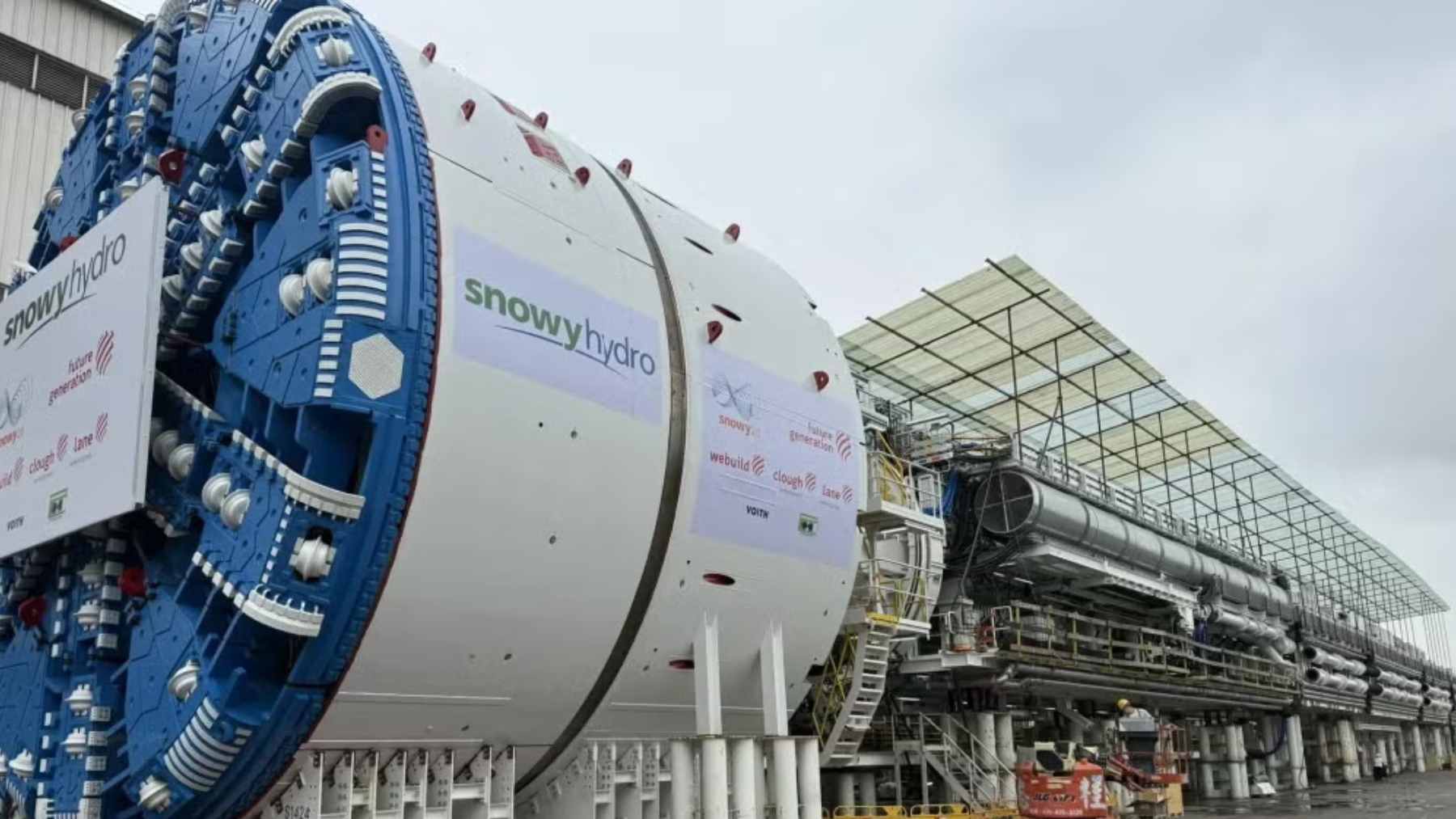
By then, the project had passed another milestone. The company said Snowy 2.0 was more than 70% complete, while work at the Lobs Hole site was shifting toward fitting out a complex underground power plant nearly 2,800 feet below the surface.
A machine with a local name
Monica was named after Monica Brimmer, a Tumut High School student who won a First Nations art and storytelling competition. Her artwork reflected flowing water, connected dams, mountains, energy, and a connection to Country.
That gives the machine a human touch in a project full of huge numbers. It also connects the engineering story to a local student, a school community, and the long history of the Snowy Mountains as a place where major infrastructure changes ordinary lives.
The bigger picture
Snowy 2.0 has not been free of scrutiny. Australian media have reported cost increases and schedule pressure, and the project is now expected to be completed by December 2028, which shows how difficult mega projects can be once geology, supply chains, safety, and budgets collide.
Still, the 152-wheel move through Cooma shows one small but visible piece of that larger effort. Before a tunnel is bored, before water moves through the mountain, and before stored energy reaches the grid, someone has to get a 151-ton cutterhead safely down the road.
The official press release has been published by Snowy Hydro.