Could a crystal you can hold in your hand expose the hidden teamwork of the quantum world? Apparently, yes.
Researchers have detected unusually deep quantum entanglement in a strange metal sample roughly four-tenths of an inch across. They did it using neutron scattering and a measurement tool borrowed from quantum information science.
The evidence suggests that at least nine quantum components joined in a coordinated response instead of acting independently. Nine or more, acting together.
It does not mean the whole crystal was placed in two states at once, like Schrödinger’s famous cat. Instead, scientists now have a rare way to measure entanglement inside a solid large enough to see and touch.
Why this metal is strange
A strange metal is not strange because of how it looks. The weird part is what happens inside.
The name describes how electricity moves through the material, especially at extremely low temperatures. Its electrical behavior does not fit neatly with what physicists expect from ordinary metals.
The crystal was made from cerium, palladium, and silicon. It belongs to a family known as heavy-fermion materials, where electrons interact so strongly that the usual picture of individual charge carriers can start to break down.
Things get particularly interesting near a quantum critical point. This is a boundary between different states of matter driven by quantum effects rather than ordinary heat.
From Schrödinger’s cat to an anthill
Federico Mazza and Sounak Biswas share first authorship of the work. Silke Bühler-Paschen led the experiments at TU Wien, Fakher Assaad led the theory at the University of Würzburg, Paul Steffens helped perform the measurements at the Institut Laue-Langevin, and Qimiao Si contributed from Rice University.
Bühler-Paschen explained that the researchers were not trying to put the entire crystal into two states at the same time.
So forget the cat for a moment. Think ants.
The better comparison is an anthill. Disturb one part of it and you may not get a response from just one ant. The whole colony can react together.
Something similar appears to be happening inside this strange metal.
Neutrons reveal collective behavior
The researchers cooled the crystal to about minus 459.6 degrees Fahrenheit, just above absolute zero, and placed it in a carefully tuned magnetic field.
Then came the neutrons.
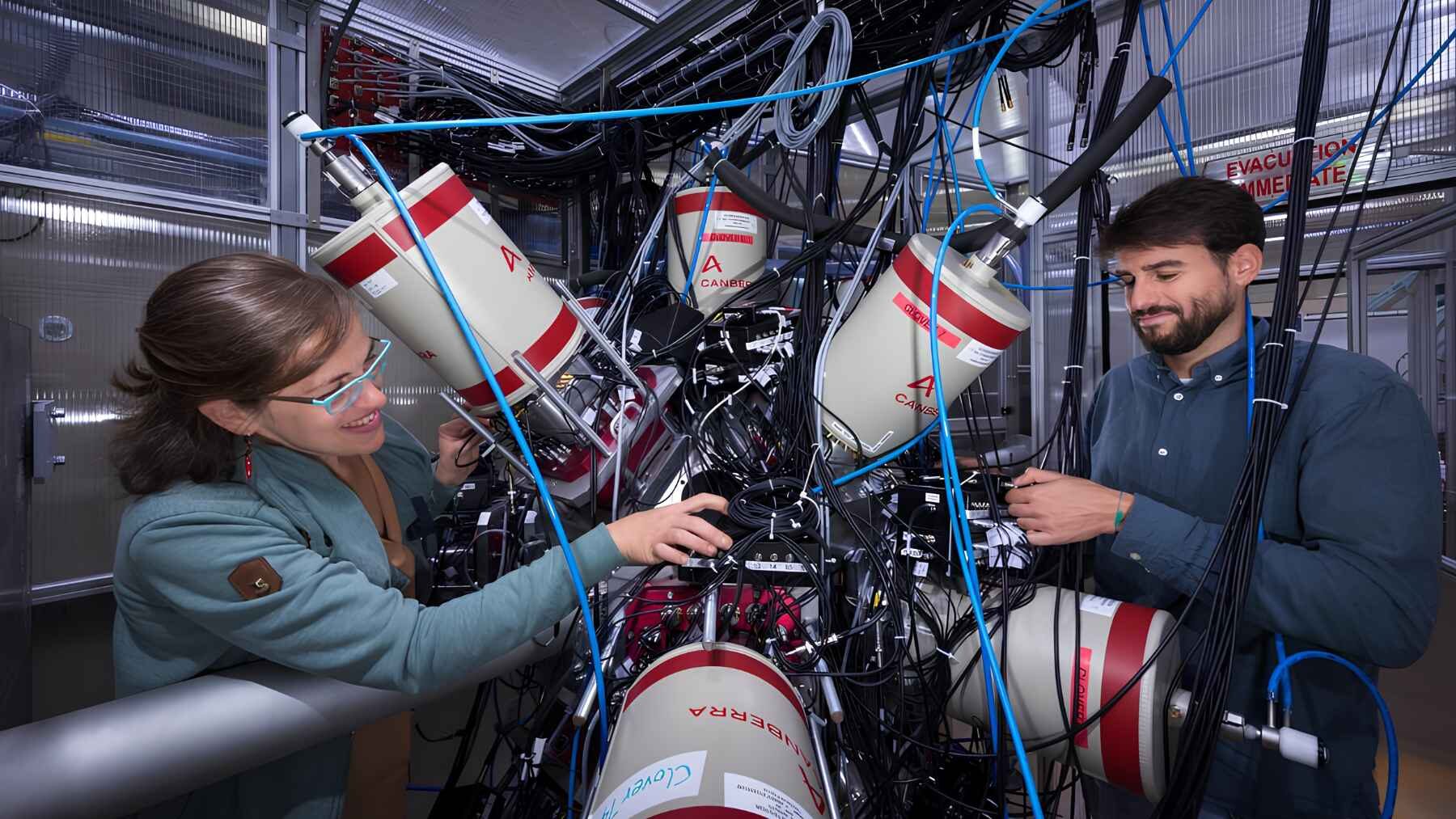
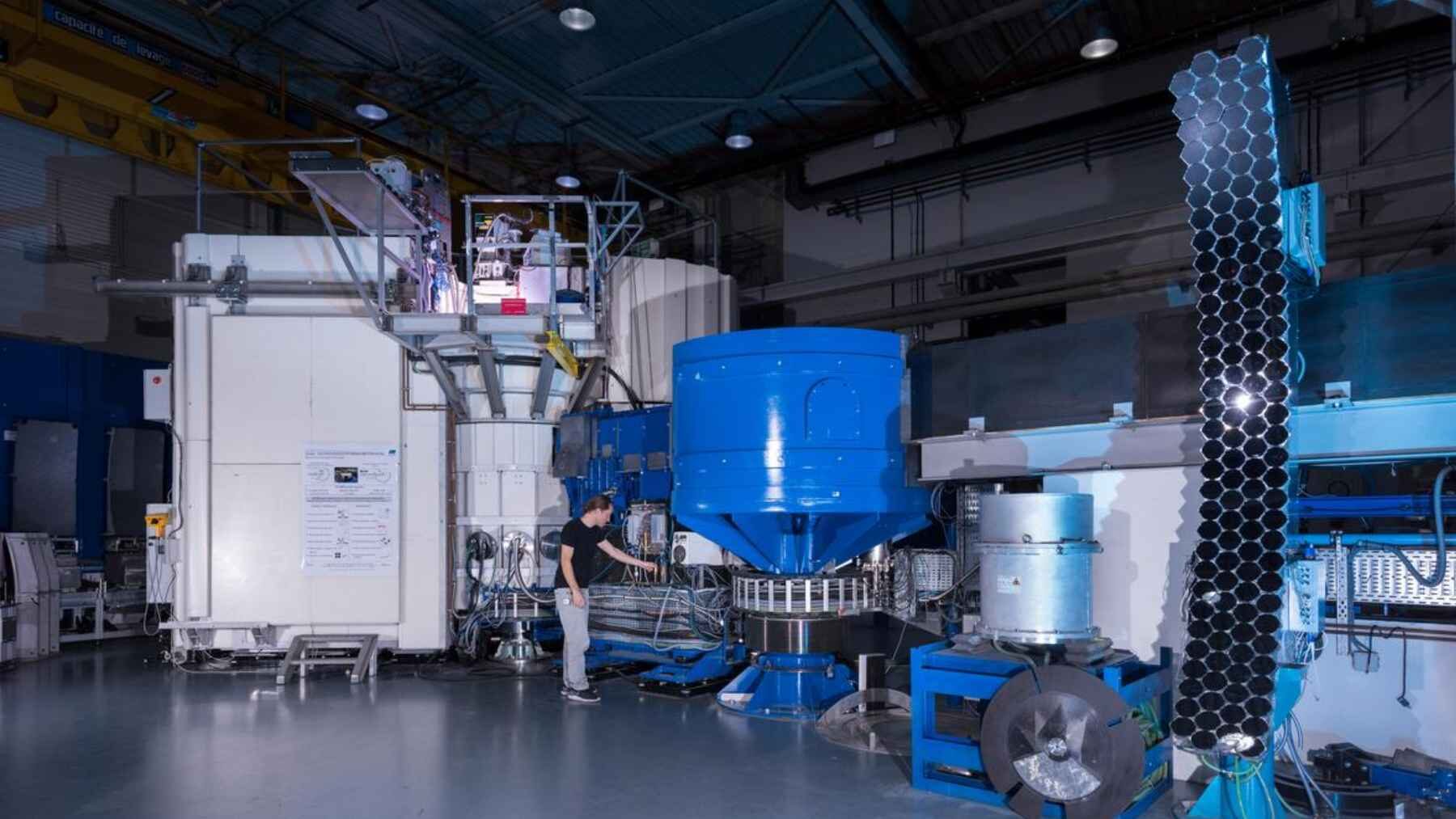
At the Institut Laue-Langevin in Grenoble, the team fired neutrons at the crystal and measured how the material absorbed and redistributed their energy.
Think of each neutron as a tiny knock on a door. In a normal material, that knock might mainly disturb one local component.
Here, things were different.
The response could not be explained by particles acting independently. Instead, the material reacted in a coordinated way, pointing toward collective quantum behavior.
Measuring something you cannot see
how do you actually measure entanglement inside a chunk of metal?
That is where quantum Fisher information comes in.
The concept measures how sensitively a quantum system responds when something disturbs it. A 2016 Nature Physics study led by Philipp Hauke and developed with Peter Zoller at the University of Innsbruck showed that this response can be used as an entanglement witness in large systems.
The basic idea is surprisingly simple.
Imagine a crowd. If everyone moves independently, the overall response has a limit. But if people somehow move together, the reaction can become much stronger.
Entangled quantum particles can behave in a similar way.
By measuring that amplified response, researchers can estimate the minimum number of quantum components taking part in the shared behavior.
At least nine act together
So how many were involved?
At least nine.
As the material was cooled, its quantum Fisher information increased by almost forty times across the measured temperature range. At the lowest temperature, the researchers found evidence that no fewer than nine quantum components were participating collectively.
That number is only a minimum. There could be more.
The result also does not mean every particle in the entire crystal belongs to one gigantic entangled network. The sample may be macroscopic, but the measurement gives scientists a lower bound on the depth of the entanglement inside it.
Still, that is a big deal for a solid you could comfortably hold in your hand.
A possible clue to quiet current
The result could also help explain another strange feature of these materials.
A 2023 Science study found strongly suppressed electrical noise in another heavy-fermion strange metal. In simple terms, its electrical current was surprisingly quiet.
Why?
The behavior suggested that electricity was not moving as a basic stream of familiar, independent charge carriers.
The new study does not prove that entanglement caused this quiet current. That connection still needs more work.
But there is an intriguing possibility. If quantum components are coordinating their behavior, they may also help suppress electrical fluctuations.
A 2025 Nature Communications study had already predicted theoretically that quantum Fisher information should become strongly amplified near this kind of quantum critical point.
Now researchers have experimental evidence pointing in the same direction.
Why the finding matters
This work connects two areas of physics that do not always meet.
On one side is solid-state physics, which investigates how real materials behave. On the other is quantum information science, where scientists study things such as entanglement for quantum computing, sensing, and precision measurements.
Now the two are talking to each other.
Tools originally developed to understand quantum information can help scientists probe what is happening inside complex metals.
And perhaps the exchange could eventually work both ways.
Strong multipartite entanglement can improve certain high-precision measurements. That means strange metals could one day inspire new ideas for quantum sensing or metrology.
One day. Not yet.
The current experiment is basic research carried out under extreme laboratory conditions, not a working quantum device.
What scientists still need to learn
The researchers say the increase in quantum Fisher information points to an unusually large entanglement depth in a quantum material.
But plenty of questions remain.
Do all strange metals behave this way? Or only certain compounds? Does the same kind of entanglement appear near other quantum phase transitions?
Future experiments will need to test more materials and develop better ways to reveal exactly how the entangled components are connected.
For now, though, the anthill comparison works surprisingly well.
One particle does not simply react alone. A whole group answers.
The full study was published in Nature Physics.